


As modern applications have become increasingly reliant on APIs for connecting services, mobile applications, cloud platforms, and third-party systems, API quality has become a critical part of software delivery. Artificial Intelligence (AI) is reshaping this scenario by helping testers create intelligent tests, validate responses, and do defect analysis faster.
In this blog, we’ll help you understand what API testing is, how AI is being used, and why AI is finally feeling like a real helper for us.
Let’s first learn what an API is and why we do API testing.
You order your food on a food delivery app. You pick your meal, click on “Place Order,” and you receive the order confirmation within a few seconds. Have you ever wondered how the app will actually send your request to the restaurant and how it will verify your payment for the order? The invisible messenger that carries all this information between different systems is an API (Application Programming Interface). API is similar to a waiter. It takes your request, delivers it to the kitchen, retrieves the response, and makes sure that everything is mailed to you. Without APIs, applications and services cannot talk to each other.
To find out whether these communication channels are functioning correctly, we do API testing. And API testing helps us answer the questions that frequently cross our minds:
Is the API sending the correct data?
Is it here to work efficiently when receiving wrong or unexpected calls from the client side?
Can the API deliver to take a few seconds to thousands of users at the same time?
Is the sensitive information protected and only accessible to authorized users?
If an API is broken, you might lose your payments, orders might not be placed, users might see wrong data, or you might expose sensitive data. Since it’s the core of almost all modern applications, it’s vital to test an API properly to create a safe and reliable experience for the users.
Why AI testing for APIs?
AI iteratively learns from API specs, past runs, and response patterns. Rather than relying on scripts, AI can discover test cases, generate edge cases, suggest assertions, and evolve with the API.
Major benefits include the following:
1. Speedier creation of API tests
2. Higher test coverage
3. Smarter response matching
4. Fewer hand-coded scripts
5. Enhanced defect analysis
6. Simpler maintenance of test automation
Traditional Approach
The typical workflow is:
1. Read API documentation
2. Analyze request and response structures
3. Understand business validation scenarios
4. Write Out Postman assertions
5. Create positive and negative tests
6. Run and debug the tests
This requires a lot of manual work, and it takes quite some time—especially if the API is new.
Trying out Postbot in Postman
To understand how that works, I tried this out. I experimented with Postbot, the AI assistant integrated into Postman.
Simple question in mind:
Can Postbot help with producing high-quality test scenarios with less effort in doing so?
I chose an API from a product that provides a tool for generating a player activity daily summary that accepts a valid loyalty card number, an email address, and a report date range to generate a request that will email the player’s activity summary.
Instead of using the “traditional” approach, I used Postbot for the whole testing of an API.
Step 1—Analyzing the API: I asked PostBot the following questions.
“Explain this API and determine the important request and response fields.”
In seconds, Postbot gave me the following:
API purpose, Request fields—mandatory, Response—when the request is successful and when the request fails, suggested validation points.
In other words, it was far quicker to get a good summary of the API instead of manually reading the entire API spec.
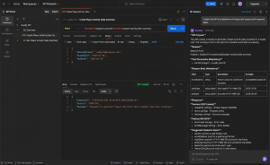
PostBot analyzes the API specification and provides a concise summary of the API purpose, mandatory request fields, response behavior, success and failure scenarios, and recommended validation points.
Step 2 – Generate Business Validation Tests: I then asked PostBot the following:
“Generate business validation test cases for this Player Activity Daily Summary API.”
PostBot generated several scenarios that were useful this way, such as:
Successful report generation, invalid card ID, invalid email address, mandatory fields missing, invalid report date range, end date in future, start date after end date, leap year (February 29th) validation.
Effective test coverage can be achieved by using AI to find which scenarios are missed in a manually designed test suite.
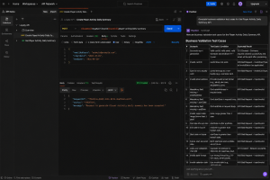
PostBot automatically generates comprehensive business validation scenarios, including positive, negative, boundary, and edge-case test scenarios, significantly improving test coverage.
Step 3 – Creating Assertions: “Create Postman test assertions for this API.” Postbot generated validations for the following:
HTTP status code, response schema, email address, report start date, report end date, and response time.
Instead of writing repetitive JavaScript test validations, I just needed to adjust a few things I thought would be most appropriate for the project.
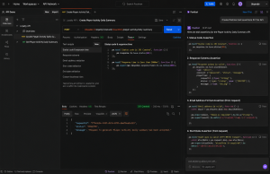
PostBot generates reusable JavaScript assertions for validating HTTP status codes, response schema, mandatory fields, date formats, business values, and API performance.
Step 4 – Running the Tests: I re-examined the generated tests and ran the API request in Postman.
The AI-generated validations were:
Successful response codes, mandatory response fields, response schema, date formats, and API performance.
The generated scripts were very useful as a starting point from where I could make a few minor adjustments and then add the tests to the automatically executed test suite for the project.
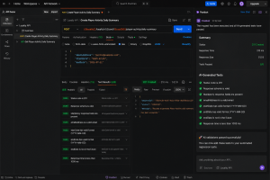
AI-generated assertions are executed in Postman, validating the API response, schema, business rules, and performance. The generated tests serve as a strong starting point for automated regression testing.
During the implementation, I saw some real benefits:
- AI greatly reduced the amount of time needed to understand new/unknown APIs.
- Business validation scenarios were generated very quickly compared to the manual effort.
- JavaScript assertions were generated with very low prompts needed from us.
- Test coverage was improved by including potentially missed scenarios and edge cases.
- You can spend more time validating the business logic rather than writing the repetitive scripts.
However, manual review of the AI-derived outputs was still required. Some of the business validations were very app-specific and required further refinement before execution. It helped me realize that AI is an assistant, not a replacement for QA.Conclusion
This practical implementation demonstrated that Postbot is a valuable AI assistant for API testing. It accelerated API understanding, generated meaningful business validation scenarios, created reusable assertions, and improved overall productivity. While Postbot reduced repetitive work and expanded test coverage, final validation still required a tester’s understanding of business rules and application behavior. The future of API testing isn’t about replacing testers with AI—it’s about enabling testers to work smarter, focus on quality, and deliver value more efficiently.