


We need to talk about how we are building software with AI agents.
Let’s paint a quick picture: You walk up to a counter and ask for a glass of Shikanji (a traditional Indian spiced lemonade). You don’t provide any specific instructions; you just demand a glass.
What might the AI give you based on its training data?
- A glass overloaded with sugar.
- A glass that is value-level salty.
- A glass with exactly one drop of lemon drowned in boiling water.
- A crunchy, undrinkable mess because it forgot to strain out the seeds.
This is exactly what happens when you let an AI agent guess your codebase implementation. When you request a glass with a concrete plan, you get exactly what you wanted to drink. It is time for software engineers to stop “vibe coding” and start adopting engineering maturity through explicit specifications.
The Crisis: Why “Vibe Coding” is a Technical Debt Trap
Right now, a typical day using generative AI coding agents looks like an endless, chaotic loop: you write a vague prompt, the agent spits out raw code, you throw it into your editor, run your tests, discover a mountain of unexpected bugs, and go right back to prompting.
We are trapped in a cycle of blind experimentation. This “vibe-first” approach completely falls apart at scale for a few major reasons:
- Lack of Structural Architecture: Without explicit design boundaries, the AI has no structural rails to stay within, leading to disjointed architectural choices.
- AI Code Hallucinations: The agent frequently invents fictitious APIs, utilizes deprecated libraries, or generates outright fantasy syntax to fill in your conceptual gaps.
- The Context Window Wall: As you keep dumping error logs back into the LLM chat window to fix the bugs it just generated, you rapidly deplete your context window limit.
- Bypassing the SDLC: We are throwing away decades of proven Software Development Life Cycle engineering methodologies just because a chat box responds instantly.
Getting It Together: The Shift to Spec-Driven Development (SDD)
If we want to stop writing fragile code, we have to start “adulting” with our AI tools. That means shifting to Spec-Driven Development (SDD). Instead of letting the AI guess the implementation details while jumping straight to code generation, we must rigorously structure the entire workflow before a single line of application code is touched.
Here is the definitive step-by-step workflow for modern developers:
1. Brainstorm the Problem Interactively
Sit down with your coding agent and discuss the problem statement. Use the LLM as a sounding board to explore edge cases, dependency constraints, and architectural trade-offs before committing to an approach.
2. Create Rigid Acceptance Criteria
Draft clear, unambiguous design documents and specifications. Tell the AI exactly what inputs are expected, what output format is required, and what the error handling expectations look like.
3. Deconstruct into Isolated Micro-Tasks
Break the massive feature down into small, completely isolated, and easily testable development tasks. If a task cannot be fully verified with a simple test case, it is still too large.
4. Execute the Step-by-Step Plan
Systematically feed these micro-tasks to your coding agent one by one. Maintain tight guardrails and make sure each piece passes validation before moving to the next block.
5. Verify the Final Validated Product
Review the fully functional system and finally drink your perfect, well-proportioned Shikanji.
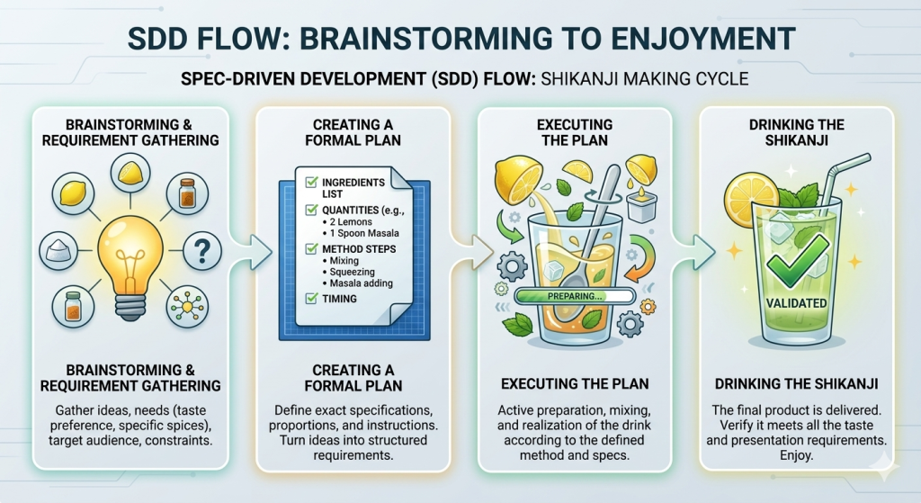
Process of creating Shikanji with SDD
Says Who? The Data-Driven Value of Spec-Driven Workflows
If doing this extra structural planning feels like tedious homework, the empirical corporate and economic data behind it proves otherwise.
According to industry developer experience research from global reports by GitHub, Microsoft, and McKinsey, moving away from an unstructured, code-first workflow yields massive dividends:
- There is a 70% reduction in logic bugs when they are proactively captured early during the specification and architectural planning phase.
- Engineering teams realize a 40% acceleration in feature delivery when using structured, AI-assisted pair programming instead of traditional, unstructured solo prompting.
Furthermore, a comparative efficiency analysis shows that a Spec-Driven Workflow operates at 65% efficiency—with the vast majority of time spent delivering stable, working features. On the flip side, a Code-First Workflow operates at an abysmal 35% efficiency because developers hit a steep “Rework Tax”—wasting hours stuck in infinite debugging loops trying to fix what the AI broke.
Conclusion: Stop Vibing. Start Planning.
AI agents are incredible execution tools, but they make terrible architects. If you treat them like a magical crystal ball, you will end up with code full of lemon seeds and salt. Take ownership of the architecture, write your specs first, and let the AI build things the right way.
What are your thoughts about using SDD in everyday coding task?