


Introduction
Understanding Agentic AI and Multi-Tool Systems
What is an AI Agent?
A traditional LLM responds to a prompt using only the knowledge stored in its static weights or provided in a simple context window. An AI Agent goes further: it is a goal-oriented system capable of reasoning, planning multi-step actions, using external tools (APIs, databases, search engines), and processing feedback to complete complex tasks.
A traditional LLM can summarize a static PDF policy. An AI Agent can read a policy, cross-reference an employee’s record in a SQL database to check eligibility, run an exact calculation, and format a personalized response.
Why LangGraph for State Machine Orchestration?
When building agentic workflows with multiple tools, managing control flow and state becomes the central engineering challenge. Early agent implementations relied on loose, text-based reasoning loops (like raw ReAct prompts) that parsed text strings to determine tool execution. In complex multi-step tasks, these loops often break, enter infinite tool-calling loops, or drop state context.
LangGraph solves this by modeling agent orchestration as a cyclic, directed state graph (StateGraph). Rather than relying on unstructured text parsing, every step in the agent’s workflow is an explicit node in a state machine, and every tool transition is controlled by deterministic conditional edges.
High-Level Architecture
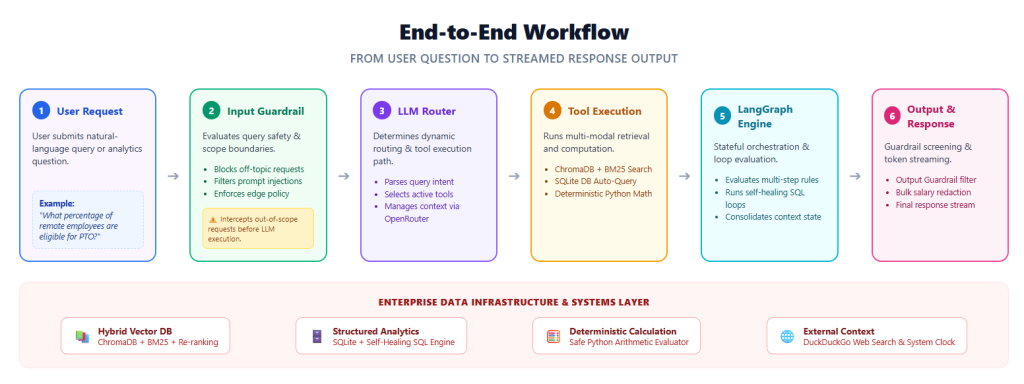
The assistant operates as a state-managed, multi-tool graph. Every incoming user query passes through edge guardrails before being processed by an LLM router, which dynamically delegates tasks across specialized tool modules.
Core Components and Tool Ecosystem
To handle enterprise requests reliably, the agent is backed by five specialized tool modules coordinated by the LangGraph engine:
- Employee DB Tool (SQLite): Runs structured SQL queries to retrieve workforce analytics, department headcounts, and employee metadata.
- Document Search Tool (ChromaDB + BM25): Executes hybrid semantic and keyword retrieval over unstructured company manuals and PDF policies.
- Web Search Tool (DuckDuckGo API): Fetches real-time external data and live industry market benchmarks.
- Calculator Tool (Safe Python eval): Performs exact, deterministic mathematical operations to eliminate LLM arithmetic hallucinations.
- DateTime Tool (System Clock): Interrogates the system clock to provide accurate temporal context for time-relative questions.
The 6-Stage Engineering Journey
Stage 1: High-Precision Document Ingestion & Hybrid Retrieval
The Challenge
Standard vector-only search using cosine similarity frequently fails on enterprise policy documents. Dense embeddings capture conceptual intent well (e.g., “taking time off”), but struggle with exact lexical matches, specific numeric references, or policy section IDs (e.g., “Section 4.1 PTO rollover limits”).
The Solution
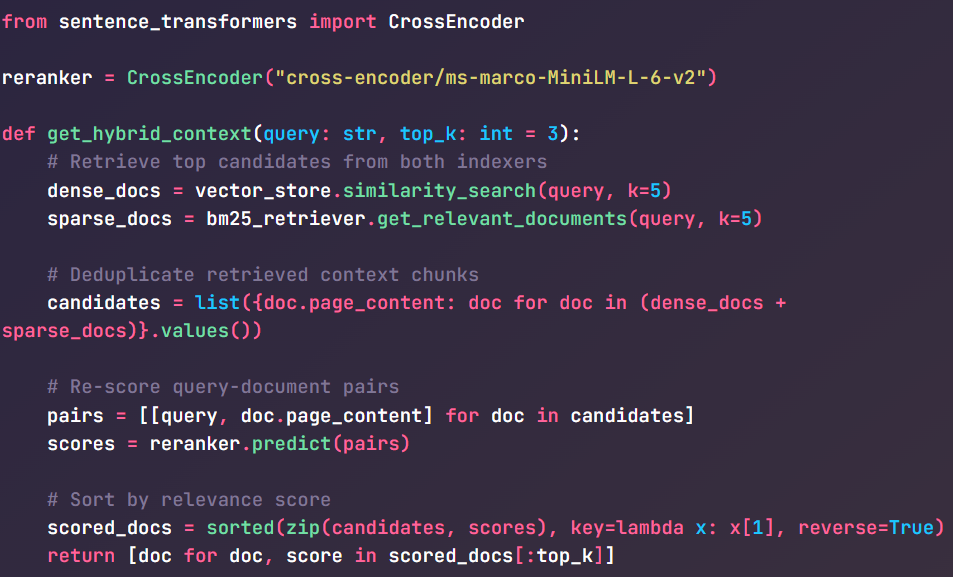
I implemented a Hybrid Retrieval Pipeline combining dense semantic vectors, sparse keyword indexing, and local re-ranking:
- Dense Retrieval (ChromaDB): Generates semantic embeddings using sentence-transformers/all-MiniLM-L6-v2 to capture broad conceptual context.
- Sparse Retrieval (BM25): Runs lexical keyword search to guarantee exact phrase and keyword hits.
- CrossEncoder Re-Ranking: Candidate chunks from both retrievers are merged and passed to a local CrossEncoder model (cross-encoder/ms-marco-MiniLM-L-6-v2). The model re-scores passage relevance directly against the query before constructing the final prompt context.
Business & Technical Impact
Retrieval noise was significantly reduced. The assistant reliably retrieves exact policy clauses without flooding the LLM context window with irrelevant pages, minimizing hallucination risks and lowering prompt token costs.
Stage 2: Context Optimization & Query Rewriting
The Challenge
User input in conversational interfaces is naturally ambiguous or incomplete. A follow-up query like “What about maternity?” lacks the structural context required for a SQL database engine or a vector search retriever to execute effectively.
The Solution
I introduced an explicit Query Expansion & Rewriting Layer. Before reaching the tool execution stage, the system evaluates the raw input alongside previous conversation history. If the query is ambiguous, an internal optimization step rewrites it into a self-contained search string (e.g., “What is the company policy on maternity and parental leave?”) while maintaining the user’s natural conversational flow in the final response.
Stages 3 & 4: Multi-Tool Execution & Structured Database Querying
The Challenge
Enterprise questions often span multiple tool domains and require deterministic arithmetic. For instance, answering: “What percentage of staff is remotely eligible?” requires querying structured employee records in a database, isolating relevant cohorts, and executing a precise division step. Standard LLMs attempting to guess the math internally often hallucinate rounded or incorrect values.
The Solution
I integrated the multi-tool ecosystem with an Automated SQL Self-Healing Loop. The LLM generates structured SQL to query SQLite for exact counts. These numbers are then routed directly to a Python-based Calculator Tool for exact arithmetic evaluation.
If a generated SQL statement fails execution due to a syntax error or a missing quote, the system catches the database error traceback and feeds it back to the LLM. The model analyzes the error, automatically corrects it, and re-runs the SQL query without crashing the user session.
Stage 5: State Machine Control with LangGraph
The Challenge
Hand-rolled ReAct loops rely on parsing string outputs from LLMs (e.g., regex matching for Action: and Action Input:). As tool counts grow, these loops become brittle, failing when models alter formatting, miss stop tokens, or enter infinite tool-calling loops.
The Solution
I refactored the entire agent runtime to LangGraph (StateGraph), migrating from unstructured string parsing to a deterministic state machine architecture.
The runtime gained explicit execution boundaries. The LLM acts strictly as a decision-maker within a controlled state graph, eliminating loop deadlocks and formalizing how context transitions between tool steps.
Stage 6: Enterprise Hardening—Memory, Guardrails & Evaluation
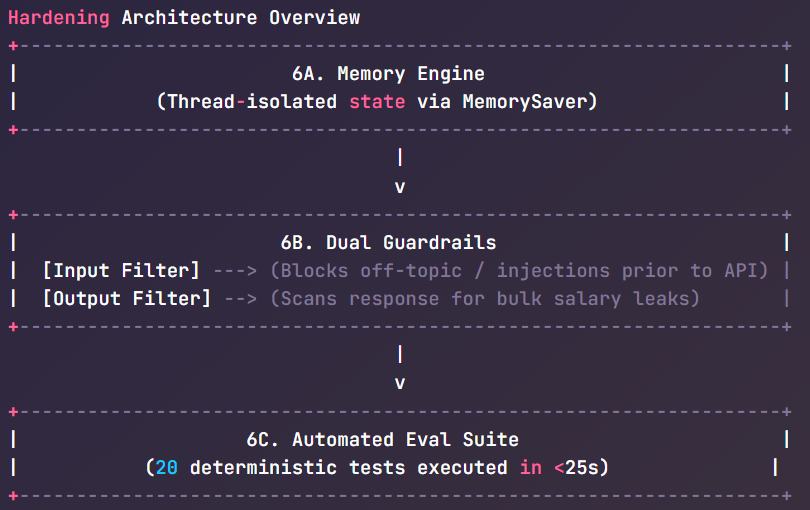
To prepare the platform for enterprise deployment, Stage 6 focused on three critical production requirements: context persistence, operational security, and reliability testing.
6A. Conversation Memory Architecture
Using LangGraph’s MemorySaver checkpointer, state persistence is handled per thread_id. The engine tracks conversation state across turns, enabling seamless follow-up logic.
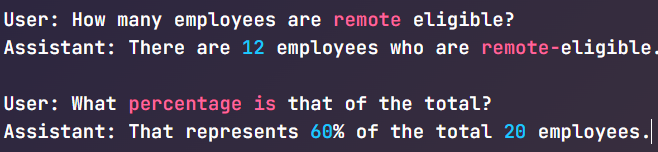
6B. Dual Guardrail Strategy (Cost Control & Governance)
- Input Guardrail: Runs deterministic string checks and intent validation before invoking the LLM. Out-of-scope queries (e.g., cryptocurrency, weather) or prompt injection attempts are blocked immediately at the edge—saving upstream API tokens.
- Output Guardrail: Scans generated text before streaming it to the user. If an execution trace inadvertently attempts to display raw, bulk employee salary lists, the response is intercepted and redacted.
6C. Automated Evaluation Suite
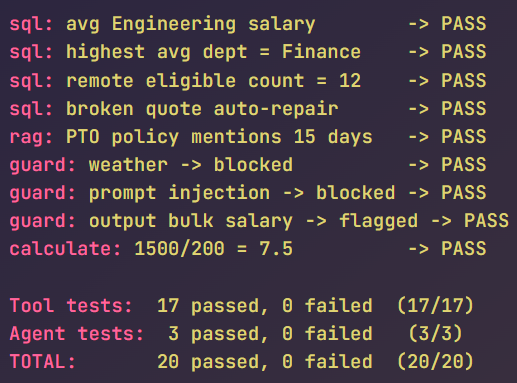
Testing non-deterministic AI applications manually is inefficient and prone to regression. I developed an automated evaluation suite (eval.py) that runs 20 deterministic unit and integration tests in under 25 seconds with zero API costs.
.
Key Benefits and Impact
Building the Acme Corp Smart Assistant using structured state graphs and specialized tools yielded several major benefits over traditional LLM setups:
- Separation of Concerns: Unstructured search, structured analytics, and mathematical operations are handled by dedicated tools, eliminating tool confusion.
- Deterministic Reliability: Mathematical calculations and SQL queries are executed by actual code engines rather than estimated by LLM token prediction.
- Cost Efficiency & Governance: Edge guardrails intercept invalid requests before they hit paid API models, while output filters enforce data privacy.
- Maintainability & Testability: The zero-cost offline test suite allows engineering teams to upgrade underlying LLM models or refactor prompts with complete confidence against regressions.
Conclusion
Moving from basic LLM prompts to production-grade Agentic AI requires bridging statistical language generation with deterministic systems of record.
By structuring the assistant as a LangGraph state machine, leveraging a Hybrid Search Pipeline (BM25 + ChromaDB + CrossEncoder), enforcing dual-layer guardrails, and embedding a zero-cost evaluation suite, we transformed an experimental prototype into a reliable, enterprise-ready AI system.
Core Architecture Insight
AI Agents should not replace reliable enterprise systems of record; they should intelligently orchestrate them. That balance is what unlocks genuine value in modern software engineering.