


Our Quietest Team Member: How AI Changed the Way I Think About Testing
It doesn’t attend stand-ups. It doesn’t ask questions during meetings. It doesn’t even have a Microsoft Teams status. Yet somehow, it has become one of the busiest members of our QA team.
It Joined the Team Without Anyone Noticing
A few months ago, I was reviewing a Jira story that looked straightforward. I had read the requirement twice, checked the linked documents, and was almost ready to start writing test cases.
Before I began, I pasted the requirement into AI and asked:
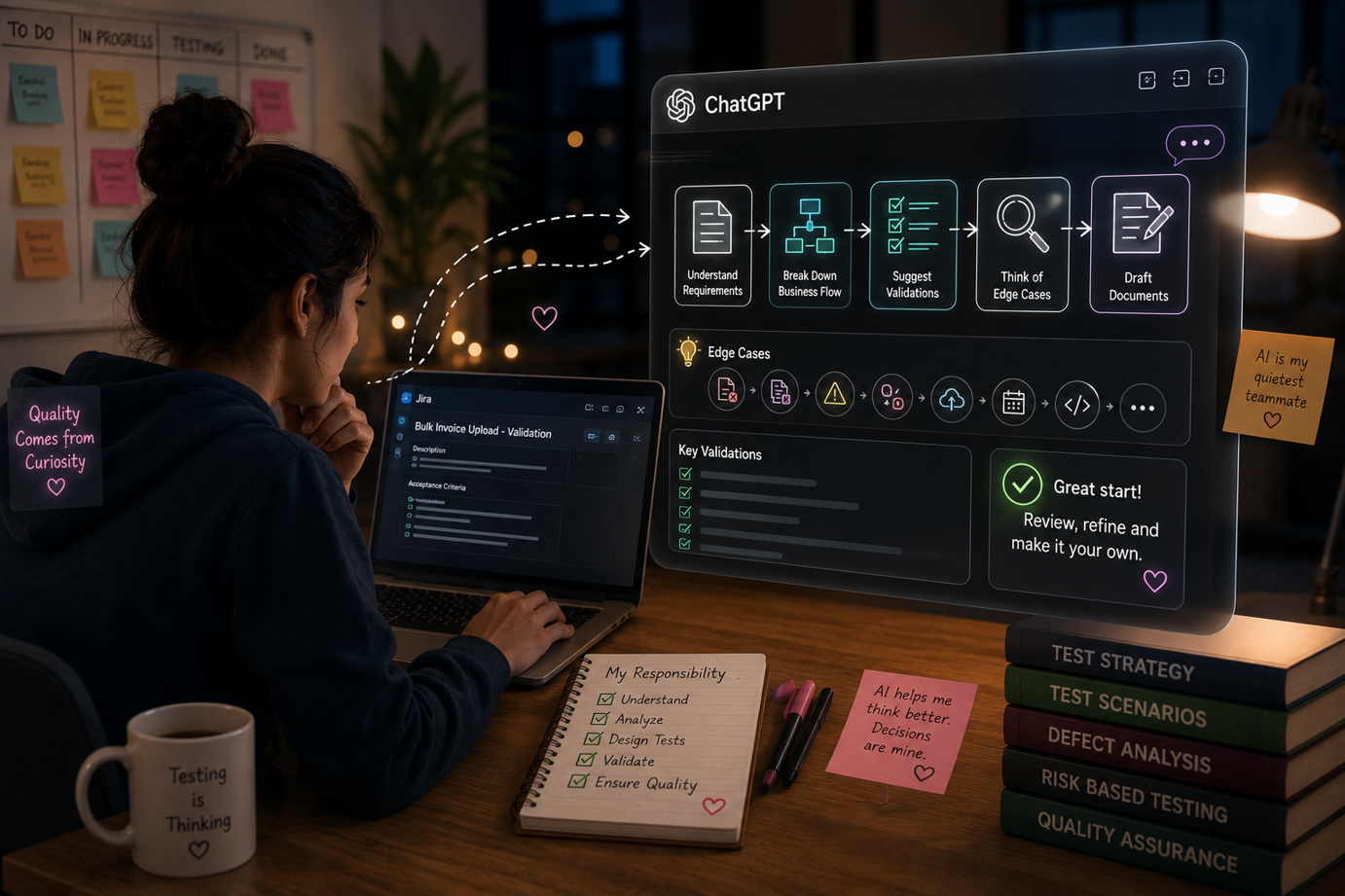
Within seconds, AI reorganized the requirement into a logical flow and highlighted a validation scenario I hadn’t considered. It didn’t replace my analysis, it improved it.
That’s when I realized something.
AI wasn’t becoming my replacement. It was becoming my quietest teammate.
A teammate who never gets tired of repeated questions, never takes a day off, and is always ready to offer a second opinion.
- The final decisions are still mine.
- The testing strategy is still mine.
- The responsibility for quality is still mine.
AI simply helps me think more clearly before making those decisions.
AI Helps Me Understand Requirements, Not Just Read Them
Every Quality Engineer has experienced this.
A Jira story lands in your sprint.
You read it once.
Then again.
Then you open the linked document.
Then you check older tickets.
Finally, you schedule a discussion because one paragraph still isn’t clear.
The requirement exists, but understanding the complete business flow often takes time.
Today, AI is usually my first discussion partner.
Instead of rereading the same requirement multiple times, I ask AI to:
- Summarize large Jira stories into simple language.
- Explain complex business flows step by step.
- List business rules and validations.
- Connect related requirements across multiple tickets.
- Highlight assumptions and clarification points.
The requirement doesn’t change. My understanding does.
And when you understand a feature better, you naturally design better test scenarios.
Example Prompt
Sample AI Response
- User uploads invoice.
- System validates GSTIN format.
- Duplicate invoices are rejected.
- Valid invoices move to processing.
- Failed records are displayed with error messages.
Suggested Validations
- Invalid GSTIN
- Duplicate invoice number
- Missing mandatory fields
- Incorrect file format
- Maximum file size exceeded
Takeaway: This isn’t my final test plan—but it’s an excellent starting point.
AI Never Runs Out of “What If?” Questions
One thing every tester enjoys is thinking about edge cases.
Sometimes we miss one, not because we lack experience, but because we’re human.
Instead of staring at a blank page, I simply ask AI:
Example Prompt
Sample AI Response
- Empty file
- Duplicate records
- Corrupted file
- Mixed valid and invalid invoices
- Unsupported file format
- Upload interrupted midway
- Maximum record limit exceeded
- Invalid date formats
- Special characters in mandatory fields
Some suggestions are expected.
Some don’t apply.
But every now and then, AI suggests one scenario I hadn’t considered. That one overlooked scenario could prevent a production issue.
Documentation No Longer Starts with a Blank Page
Every tester knows this feeling.
- You open a blank document.
- The cursor keeps blinking.
- You know what to write.
- You just don’t know where to begin.
Instead of asking AI to complete the work, I ask it to create the first draft.
- Functional documentation
- Test strategy
- Test scenarios
- Release notes
- Meeting summaries
I review it.
I edit it.
I verify it.
Then I make it my own.
Editing is almost always easier than starting from nothing.
The Biggest Thing AI Gave Me
Many people say AI saves time.
I think it gives us something even more valuable: Thinking Time.
- Instead of formatting documents, I question the feature.
- Instead of rewriting summaries, I explore risks.
- Instead of copying old test cases, I design better ones.
Quality has always depended on curiosity. AI simply gives us more room to be curious.
AI Still Needs a Responsible Teammate
As helpful as AI is, it isn’t always correct. That’s why I follow a few simple rules:
- Never include confidential information or PII in prompts.
- Treat AI suggestions as ideas—not final answers.
- Validate every recommendation against business requirements.
- Maintain traceability between requirements and test cases.
AI can improve our thinking. It should never replace our judgment.
Maybe That’s Why It’s So Quiet
Think about your best teammate.
- They’re not always the loudest person in the room.
- They’re the one who quietly makes everyone else’s work easier.
- That’s exactly what AI has become for me.
It quietly summarizes.
It quietly reviews.
It quietly suggests.
It quietly organizes.
It quietly removes repetitive work.
It doesn’t ask for recognition.
It simply helps us build better software.
That’s why I call it Our Quietest Team Member.
While we’re discussing requirements, investigating defects, preparing test scenarios, and validating releases…
It’s already sitting beside us.
Quietly helping. One prompt at a time.
Give It a Try
The next time you receive a Jira story, try this prompt:
You might not use every suggestion. But you may discover the one question that leads to your next important defect.
A Final Reflection
Quality Engineering has never been about executing more test cases. It’s about understanding the bigger picture, asking the questions others might overlook, and making sure quality is built into every step of the process.
AI doesn’t ask those questions for us. It doesn’t replace our experience, our judgment, or our responsibility as Quality Engineers.
Instead, it quietly takes care of repetitive work, allowing us to spend more time thinking deeply, exploring possibilities, and making better decisions.
“AI doesn’t replace Quality Engineers. It removes repetitive work so we can focus on what matters most—thinking, questioning, and delivering better quality.”
And if that’s what the quietest member of our team can do, I’d happily keep a seat reserved for it in every project.