


Introduction
Apple has been introduced Apple intelligence for making your application faster, smarter and personalized. Apple intelligence is an new experience for users that provides intelligence search, content recommendations, text summarization and natural language understanding. Apple intelligence is mostly work with Apple Silicon and Neural Engine for executing AI related tasks.
In this blog, you will learn about Apple intelligence, its architecture, how does it work and how developers can use it to build smarter applications using Swift and Apple’s AI frameworks.
What is the Apple Intelligence?
Apple Intelligence is called Apple’s built in AI system that helps users to complete its task securely, faster and naturally. Apple Intelligence is a combination of On Device AI, Apple Silicon and Foundation Models to language understanding, generate content description, summarise text and provide intelligence assistance across Apple’s ecosystem.
Traditional AI is totally depends on Cloud servers but Apple intelligence processes many request locally on the device that provide faster response and provide more privacy. Apple also provided Private Cloud Compute to handle complex AI tasks and it is also maintaining data privacy and security.
Developer can use swift and Apple’s AI framework to enable AI features on your application. These frameworks are having pre trained and build AI models.
Key Components
- Apple Foundation Model – Helps to understand AI task and generate intelligent responses.
- Core ML – Used to optimize AI model execution.
- Siri – Provides natural language interaction.
- Apple Silicon and Neural Engine – Helps to compute AI related tasks or requests.
- Private Cloud Compute – Helps to complete complex AI tasks.
Architectural flow of Apple Intelligence
Apple Intelligence is used in privacy first architecture that decides your AI request can be executed either on device or needs a help of Private Cloud Compute.
- User Request – This layer used to take users requests from a prompt, speaking to Siri or engaging with an application.
- Apple Intelligence – Apple intelligence layer user to understand user’s request and intention behind request.
- Decision Layer – This layer used to decide this request can we process on device or PCC.
- On Device AI – On Device AI executes AI task locally with the help of foundation model, Apple Silicon and Neural Engine.
- Private Cloud Compute – Private Cloud Compute is used to handle complex and large AI requests.
- AI Response – This layer is used to generate AI response and share to Application and user.
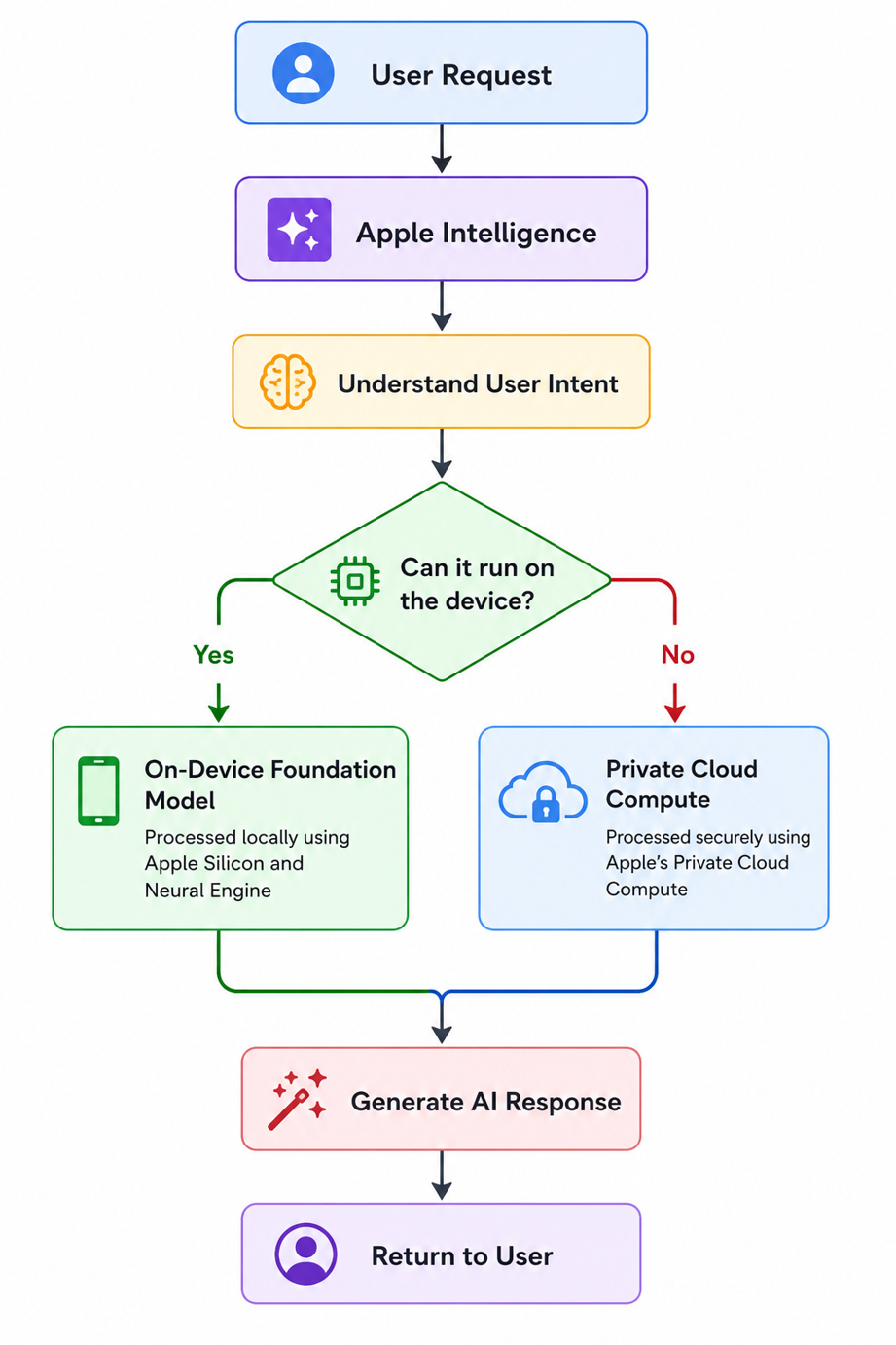
Diagram: Architecture of Apple Intelligence
On-Device AI
On-Device AI is the latest evolution of Artificial intelligence, that works directly on user’s device instead of cloud servers. It uses Apple foundation Model, Apple Silicon and Neural Engine to execute AI related task. These are the following benefits of On Device AI:
- Faster response times
- Better privacy since data stays on the device
- Reduced internet dependency
- Lower cloud infrastructure costs
- Improved user experience
Component of On-Device AI
- Apple Silicon
- Neural Engine
- Apple Foundation Model
Apple Silicon
Apple Silicon is Apple’s custom designed processor that powers devices such as the iPhone, iPad, Mac and Apple TV. Apple designs both the hardware and software allowing them to work together efficiently. Apple integrated CPU, GPU, Neural Engine, Unified Memory and Media Engine into a single chip. Apple Silicon delivers faster performance, improved power efficiency and optimised AI processing.
Components
- CPU – Executes application and system tasks.
- GPU – Handles graphics rendering and visual effects.
- Neural Engine – Accelerates AI and Machine Learning tasks.
- Unified Memory – Allows all component to access same memory to perform data processing faster.
- Media Engine – Optimizes video encoding, decoding, and playback.
Neural Engine
The Neural Engine is a special processor inside Apple Silicon that is built for AI and Machine Learning tasks. Neural Engine is pre trained AI model that performs AI calculations much faster than the CPU and making features like voice recognition, natural language understanding, image recognition and smart recommendations faster and more efficient.
Roles –
- CPU – Handles app and system tasks.
- GPU – Handles graphics and video processing.
- Neural Engine – Handles AI and Machine Learning tasks.
Apple Foundation Model
Foundation Models are Apple’s pre trained AI models that help developers add intelligent features to their applications. Developers do not need to train these AI models, Apple has already trained and optimised them. Developers simply provide a prompt and model understands the request and generates a response.
Key Capabilities
- Summarisation
- Text generation
- Classification
- Recommendations
- Natural language understanding
How It Works
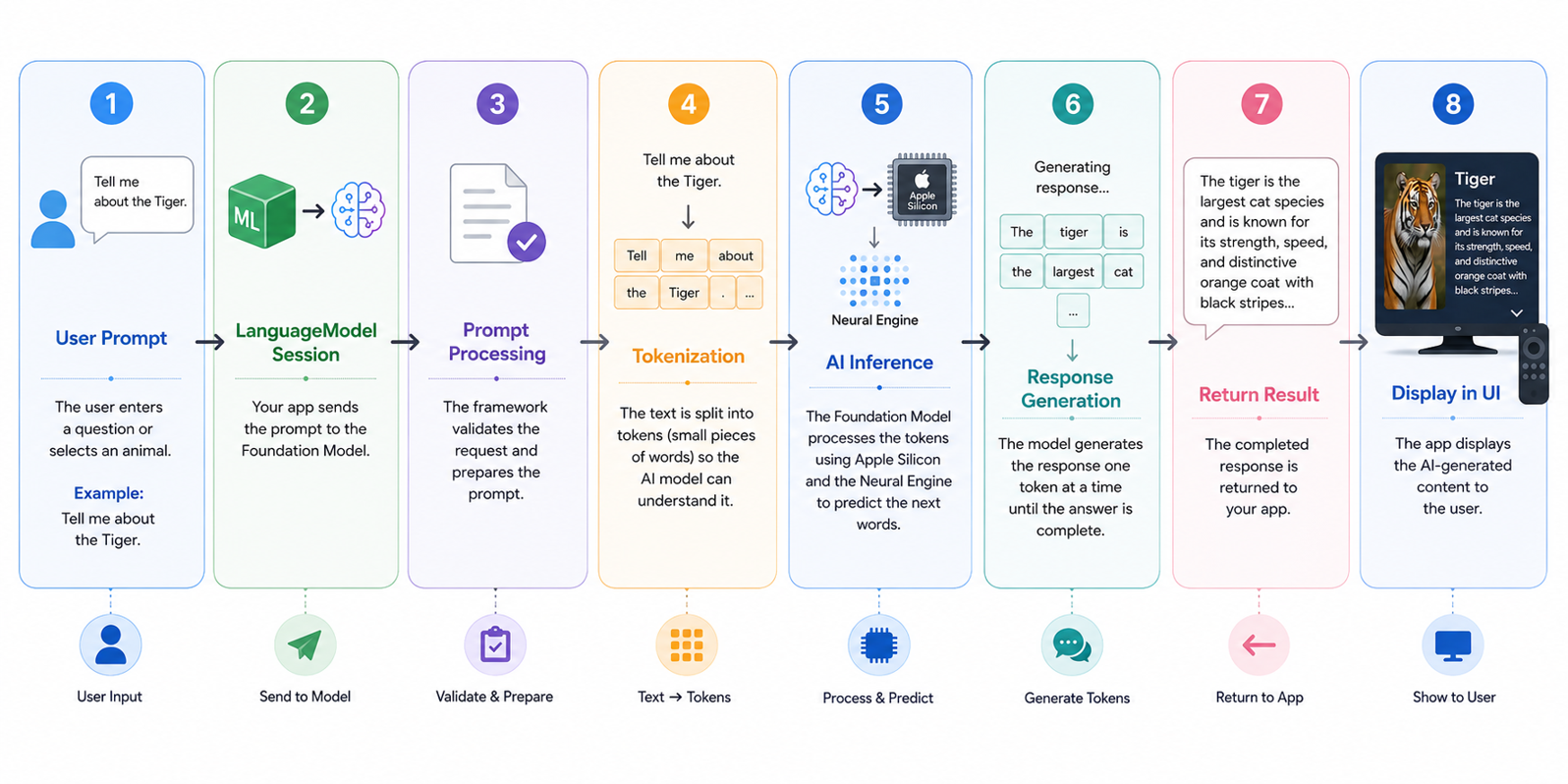
Diagram: Process of Foundation Model
LanguageModelSession
LanguageModelSession is the main entry point for interacting with Apple’s Foundation Models. It creates a communication session between your app and the AI model. Developers use it to send prompts, maintain conversation context and receive AI generated responses.
Responsibilities
- Creates a connection to the Foundation Model.
- Sends user prompts to the AI model.
- Maintains conversation context across multiple interactions.
- Returns AI generated responses.
- Handles communication with the model automatically.
Example:

Code Snipped
Performance of Apple Intelligence
- Lower Latency – Faster AI responses with local processing.
- Less Internet Dependency – Supported AI features can work without a constant network connection.
- Better Privacy – User data remains on the device whenever possible.
- Optimised Performance – Apple Intelligence uses Apple Silicon and Neural Engine to execute AI tasks on device.
Privacy in Apple Intelligence
- Prompt processed on device
- Apple Silicon processes data
- Data remains private
- Most tasks work locally
- Faster response
Limitation of Apple Intelligence
- No Live Internet – On device AI cannot access real time web information or latest updates.
- Smaller Models – Uses smaller AI models to save device storage and power which may have limited knowledge.
- Less Reasoning – Apple intelligence may be efficient to make very complex tasks or deep reasoning as Cloud AI handles.
- Hardware Limitations – Performance depends on the device processor, memory and AI capabilities.
- Large Prompts Slower – On device AI takes more time to execute large and complex AI task.
- Not Suitable for Every Use Case – Some advanced tasks still require powerful cloud based AI model
Comparison of Traditional AI and On Device AI
| Feature | Traditional AI | On Device AI |
| Latency | Higher due to network communication | Low, processed locally |
| Internet | Required | Not required for most tasks |
| Privacy | Data sent to cloud servers | Data stays on the device |
| Cloud Cost | Higher cloud infrastructure cost | Lower cloud dependency |
| Offline Support | Limited or unavailable Works | offline for supported features |
| Security Data | transmitted over the internet | Data remains on the device |
| Performance | Depends on network speed | Fast and consistent on supported devices |
Best Practices
Follow these best practices to build efficient and reliable On Device AI applications:
- Use AI only where it adds value to the user experience.
- Keep prompts clear, concise and specific.
- Run AI tasks asynchronously to keep the UI responsive.
- Create dedicated service or AI Manager for handling all AI related task with disturbing UI logics.
- Handle errors gracefully and provide fallback behaviour when needed.
- Optimise prompts and responses to reduce processing time.
- Process user data on device whenever possible to maintain privacy.
Conclusion
Apple Intelligence is changing the way developers build apps by making AI faster, smarter and more private. With technologies like On Device AI, Foundation Models and Apple Silicon developers can create intelligent features while keeping user data secure.
Apple Intelligence is continuously growing and providing AI’s powerful feature without sharing user’s data to the cloud server. Apple Intelligence is the next generation innovation for Apple ecosystem that maintaining data security and privacy. This technology is making your app smarter, faster and secure.
Happy Coding….