


Idempotency in Data Pipelines: Patterns and Best Practices
Introduction
What happens when your data pipeline runs twice?
In development, a second run may not seem like a big problem. In production, however, duplicate processing can lead to incorrect records, inflated metrics, inconsistent reports, broken downstream processes, and expensive data cleanup.
Idempotency means designing a pipeline so that processing the same input multiple times produces the same final state as processing it once.
This is especially important because retries, task failures, streaming replays, late-arriving data, backfills, duplicate files, and concurrent executions are normal in modern data platforms.
A production-grade pipeline should not only work when everything goes as planned. It should also produce predictable results when something goes wrong.
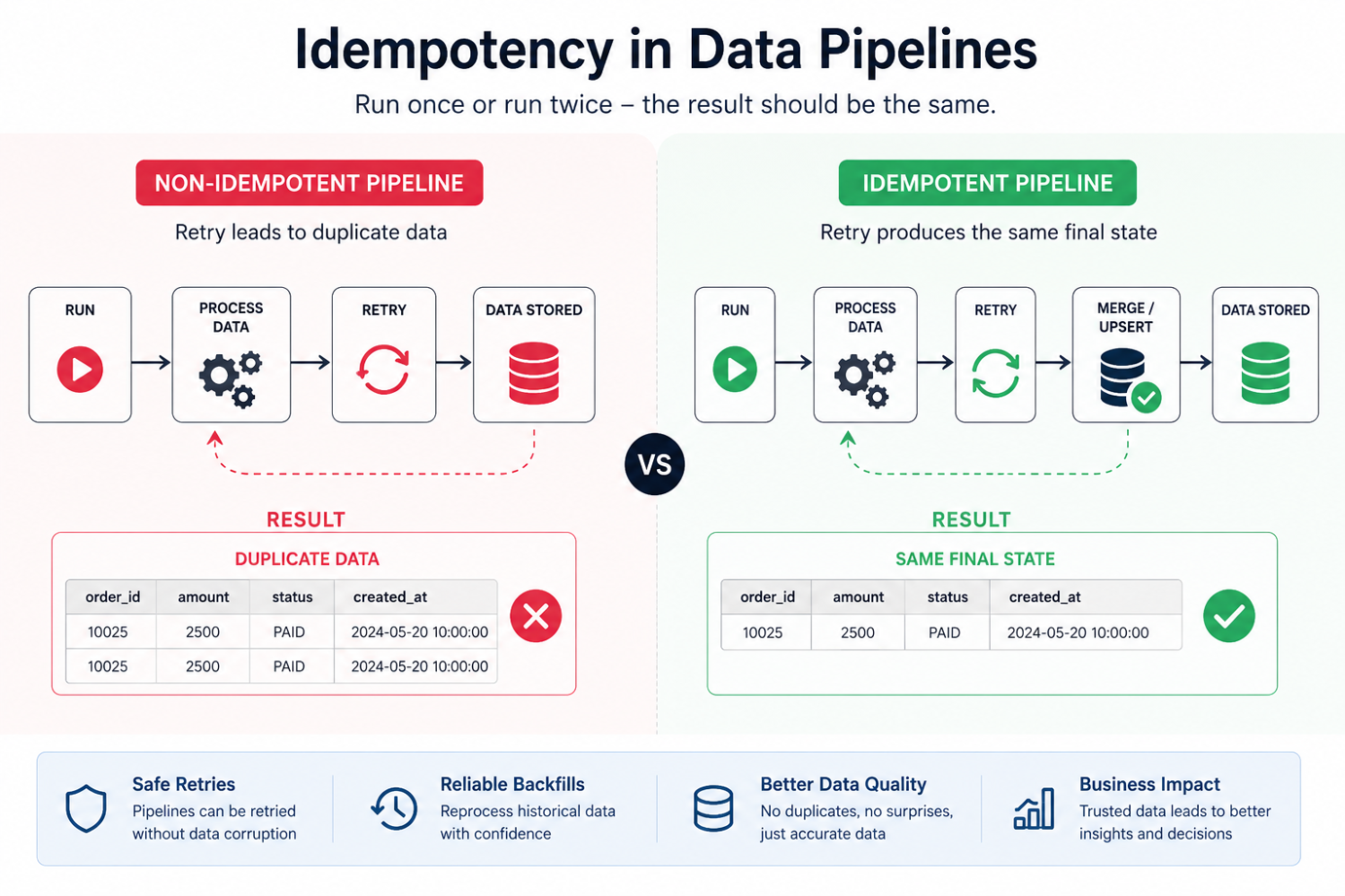
Idempotency in Data Pipelines
Why Does Idempotency Matter?
Consider two pipelines:
| Pipeline | Runtime | Retry | Backfill | Pipeline A | 8 minutes | Unsafe | Risky | Pipeline B | 15 minutes | Safe | Safe |
|---|
For production workloads, Pipeline B is often preferable. Saving a few minutes of compute is usually less costly than correcting incorrect data.
Idempotency improves data correctness, recovery from failures, backfill safety, and overall trust in analytics.
How Duplicate Data Happens
Consider a simple pipeline:
Source
↓
Transform
↓
Load
↓
Warehouse
Suppose the load succeeds, but the task fails before the orchestrator records the successful completion. The orchestrator retries the task.
If the pipeline uses:
INSERT INTO orders
VALUES ('10025', 2500, 'PAID');
the retry can create:
10025 | 2500 | PAID
10025 | 2500 | PAID
The pipeline is restartable, but the data is not safely recoverable. This highlights the difference between restartability and idempotency.
Common Idempotency Scenarios
1. Retries and Partial Failures
A task may successfully write data and then fail before completing. A retry can process the same data again.
Partial failures create a similar problem. If three partitions succeed and one fails, restarting the entire job may process the successful partitions twice.
Partition-level processing, deterministic writes, and MERGE operations can make these retries safe.
2. Backfills
Backfills are another important scenario. Suppose business logic changes and historical data needs to be reprocessed.
Appending recalculated data can create duplicates. Instead, the affected partition or date range can be replaced or merged deterministically.
Existing Data
↓
Identify Affected Range
↓
Reprocess Source
↓
Replace / Merge
↓
Correct Final State
3. Late-Arriving Data
A common incremental strategy is:
WHERE updated_at > last_processed_timestampThis can miss records that arrive late. A safer approach is to use an overlap window:
Previous Checkpoint
↓
T - Overlap → Current Time
↓
Deduplicate
↓
Merge
Reprocessing a small amount of data is often safer than missing records.
4. Duplicate and Out-of-Order Streaming Events
Consider a streaming architecture:
Application
↓
Kafka
↓
Consumer
↓
Data Lake / Warehouse
A consumer may process an event successfully but fail before committing its offset. The same event can then be delivered again.
A stable identifier such as event_id allows the target system to recognize and safely handle the replay.
Streaming events can also arrive out of order. A sequence number, event timestamp, or version can prevent an older event from overwriting newer state.
5. Concurrent Pipeline Runs
Idempotency is not limited to failures. Two pipeline instances may process the same partition simultaneously.
Run A → 2026-08-25
Run B → 2026-08-25
Possible protections include concurrency controls, partition-level locks, unique constraints, and deterministic MERGE operations.
6. File Reprocessing
File-based ingestion can also produce duplicates. If a file is successfully loaded but the pipeline fails before recording its completion, the file may be processed again.
A processing registry can track the file path, checksum, processing time, run ID, and status.
A checksum is particularly useful when the same filename can be uploaded with different content.
7. External API Retries
Suppose a pipeline calls an external API. The request succeeds, but the pipeline times out before receiving the response and retries the request.
For operations with side effects, such as creating an order or transaction, this can create duplicate records.
An idempotency key, such as transaction_id or request_id, allows the external service to recognize repeated requests and safely return the original result.
Practical Patterns for Idempotent Pipelines
1. Use Stable Business Keys
Important records should have stable identifiers such as:
order_idtransaction_idcustomer_idevent_id
These keys allow the pipeline to distinguish new records from replayed records.
2. Use MERGE or Upsert
Instead of blindly inserting data, update an existing record or insert it when it does not exist.
MERGE INTO target t
USING staging s
ON t.order_id = s.order_id

WHEN MATCHED THEN
UPDATE SET
amount = s.amount,
status = s.status

WHEN NOT MATCHED THEN
INSERT (order_id, amount, status)
VALUES (s.order_id, s.amount, s.status);
Processing the same input again updates the existing record instead of creating another copy.
3. Stage, Validate, and Deduplicate
A common production pattern is:
SOURCE
↓
RAW / BRONZE
↓
STAGING
↓
VALIDATE + DEDUPLICATE
↓
MERGE / UPSERT
↓
FINAL
The staging layer provides a controlled location for validation and deduplication before modifying the final dataset.
4. Maintain Processing Metadata
A production pipeline should be able to identify what was processed and by which run.
Useful metadata includes:
run_idpipeline_namebatch_idpartition_datestatusrecords_processed
This improves observability and makes retries and recovery easier.
How to Test Idempotency
The simplest test is:
Can I safely run the same input twice?
Run 1 → August 25 → SUCCESS
Run 2 → August 25 → SUCCESS
The final dataset should remain correct and predictable.
Also test:
- Retrying a failed task
- Reprocessing a failed partition
- Replaying a streaming event
- Processing events out of order
- Running concurrent pipeline instances
- Reprocessing historical data
- Loading the same file twice
- Retrying an external API request
- Processing late-arriving records
Conclusion
Data engineering is not only about processing data faster. Failures, retries, duplicate events, partial processing, late-arriving data, concurrent executions, and backfills are normal in production.
A reliable pipeline should therefore be designed for both the first run and the second run.
The key principles are simple: use stable identifiers, make writes deterministic, deduplicate replayed data, handle retries and late data, control concurrent executions, and maintain processing metadata.
Before asking:
“How fast is my pipeline?”
also ask:
“If I run it again, will I still trust the data?”
That is one of the simplest ways to think about production-grade data engineering.