


Whenever the codebase of a frontend application starts growing bigger, the initial solution seems straightforward. You just hire a couple more developers, spin up a few new feature branches, and keep pushing code into the same repository. For a while, that works perfectly fine. It’s the classic way software gets built. But eventually, reality hits. The codebase balloons into a massive monster. Suddenly, there are five or six different teams touching the exact same files at the exact same time. Releases turn into a nightmare of endless Slack threads and painful cross-team coordination. Git merge conflicts become a daily morning ritual that wastes hours. This friction is exactly why so many engineering teams start looking into Micro Frontends and, more specifically, Module Federation.
What Exactly Is This Architecture Anyway?
If Module Federation is a new term, there is no need to sweat it. The documentation can be notoriously confusing at first glance.
To strip away all the fancy marketing buzzwords, Module Federation basically lets one frontend application dynamically load pieces of another entirely separate application while it’s running right inside the user’s browser.
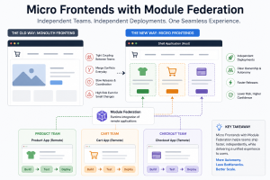
Instead of building one giant, heavy monolithic frontend, the whole system gets broken down into smaller, bite-sized applications owned by different autonomous teams. For instance, think of a massive e-commerce setup:
- The Product Team entirely manages the product catalogue pages.
- The Cart Team runs the shopping cart logic and local storage state.
- The Checkout Team takes care of complex payment gateways and security.
Every single team can build, test, and deploy its own code whenever they want, completely independent of the others. But for the end user browsing the website, it all still looks and feels like a single, smooth, unified application.
On paper? It sounds like paradise. In reality, it comes with a lot of hidden, expensive costs.
The Good Side (Why Everyone Sells It)
Let’s talk about the benefits that make this setup so attractive. The absolute crown jewel of this architecture is pure team independence.
When a team doesn’t have to wait for three other squads to approve or run a full regression test on a release, feature velocity goes through the roof. If there’s a critical bug in the shopping cart, the responsible team can patch it and ship it in ten minutes. They shouldn’t have to rebuild, retest, and redeploy the entire platform just for that one fix. For massive engineering organisations, that kind of autonomy is a massive game-changer.
Another big win is crystal clear ownership. When a specific team completely owns a specific business domain, all the finger-pointing stops. There is no ambiguity. Everyone knows exactly which team is responsible for what feature, code reviews actually start making sense, and developers know exactly who to page on Slack if something breaks in production.
The Messy Reality After Going Live (The Hidden Overhead)
Setting up Module Federation initially isn’t the hard part. Honestly, getting the Webpack or Vite config to work is the easiest part of the whole project.
The real headache begins right after the micro frontends go live in production.
Suddenly, teams are hit with a barrage of tough architectural questions that don’t have straightforward answers in any basic tutorial:
- Communication: How should these separate, isolated apps talk to each other without becoming tightly coupled? Do they use custom events, a shared global state, or window objects?
- Authentication: Who actually owns the user login and session management? How do tokens get securely passed down to child applications?
- Design Systems: How do teams share common UI components without bloating the bundle size? If every team bundles their own version of a button, the page weight explodes.
- Dependency Hell: What happens when Team A decides to upgrade React to the latest version because they need a new feature, but Team B is stuck on legacy code and doesn’t have time to upgrade for the next six months?
None of these problems is impossible to fix. People solve them every day. But solving them adds a massive layer of operational complexity, governance, and meeting overhead. And in software engineering, extra complexity always sends a bill eventually.
When Does It Actually Make Sense?
Micro Frontends only make sense when organisational scaling pain is significantly worse than the technical complexity being introduced.
If a company has hundreds of developers split into different business domains, and they are constantly stepping on each other’s toes and blocking each other’s release cycles, then the payoff is absolutely worth it. This architecture typically succeeds in specific environments:
- Massive, global e-commerce platforms with tons of moving parts.
- Complex banking, trading, or insurance applications.
- Heavy-duty Enterprise SaaS products with distinct feature suites.
In these specific scenarios, the human communication bottleneck is a much bigger threat to the company than the architectural overhead of managing Module Federation.
When to Stay Far, Far Away
For small or medium-sized products, the best advice is simple: keep it simple and stick to a monolith. A traditional, single frontend application is easier to reason about, vastly simpler to debug, and infinitely faster to build and ship from scratch. An application can easily be organised with good folder structures, linting rules, and internal modules without needing the nuclear option of dynamic runtime loading.
Too many teams jump headfirst into Micro Frontends simply because it’s trendy, it sounds cool in tech blogs, or it looks good on a resume. Building a complex ecosystem for an application that only has a handful of developers working on it is the ultimate, textbook recipe for ruining a project with over-engineering.
Final Thoughts
A great rule of thumb in software engineering is that architecture should solve a problem that exists right now—not a hypothetical problem that might appear three years down the road.
Module Federation is an incredibly clever and powerful tool, but it’s fundamentally a scaling solution for large corporate structures, not a magic shortcut to writing better or cleaner software. If a development organisation is genuinely drowning in release blocks, organisational friction, and ownership confusion, it is a fantastic fit.
If not? Keep it simple. Sometimes the smartest architectural move isn’t adding another clever layer of abstraction—it’s having the discipline to choose to live without it.