


Introduction
A while back, I was working on a simple microservices-based flow — nothing too complex on the surface.
The requirement was straightforward:
- Create inventory
- Create order
- Generate billing
At first glance, this looked like a typical workflow.
But then an important question came up:
What happens if one service fails in the middle of this process?
In a monolithic application, we rely on database transactions — commit everything or roll everything back. But in microservices, each service has its own database and transaction boundary. As a result, there is no longer a single global rollback mechanism capable of automatically reverting changes across all services. This is where distributed transactions become essential in microservices architecture.
What are Distributed Transactions?
A distributed transaction is a process where a single business operation spans across multiple services or databases.
Why is this important?
In a microservices architecture, services operate independently and maintain their own databases and transaction boundaries. However, real business workflows often span across multiple services, which makes maintaining consistency significantly more challenging when failures occur during execution.
Without proper handling, even a single service failure can leave the system in a partially updated and inconsistent state.
Example :
User Service → stores users
Order Service → stores orders (linked via userId)
Now imagine:
A user is deactivated, and the system attempts to deactivate all associated orders. However, if the Order Service becomes unavailable or an exception occurs during processing, the user may be deactivated while their orders remain active.
This leads to data inconsistency across services.
Understanding the Core Problem
In microservices architectures, distributed transactions introduce several challenges, including maintaining consistency across services, avoiding partial updates, handling failures gracefully, and coordinating operations across independent databases. The biggest challenge arises when one service successfully completes its operation while another service fails during the same workflow.
Example:
- Inventory updated successfully, but
- Order creation failed
The system is now left in a partially updated state.
To handle these kinds of distributed workflow failures more effectively, patterns like Saga are commonly used.
Introducing the Saga Pattern
Instead of relying on one large distributed transaction, the Saga pattern breaks the workflow into a sequence of smaller local transactions, where each step executes independently and defines a corresponding compensation action (rollback logic).
Unlike database rollbacks, compensation actions are explicitly defined business operations that reverse previously completed changes when a failure occurs later in the workflow.
Saga workflows are commonly implemented using two coordination approaches depending on how services communicate and manage transaction flow.
Types of Saga Pattern
1. Orchestration Saga : In the orchestration approach, a central coordinator controls the workflow by invoking services sequentially, monitoring execution flow, and triggering compensation actions whenever failures occur.
Advantages:
- Centralized control
- Easier debugging
- Clear flow visibility
Disadvantages:
- Can become a bottleneck
- Single point of failure
2. Choreography Saga: In the choreography approach, there is no central controller. Services communicate through events, and each service independently reacts to state changes produced by other services in the workflow.
Advantages:
- Loosely coupled
- Highly scalable
- Independent deployments
Disadvantages:
- Hard to track flow
- Debugging is complex
- Risk of missing events
Common tools used here include event brokers like Apache Kafka or RabbitMQ.
Both approaches solve distributed transaction challenges differently, and the choice largely depends on system architecture and communication patterns.
Orchestration-based Saga workflows are generally preferred for complex business processes that require centralized coordination, better execution visibility, and simpler failure management. In contrast, choreography-based approaches work well for highly event-driven systems where services communicate asynchronously and remain loosely coupled.
My POC: A Practical Implementation
The implementation was designed using an orchestration-based Saga approach with compensation-driven rollback handling.
To understand this better, I implemented a simple system with three microservices:
- Inventory Service
- Order Service
- Billing Service
Execution Flow :
createInventory()
↓
SagaAspect intercept
↓
Inventory saved
↓
Saga.compensate registers rollback
↓
Call Order Service
↓
Order Service fails (due to an exception or service unavailability)
↓
Exception thrown
↓
SagaAspect catches exception
↓
SagaManager.rollback()
↓
Execute rollback steps
Key Implementation Concepts :
1. Custom Annotation
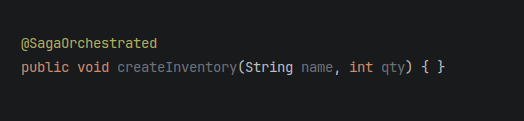
Custom annotation used to identify and orchestrate methods participating in a Saga-based distributed transaction flow
This annotation identifies methods that participate in Saga orchestration.
2. AOP (Aspect-Oriented Programming)
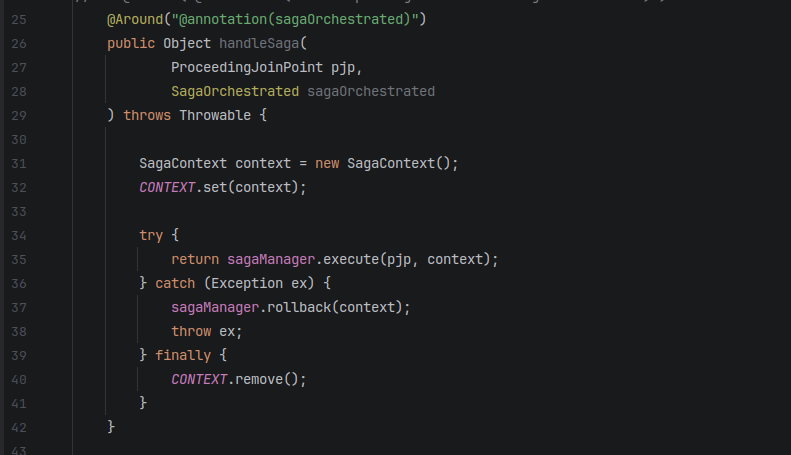
Spring AOP intercepting Saga workflows to centrally manage transaction execution and compensation-based rollback handling
This approach:
- intercepts method execution
- wraps the transaction flow
- automatically triggers rollback on failure
Without AOP, this logic would be scattered across multiple services.
3. Registering Rollback Logic

Defining compensation actions to safely recover completed operations and ensure consistency across distributed transaction flows
This does not execute immediately — it registers a rollback action.
4. Rollback Ordering Strategy
To ensure consistency, compensation actions are executed in the reverse order of successful operations. Internally, rollback steps are maintained using a stack-like structure (Deque), allowing the most recently completed operation to be reverted first.
This follows the Last-In-First-Out (LIFO) approach, which is critical in distributed transaction recovery scenarios.
For example:
Step 1: Inventory created
Step 2: Order created
If a failure occurs afterward:
Order rollback executes first
Inventory rollback executes next
This prevents dependency conflicts and helps restore the system to a consistent state.
5. Compensation Execution Flow

Sequential execution of registered compensation handlers using reverse-order transaction unwinding
The rollback manager iteratively invokes each registered compensation handler from the stack until all previously committed operations are reverted.
This approach ensures controlled transaction unwinding while preserving execution order dependencies between services.
Important Design Considerations :
While implementing the Saga workflow, a few important distributed system design considerations became clear.
Idempotency
Each operation and compensation step should be idempotent, meaning it can be safely retried without side effects.
Compensation Failures
Rollback logic itself can fail. Therefore:
- compensation actions should be retryable
- proper logging and monitoring are essential
Eventual Consistency
Saga does not guarantee immediate consistency. Instead, it ensures that the system will eventually reach a consistent state. During this transition period, temporary inconsistencies between services are expected and considered normal behaviour in distributed systems.
How Saga Restores Transaction Consistency
Revisiting the earlier scenario where inventory creation succeeds but order creation fails:
Without Saga:
- Inventory remains updated
- System becomes inconsistent
With Saga:
- Compensation action triggers
- Inventory update is rolled back
- System returns to a consistent state
A Simple Real-World Analogy
Consider a food delivery application:
- Payment is processed
- Restaurant accepts the order
- Delivery partner is assigned
If the restaurant later rejects the order:
- The payment is refunded
Each step is handled by a separate service, and failure triggers a compensation action.
Key Learnings From My Implementation :
From this implementation, a few important lessons became very clear:
- Compensation logic must be explicitly defined
- Execution order is critical (LIFO)
- AOP helps keep the implementation clean
- Failures are not exceptions — they are expected scenarios
While this implementation was part of a learning exercise, it provided practical insight into how distributed transaction management works in real-world microservices architectures.
Conclusion
Distributed transactions remain one of the most complex challenges in microservices architecture because business workflows often span across multiple independent services and databases.
The Saga pattern offers a practical and scalable approach to solving this problem by breaking large workflows into smaller local transactions and handling failures through compensation mechanisms. Instead of relying on immediate consistency, Saga focuses on maintaining eventual consistency while allowing services to remain loosely coupled and independently scalable.
From my experience, implementing Saga reinforced an important principle about distributed systems:
Failure is not an edge case — it is an expected part of system behavior. Designing reliable compensation workflows, retry mechanisms, and recovery strategies is often just as important as implementing the business logic itself.