


It started with a number: 147
I was doing routine cleanup in our main Google Tag Manager container – scroll through the tags, kill the old ones, check the variables. Standard housekeeping. But I stopped mid-scroll and actually counted.
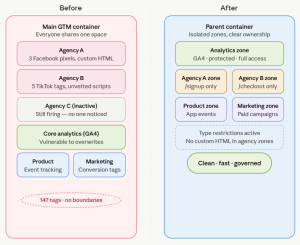
147 tags. Half of them with no clear owner. Three separate Facebook pixels. Five TikTok tags. Custom HTML scripts from an agency we hadn’t worked with in over a year still sitting there, quietly firing on every page load.
This isn’t just our problem
If you work in digital analytics at a mid-to-large organisation, this is almost certainly familiar. GTM containers don’t start chaotic, they get that way gradually, as more teams and vendors pile into the same shared workspace.
In most enterprises, a single container ends up serving:
- Marketing teams running campaigns and A/B tests
- Media agencies dropping conversion and retargeting pixels
- Analytics teams maintaining core measurement infrastructure
- Product teams tracking feature adoption and user flows
- CRO vendors injecting testing and personalisation scripts
Each group has legitimate needs. But without structural governance, they all end up in the same room with no walls. Tags accumulate faster than they’re removed. Permissions get handed out for convenience and never revoked. No single team has a complete picture of what’s running or why and the container becomes nearly impossible to audit, difficult to secure, and genuinely risky to touch.
What bothered us most wasn’t the mess. It was the exposure. Giving an outside agency editor access to your primary GTM container is handing them a key to your website’s source code. One sloppy line of JavaScript, and your checkout page goes down.
The question we kept asking: Why does every team have to live in the same GTM house?
The answer: GTM Zones
Zones let you link separate containers together inside a parent container, with controlled boundaries. Each agency or sub-team gets their own isolated sandbox which they can publish what they need without touching core infrastructure.
Think of it like an apartment building. We own the building. Agencies rent a unit. They can do what they like inside it but they can’t knock down load-bearing walls.
Three things changed immediately:
1. Boundaries that mean something
We scoped one agency’s Zone to fire only on /signup. The moment a user navigates away, their entire container drops out of the browser’s memory. No unnecessary load. No cross-page bleed.
2. Type restrictions – the real safeguard
We configured the Zone to allow only standard Google and Meta conversion tags. If the agency attempts to publish a Custom HTML tag with unvetted code, the Zone configuration prevents it from executing. They get their tracking. We keep our guardrails.
3. Core data that stays protected
Vendors working inside their own containers physically cannot delete our GA4 triggers or overwrite our custom variables. The data stream is clean because it’s structurally separated, not because we’re relying on trust.
What happened after
We deleted over 80 legacy pixels from the main container and moved active agency partners into scoped Zones. The impact was immediate:
- Tags dropped from 147 to 61 – 58% reduction in container complexity
- Page load improved by ~300ms on key landing pages, improving bounce rate and ad quality scores
- Zero deployment incidents in three months, versus two checkout disruptions the prior quarter
- Vendor onboarding reduced to under an hour, down from a multi-day IT vetting process
More than the numbers, our team stopped being the people cleaning up after everyone else and started being the people who designed how everyone else worked.
Conclusion
A bloated GTM container is not a housekeeping problem, it is a governance problem. And governance problems are not solved by asking teams to be more disciplined. They are solved by putting the right structure in place.
GTM Zones provide that structure: clear ownership, scoped third-party access, and technical guardrails that do not depend on manual oversight. The result is a tagging infrastructure that is auditable, secure, and scalable as vendor relationships evolve.
For analytics and martech teams at enterprise scale, the question is no longer whether to govern your GTM environment, it is whether your current setup gives you the architecture to do so effectively.
If it does not, Zones are worth a serious look.