


Introduction
As streaming services continue to evolve, users expect a seamless and feature-rich viewing experience across all devices, including Apple TV. While AVPlayerViewController offers a robust playback solution out of the box, modern OTT platforms often require greater flexibility to support custom branding, advanced playback controls, personalised content recommendations, analytics, advertisements, and DRM.
Building a custom player with AVFoundation enables developers to create a scalable playback architecture while delivering a polished 10-foot viewing experience tailored for tvOS.
In this article, we’ll explore the architecture, core components, and best practices for building a production-ready OTT player on Apple TV.
Why Build a Custom OTT Player?
AVPlayerViewController offers a reliable native playback experience, but its built-in UI and behaviour are often insufficient for modern OTT applications. Streaming platforms require complete control over the viewing experience to implement features such as custom playback controls, branded interfaces, Skip Intro/Credits, Continue Watching, Up Next recommendations, multi-language audio and subtitles, playback analytics, SSAI/CSAI advertisement workflows, and DRM-protected content.
A custom player built on AVFoundation enables developers to extend Apple’s powerful media engine while retaining full control over the playback lifecycle, buffering, error recovery, and user interactions. This flexibility makes it easier to build scalable, feature-rich streaming applications that meet both business objectives and evolving user expectations.
Designing a Scalable Player Architecture
A well-designed OTT player separates the user interface, playback engine, and supporting services into independent layers, ensuring each component has a single responsibility. This modular architecture improves maintainability, simplifies testing, and makes it easier to introduce new capabilities—such as DRM, analytics, advertisements, or playback enhancements—without impacting the overall player experience.
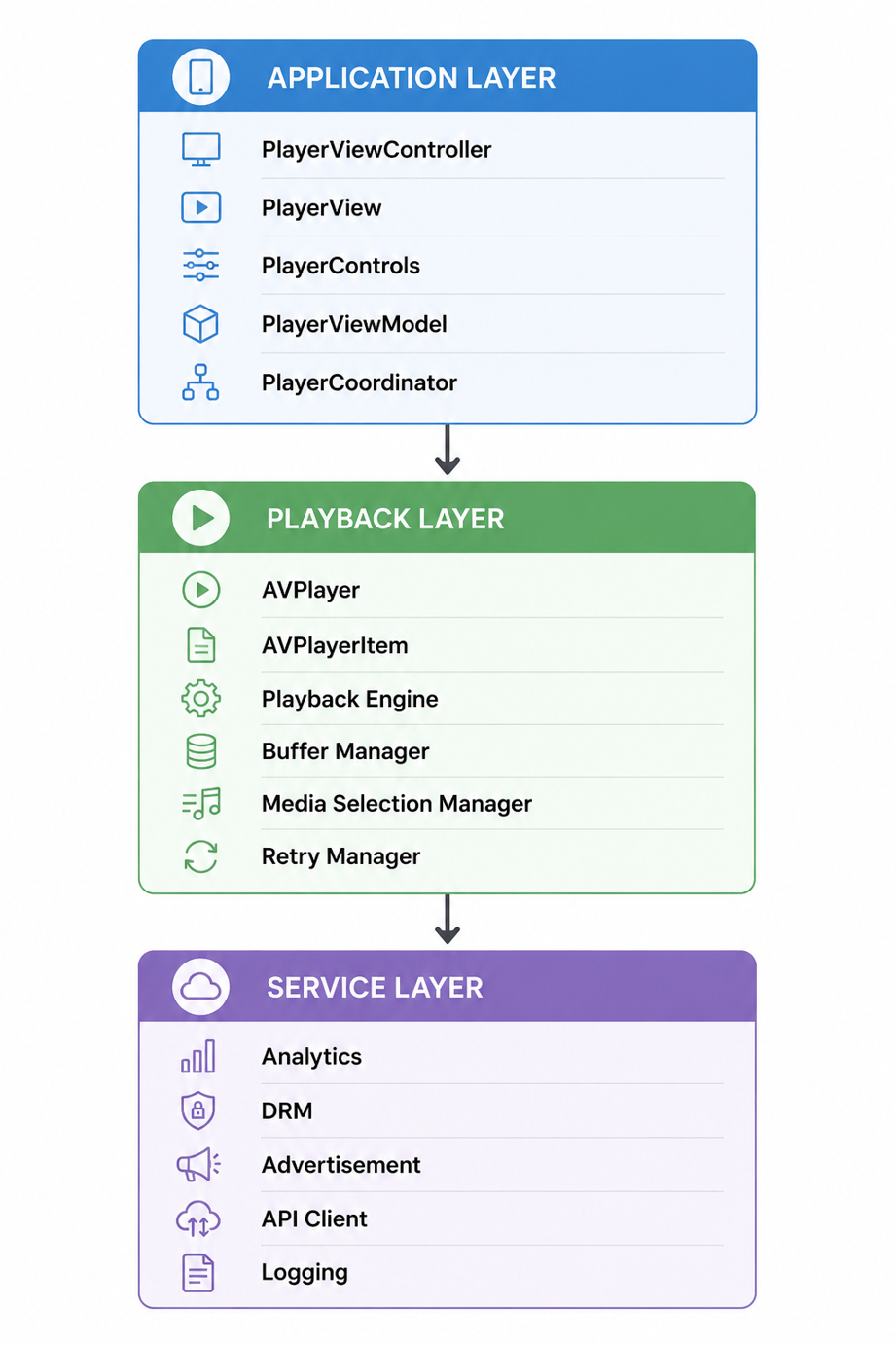
Scalable Player Architecture
Why this architecture?
By clearly separating concerns, each layer can evolve independently with minimal impact on the others. This approach enhances code reusability, simplifies debugging, enables easier feature additions, and results in a scalable, production-ready OTT player that is easier to maintain over time.
Leveraging AVFoundation Effectively
At the core of every custom OTT player lies AVFoundation, Apple’s powerful multimedia framework that provides the building blocks for high-performance audio and video playback. Rather than relying on AVPlayerViewController, a custom player composes several AVFoundation components to create a flexible and scalable playback pipeline. Each component has a distinct responsibility, working together to deliver a seamless streaming experience.
AVFoundation Playback Architecture
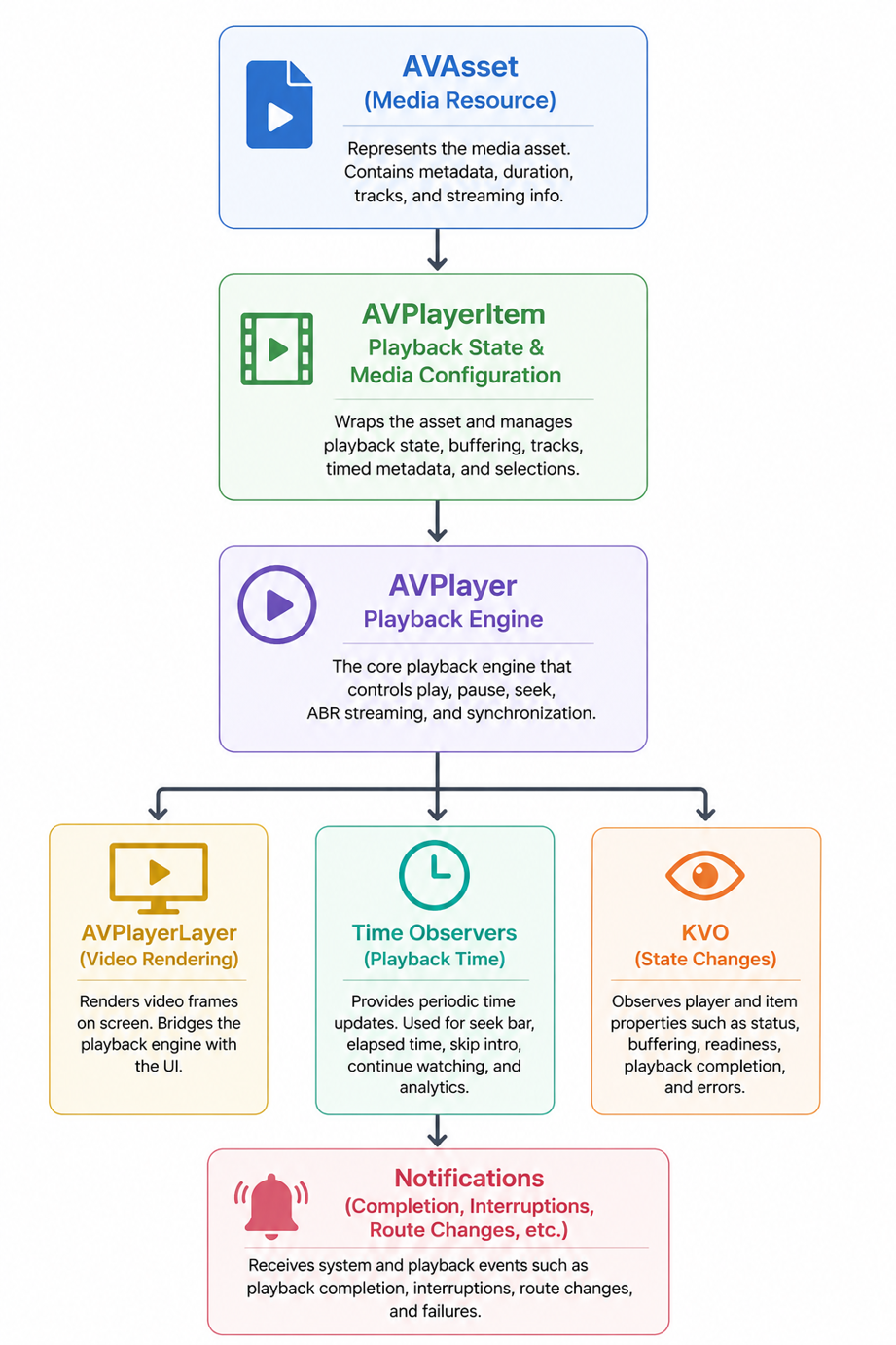
AVFoundation Playback Architecture
Designing a TV-Optimized Experience
Unlike mobile devices, Apple TV is designed for a lean-back, big-screen viewing experience, where users interact with content from across the room using the Siri Remote. This requires a UI that prioritises simplicity, readability, and effortless navigation. Leverage tvOS’s focus engine to create intuitive focus-based navigation with smooth animations and clearly visible focus states. Design large, remote-friendly controls that are easy to select, minimise on-screen overlays to keep the content front and centre, and automatically hide playback controls when inactive. Use large typography, high-contrast visuals, and reduce the number of interaction steps to ensure a comfortable, immersive viewing experience that feels natural on television.
Implementing Production-Grade Playback Features
A production-grade OTT player goes beyond basic video playback by supporting features such as Play/Pause, Seeking, Fast Forward/Rewind, Playback Speed, Resume Playback, Live Stream, Picture in Picture (PiP), Background Playback, and Buffer Monitoring. These capabilities should be designed as modular playback components rather than being tightly coupled to the UI. A scalable architecture makes it easier to extend functionality, maintain code, and deliver a smooth, reliable streaming experience as product requirements evolve.
Supporting OTT-Specific Features
Modern OTT platforms differentiate themselves through personalised and intelligent playback experiences that go beyond standard media controls. Features such as Continue Watching, Skip Intro, Skip Credits, Episode Autoplay, Up Next recommendations, Playback Bookmarks, Watch History, and Chapter Navigation work closely with the playback engine and backend services to deliver a seamless viewing journey. A well-architected player keeps these business-driven features separate from the core playback logic, making them easier to maintain, extend, and customise as product requirements evolve.
Integrating Analytics and Advertisements
Analytics and advertisement workflows are essential components of any production-grade OTT player, providing valuable insights into user behaviour and enabling content monetisation. The player should generate analytics events such as Play, Pause, Seek, Buffering, Startup Time, Playback Completion, and periodic Heartbeat events to measure playback quality and engagement. Likewise, advertisement modules should support SSAI, SCTE markers, Pre-roll, Mid-roll, and Ad Tracking without interfering with core playback functionality. By keeping analytics and advertisement services independent from the playback engine, the architecture remains modular, easier to maintain, and flexible enough to integrate new analytics providers or ad platforms with minimal changes to the core player.
Optimising Performance and Reliability
Delivering a smooth OTT experience requires more than feature-rich playback—it demands a strong focus on performance and reliability. Optimisations such as efficient observer management, buffer tuning, player reuse, and memory management help reduce resource consumption and ensure responsive playback. Techniques like thumbnail caching, adaptive bitrate streaming (ABR), network resilience, silent retry mechanisms, and robust error recovery minimise playback interruptions and improve the viewing experience under varying network conditions. By incorporating these optimisations into the player architecture, developers can build a resilient, high-performance streaming solution that consistently delivers a seamless user experience.
Best Practices for Building a Custom OTT Player
- Separate playback logic from the UI to improve maintainability and enable independent feature development.
- Prefer composition over monolithic player classes by organising functionality into reusable, single-responsibility components.
- Centralise player state management to ensure consistent playback behaviour across the application.
- Manage observers and listeners carefully to prevent memory leaks and unnecessary resource consumption.
- Design reusable playback modules that can be extended without affecting the core player architecture.
- Optimise for tvOS interactions with focus-based navigation, remote-friendly controls, and minimal user actions.
- Keep analytics and advertisement services decoupled from the playback engine for easier integration and maintenance.
- Test under diverse network conditions to validate buffering, retries, adaptive bitrate streaming, and error recovery.
- Prioritise accessibility by supporting subtitles, multiple audio tracks, audio descriptions, and intuitive remote navigation.
Continuously monitor playback performance using analytics and telemetry to identify issues and enhance the overall streaming experience.
Conclusion
Building a custom OTT player is about creating a viewing experience that goes beyond the capabilities of a standard media player. A well-designed architecture makes it easier to add new features, adapt to changing business needs, and maintain the player as the platform evolves. By combining the power of AVFoundation with tvOS best practices, developers can deliver a seamless, reliable, and engaging streaming experience that meets the expectations of today’s OTT users while remaining flexible for future enhancements.