


Introduction
Artificial Intelligence is moving beyond simple prompt-and-response interactions. Earlier AI applications were often built around a single prompt sent to a Large Language Model. The model generated an answer, and the workflow ended there.
That works well for summaries, brainstorming, and content generation. But real enterprise problems often need planning, tool usage, validation, collaboration, governance, and structured outputs.
This is where AI Agents, Agentic AI, and Multi-Agent Systems become important.
CrewAI is a framework that helps developers build these systems in a structured way. Instead of depending on one large prompt, CrewAI allows developers to define specialized agents, assign tasks, connect tools, and orchestrate the workflow like a team.
In this blog, we will understand CrewAI using a practical data engineering example: a Databricks Lineage and Impact Analysis system. This project uses CrewAI agents to interpret schema change requests, analyze lineage evidence, assess risk, recommend next steps, and generate an impact report.
What Are AI Agents?
An AI Agent is an AI-powered system that can reason about a goal, use tools, make decisions, and perform actions to complete a task. A simple LLM responds to a prompt. An AI Agent goes further by interacting with external systems such as APIs, databases, files, search tools, and enterprise platforms.
For example, a normal LLM can suggest restaurants. An AI Agent can search restaurants, check availability, compare ratings, book a table, and send a confirmation. That is the key difference: a normal AI model provides an answer, while an AI Agent helps complete a task.
AI Agents are usually goal-oriented, tool-using, context-aware, decision-making, action-capable, and role-based.
Understanding Agentic AI
Agentic AI refers to AI systems that can plan, reason, coordinate, use tools, and execute multi-step workflows with a higher level of autonomy.
It is broader than a single AI Agent. One agent may complete a specific task, but Agentic AI usually involves a larger system where one or more agents work together toward a bigger goal.
For example, a data engineering team may ask:
“If we drop this column from a Databricks table, what downstream tables, jobs, and reports will break?”
A simple LLM cannot answer this reliably because it does not know the organization’s live Databricks metadata or lineage. An Agentic AI system can interpret the request, retrieve metadata, analyze lineage, assess risk, and generate recommendations.
Multi-Agent Systems
A Multi-Agent System is an AI setup where multiple specialized agents work together to complete a larger goal. Instead of one agent handling everything, each agent focuses on a specific responsibility such as planning, research, validation, analysis, or recommendation. This makes the workflow more organized, scalable, and easier to maintain. In CrewAI, multi-agent systems are useful because agents can collaborate through structured tasks and produce more reliable outcomes.
What Is CrewAI?
CrewAI is an AI agent framework used to build role-based Multi-Agent Systems.
The core idea is simple: Instead of asking one AI model to do everything, define a team of specialized agents and let them collaborate through structured tasks.
CrewAI is beginner-friendly because its concepts are easy to understand. Agents are workers, tasks are assignments, tools provide external capabilities, crews bring agents together, and processes define how work flows.
Developers use CrewAI to build structured AI workflows, separate responsibilities across agents, connect agents to tools, and make workflows easier to explain and maintain.
Core Concepts of CrewAI
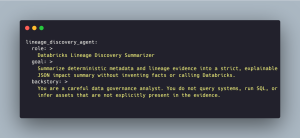
1. Agents
An Agent is a role-based AI worker responsible for a specific type of task. In CrewAI, an agent is not a generic chatbot. It has a clear role, goal, background, and responsibility.
For example, one agent may act as a Lineage Discovery Agent, while another may act as a Risk Assessment Agent. Each agent focuses on one part of the workflow instead of solving everything alone.
2. Tasks
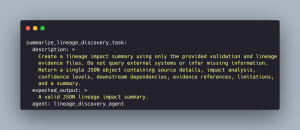
A Task is the work assigned to an agent. If the agent is the worker, the task is the assignment.
A task defines what needs to be done, what information should be used, and what output is expected. This makes AI workflows more predictable and easier to validate.
3. Tools
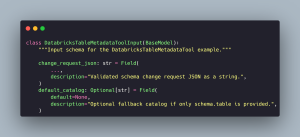
A Tool is an external capability that an agent can use to complete a task. Tools allow agents to interact with APIs, databases, files, search engines, Python functions, or platforms like Databricks.
Without tools, agents are mostly limited to the information already provided in the prompt.
4. Crews
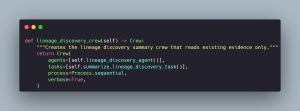
A Crew is a collection of agents and tasks working together toward a shared goal. It represents the team structure in CrewAI.
In a crew, each agent has a role, and each task has a purpose. The crew brings them together and defines how the work should be completed.
For example, a Databricks Impact Analysis Crew may include a Query Interpreter Agent, Lineage Discovery Agent, Risk Assessment Agent, and Recommendation Agent.
5. Processes
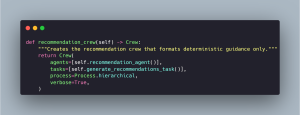
A Process defines how tasks are executed inside a crew. In a sequential process, tasks run one after another, which is useful when each step depends on the previous step. In a hierarchical process, a manager agent or manager LLM coordinates the workflow, decides which agent should work next, and manages task delegation. This is useful for more complex workflows where the execution path may change based on intermediate results.
Real-World CrewAI Project Overview
The project discussed here is a CrewAI-powered Databricks Lineage and Impact Analysis system.
It solves a common data engineering problem: when a table, column, schema, or data type changes in Databricks, teams need to quickly understand which downstream assets may be affected.
Schema changes can impact downstream tables, ETL jobs, PySpark transformations, reports, data quality checks, and business metrics. Manual impact analysis is often slow and error-prone because engineers must inspect lineage, review dependencies, check SQL logic, and coordinate with multiple teams.
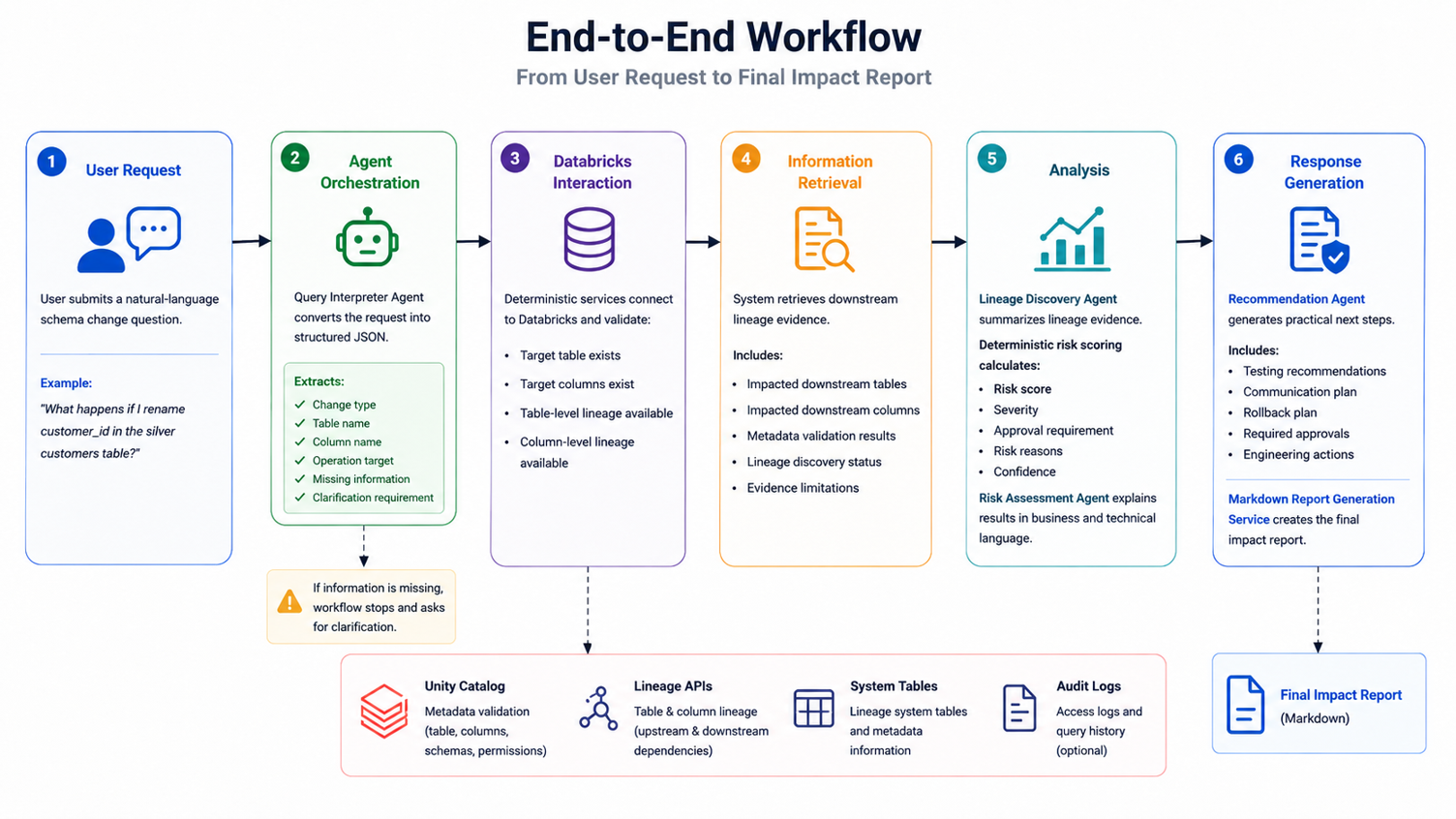
This project reduces that effort by combining CrewAI with Databricks. CrewAI was chosen because the workflow naturally separates into responsibilities such as request interpretation, metadata validation, lineage discovery, risk assessment, recommendations, and report generation.
High-Level Architecture
Agents Used in the Project
1. Query Interpreter Agent
The Query Interpreter Agent converts the user’s natural-language schema change request into a structured format.
For example, if the user asks:
“What happens if I drop the customer_email column from the silver_customer table?”
The agent extracts details such as change type, table name, column name, catalog, schema, and whether clarification is required. This prevents ambiguity from flowing into later steps. If key information is missing, the workflow can stop early and ask the user for clarification.
2. Lineage Discovery Agent
The Lineage Discovery Agent converts raw lineage evidence into a clear impact summary.
It does not call Databricks directly and does not invent dependencies. Deterministic services first retrieve table-level and column-level lineage from Databricks. The agent then summarizes the results.
Its output includes impacted downstream tables, impacted downstream columns, affected source columns, evidence references, and limitations.
3. Risk Assessment Agent
The Risk Assessment Agent explains the risk associated with the proposed schema change.
The risk score is calculated by a deterministic service. The agent does not compute or modify the score. It explains the result in business and technical language so stakeholders can understand why a change is low, medium, high, or critical risk.
4. Recommendation Agent
The Recommendation Agent converts deterministic decision guidance into practical next steps.
It may recommend testing dependent jobs, notifying downstream owners, validating dashboards, preparing rollback steps, or getting approval before deployment.
This agent helps turn analysis into action.
How Databricks Was Used
Databricks is central to the project because the system needs real metadata and lineage evidence.
An LLM cannot reliably know which tables, columns, and downstream assets exist in a live Databricks environment. That information must come from Databricks itself.
The system uses Databricks for table metadata validation, column metadata validation, table-level lineage discovery, and column-level lineage discovery.
Deterministic services interact with Databricks, retrieve factual evidence, and write outputs that agents can read. This makes the workflow more reliable, auditable, and production-friendly.
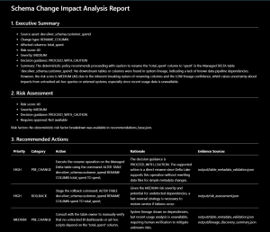
Output Format
Benefits of Using CrewAI
- CrewAI is useful here because the problem requires multiple focused responsibilities.
- The main benefits are better separation of concerns, clearer agent responsibilities, easier debugging, reduced hallucination risk, more explainable outputs, faster impact analysis, better governance, and a more maintainable architecture.
- Instead of using one large prompt, the project uses specialized agents and deterministic services together.
Conclusion
- CrewAI provides a practical way to move from simple LLM interactions to structured Agentic AI systems.
- For beginners, its biggest strength is the mental model. Agents have roles, tasks define assignments, tools provide capabilities, crews organize the work, and processes control execution.
- The Databricks Lineage and Impact Analysis project shows how this works in a real data engineering scenario. Instead of relying on one large prompt, the system uses multiple agents and deterministic services to interpret schema changes, retrieve lineage evidence, assess risk, recommend actions, and generate a clear impact report.
- The most important learning is that agents should not replace reliable systems of record. They should work with them.
- That balance is what makes Agentic AI useful in enterprise workflows.