


Hook: Experience vs Content
Today, content is everywhere. Movies, shows, reels, podcasts, live streams—audiences are overwhelmed with choices across platforms. The problem is no longer content availability; it’s content discovery and OTT user experience.
Modern media platforms are not competing on content libraries alone anymore—they are competing on OTT personalization and user experience. This is why platforms like Netflix, Amazon Prime Video, and Disney+ invest heavily in AI-driven personalization, recommendation engines, and intelligent content discovery systems.
Here’s the reality: users don’t return for content alone; they return for the experience of discovering the right content effortlessly.
If users can’t find something they love within 30–60 seconds, they don’t keep searching. They leave.
This is choice paralysis—and it’s one of the biggest drivers of churn in streaming platforms.
At its core, OTT personalization is about reducing friction between user intent and content discovery.
GenAI is not just improving recommendations; it is transforming how users discover, explore, and interact with content. From AI-generated summaries and voice search to hyper-personalized homepages and multilingual content experiences, GenAI is becoming the core engine behind next-generation media platforms. In simple terms, Generative AI is the technology that turns content platforms into experience platforms.
The problem: Content discovery is broken
For years, media companies focused on quantity. “More is better,” the thinking went. But today, we are drowning in content. The irony is that the more options we have, the harder it is to choose.
Many users feel like they spend too much time searching instead of watching—a key symptom of poor discovery design in OTT platforms.
- Endless scrolling
- Repetitive recommendations
- “Continue Watching” clutter
- Irrelevant suggestions
This leads to one thing: fatigue.
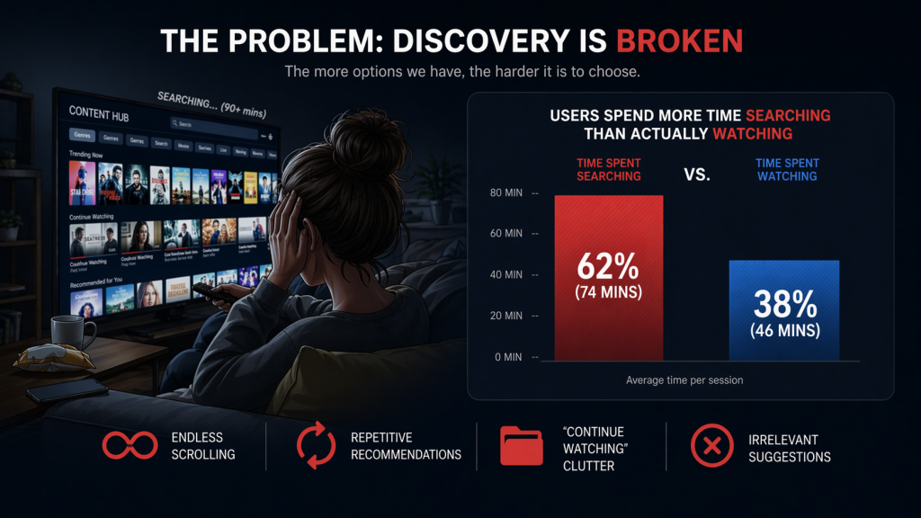
USERS SPEND MORE TIME SEARCHING THAN ACTUALLY WATCHING
When users can’t quickly find something they love, they leave.
Not because your content is bad—but because they couldn’t discover it.
Myth: Personalization is solved
You might think, “Wait, don’t we already have ‘Recommended for You’ rows?” Yes, but most of those systems are reactive. They look at what you clicked yesterday and show you more of the same. It’s basic math, not true understanding. If you watched one documentary about bees, you’re stuck with insect videos for a month. That’s not personalization; it’s a loop.
But let’s be real—this is basic personalization, not true personalization.
This worked before. But today’s users expect more.
The strategic shift: from ML to GenAI
Standard Machine Learning (ML) is great at recognizing patterns, but GenAI is great at understanding context.
Traditional ML answers: “What did the user watch before?”
GenAI goes further: “What does the user feel like watching right now?”
The following table breaks down why this shift is the “secret sauce” for modern retention:
| Capability | Traditional Machine Learning (ML) | Generative AI (GenAI) |
| Logic | Reactive: “You watched X, so you might like Y.” | Contextual: “You’re in the mood for X, but only have 20 minutes. |
| Data Source | Historical clicks and viewing logs. | Real-time intent, deep metadata, and conversational cues. |
| Discovery Style | Passive rows and “More Like This” lists. | Active journeys (Dynamic UI, AI summaries, Voice chat). |
| The “Cold Start” | Fails; needs weeks of data to rank new content. | Succeeds; AI “understands” new content instantly. |
| User Feel | Predictable and often repetitive (The “Loop”). | Intuitive, fresh, and highly empathetic. |
Solving the “Cold Start” Problem
One of the biggest pain points for media companies is the Cold Start Problem: how do you recommend a brand-new show that has zero viewing history?
Traditional systems fail here because they rely on historical user data. GenAI fixes this through Deep Metadata Enrichment. AI “watches” the new content, indexing every emotional beat, visual style, and plot nuance. It can then match a brand-new release to a user’s specific taste profile instantly, ensuring new hits don’t gather digital dust.
What “Netflix-Level” really means in the GenAI era
When enterprises talk about “Netflix-level personalization,” they often reduce it to recommendation engines. That is a fundamental misunderstanding. Recommendation algorithms are only one layer of the personalization stack. True OTT personalization operates across the entire digital experience layer – UI, content discovery, artwork, metadata, and engagement workflows.
Companies like Netflix have built personalization as a system-wide architecture, not a feature. It is embedded into the platform’s data pipelines, AI models, content metadata systems, and front-end experience delivery.
In practical terms, “Netflix-level personalization” means the platform dynamically adapts to each individual user, not just through recommendations but through the entire interface and discovery journey.
What This Actually Includes
- Dynamic Homepages: Every user sees a different homepage based on viewing history, watch time, search behavior, genre affinity, and even time-of-day consumption patterns.
- Personalized Artwork and Thumbnails: Artwork changes based on user preference. For example, if a user watches more romantic content, a movie thumbnail may show a romantic scene, while another user may see an action scene for the same movie.
- Personalized Trailers and Previews: Trailers, thumbnails, and titles are optimized per user segment using AI models that predict what type of preview will maximize engagement.
- Intelligent Content Discovery: Search, recommendations, categories, and rows are dynamically generated so that discovery feels effortless rather than overwhelming.
- Continuous Learning Systems: The platform continuously learns from user interactions; clicks, scroll behavior, watch duration, drop-off points, and updates recommendations in near real time.
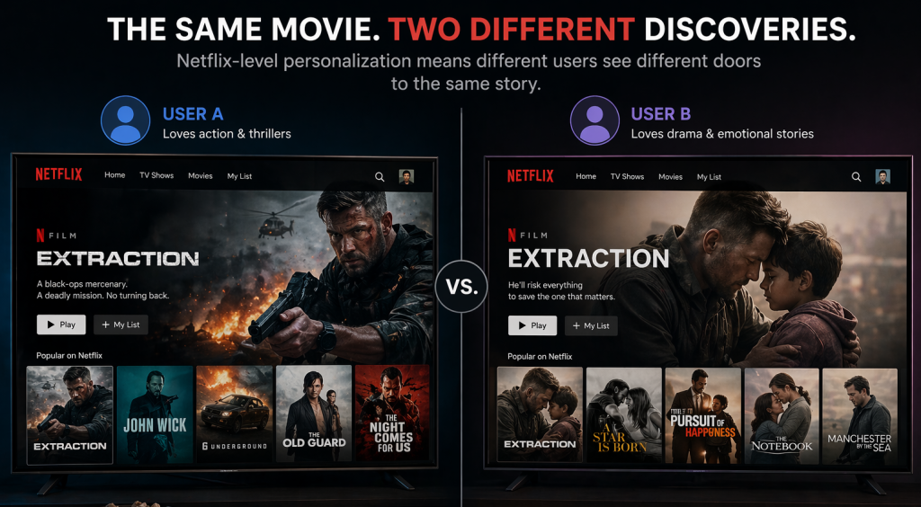
OTT personalization with different homepages for different users based on viewing behavior
The objective is not just personalization for the sake of personalization. The goal is very specific:
Make the right content to find the user, without the user having to search for it.
This reduces choice paralysis, increases watch time, improves retention, and ultimately drives subscription lifetime value (LTV).
Where GenAI fits in your stack
You don’t need to rebuild from scratch. GenAI acts as the “brain” on top of your existing library:
- Metadata Enrichment: AI “watches” your videos and tags them with deep emotional cues (e.g., “bittersweet,” “nostalgic,” “high-tension”).
- Dynamic UI: Changing the layout of your app based on the time of day or user mood.
- Conversational Search: Instead of typing “Horror,” a user can say, “Show me something spooky but okay for a 10-year-old.”
Business impact
The math is simple: Better Personalization = Lower Churn.
This is not just a tech upgrade—it’s a revenue move.
Better personalization leads to:
- Higher watch time
- Better engagement
- Subscription retention
- Ad revenue (more relevant targeting)
And most importantly: Users feel like the platform “gets them.”
That’s how loyalty is built.
Challenges & reality check
It’s not all magic. There are hurdles to clear:
- Data Privacy: You need to personalize without being “overly invasive.”
- AI Hallucinations: You don’t want an AI recommending a TV-MA or R-rated drama in a “Family Movie Night” collection.
- Costs: Running massive AI models requires a smart budget and the right tech partners.
The future of media personalization
We are moving toward a world where the “Main Menu” doesn’t exist. Instead, the moment you open an app, it starts playing exactly what you need. The media won’t just be something you watch; it will be an experience that understands you.
The “Netflix-level” bar has been raised. The question is: Is your media empire ready to jump?
Final thought
The streaming wars are no longer fought with content budgets alone—they are defined by OTT personalization and experience engineering. Every major platform now has exclusive releases and global reach. The real differentiator has shifted: it’s no longer about what users watch, but how they feel while finding it.
Platforms that rely only on traditional recommendation engines risk feeling outdated compared to AI-powered ecosystems that understand intent, mood, and context in real time.
The “Netflix-level” bar has been raised. Is your media empire ready to stop being a library and start being an experience?