


If you’ve been working with Salesforce Marketing Cloud for a few years, you’ve probably noticed the platform is going through a significant change. For a long time, the toolkit was familiar: Data Extensions, SQL, Automation Studio, Journey Builder, AMPscript, SSJS, CloudPages, and APIs. That model is still very much alive. But Salesforce is now moving toward Marketing Cloud Next, with a much stronger connection between marketing, Salesforce CRM, Data 360, Flow, AI, and multiple engagement channels.
Marketing Cloud is becoming more connected to Salesforce
From my perspective, this isn’t about throwing away everything we know about SFMC. It’s about expanding the platform and changing where some of the work happens.
One of the biggest changes is the move toward a much more connected Salesforce ecosystem. In a traditional implementation, data comes from several places, and a lot of development effort goes into getting the right data into the right Data Extension at the right time.
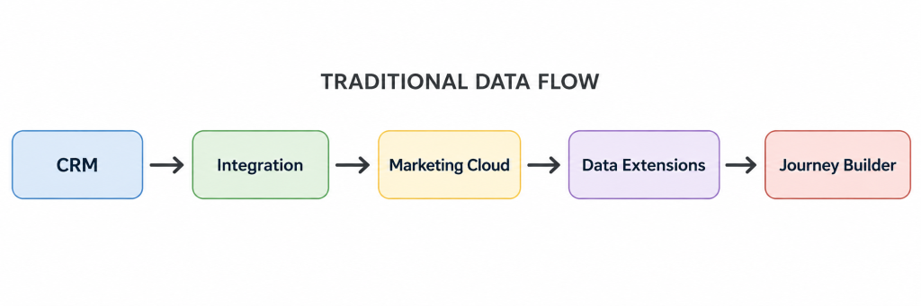
Marketing Cloud is becoming more connected to Salesforce.
In a large enterprise, there may be more systems: data warehouses, APIs, S3 files, membership systems, websites, and other marketing platforms. Marketing Cloud Next moves toward a model where Salesforce CRM and Data 360 play a much bigger role in providing a unified view of the customer.

Data Extension.
That’s a far more architectural way of thinking about marketing automation than most of us are used to.
Data Extensions are not suddenly going away
There’s sometimes an assumption that Marketing Cloud Next means Data Extensions, SQL and AMPscript stop mattering. I don’t see it that way; existing SFMC skills still matter. What changes is that we get more options for how customer data is stored, unified, and used.
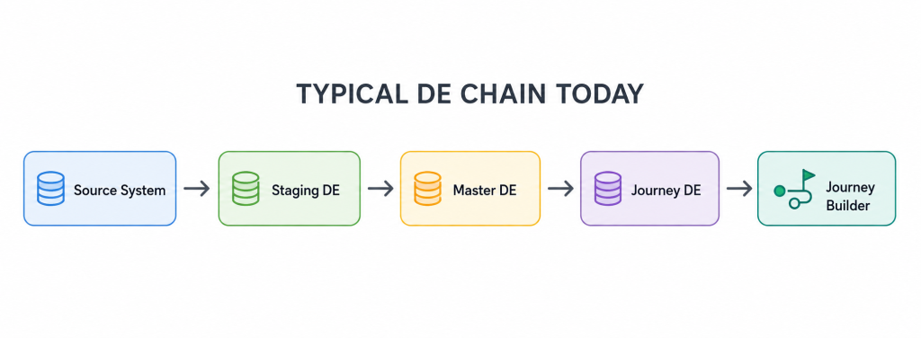
Data Extensions are not suddenly going away.
This works, but it also creates a lot of duplicated data and maintenance. As the ecosystem gets more connected, better questions become possible:
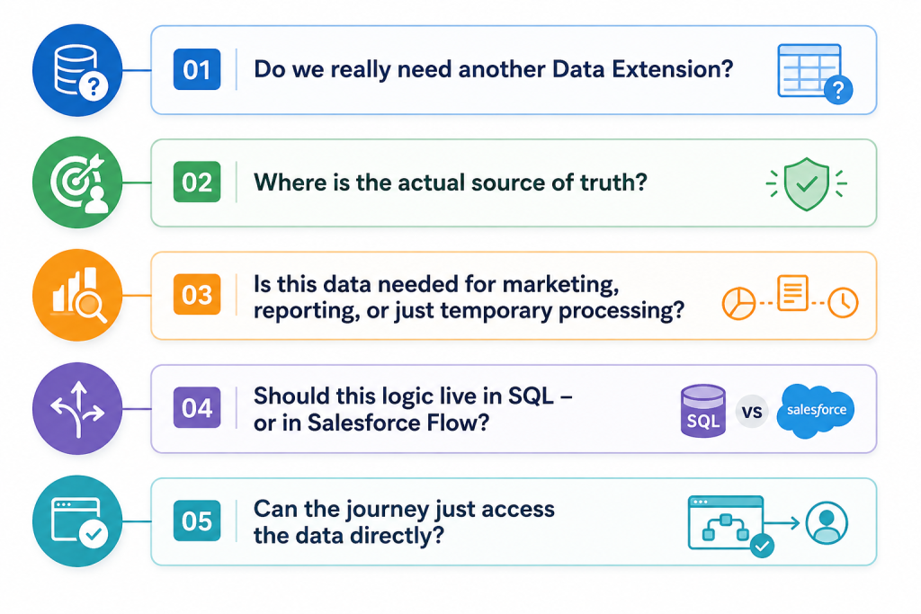
Questions become possible.
From my perspective, this isn’t about throwing away everything we know about SFMC. It’s about expanding the platform and changing where some of the work happens.
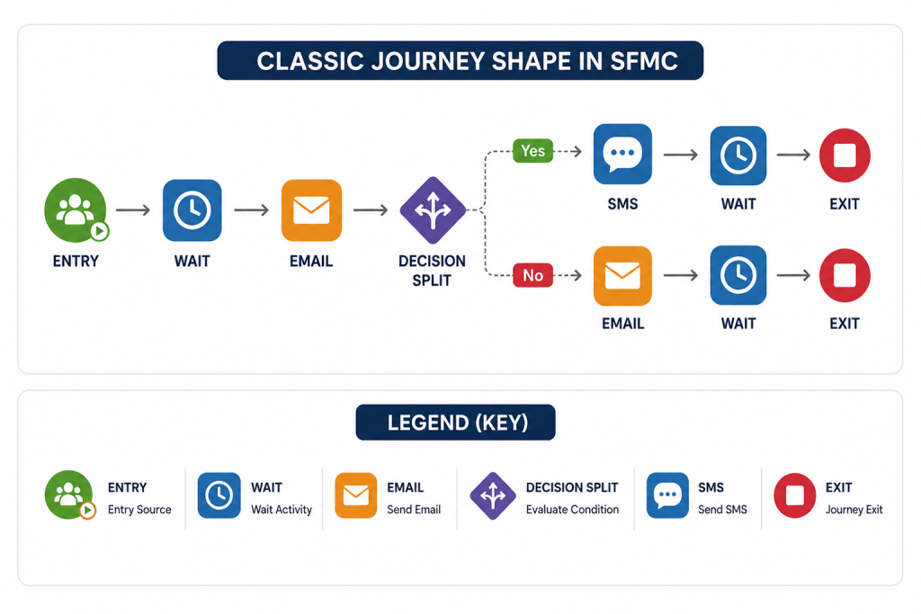
Journey Builder is no longer the only orchestration option.
But Salesforce is expanding the orchestration layer, with stronger ties to Salesforce Flow and event-based processes. That means we should stop treating every marketing requirement as automatically a Journey Builder requirement. A simple business process may be better handled in Flow, while a multi-step marketing campaign may still be a perfect fit for Journey Builder. The real skill is knowing which tool should own the logic.
Email is no longer the centre of the marketing strategy
Traditional SFMC implementations are often heavily email-focused; we build an email, add SMS as another activity, and build the campaign around those channels. Marketing Cloud Next moves toward a genuinely omnichannel approach: email, SMS, WhatsApp, RCS, mobile, web, and conversational experiences. This is especially relevant across markets like India, where WhatsApp and SMS are already central to customer communication.
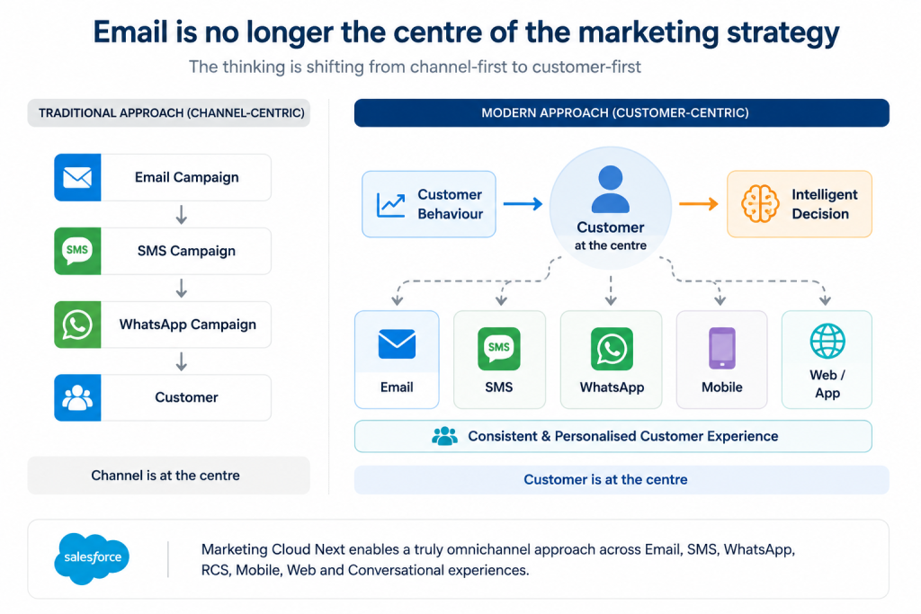
Email is no longer the centre of the marketing strategy.
The customer sits at the centre now, rather than the channel.
AI is moving from assistant to worker
This is the part that gets the most attention, but it’s worth looking past AI-generated subject lines. Salesforce is moving toward Agentforce and agentic marketing, where AI assists with campaign planning, segmentation, content creation, personalization and optimisation across a process that today looks like this:
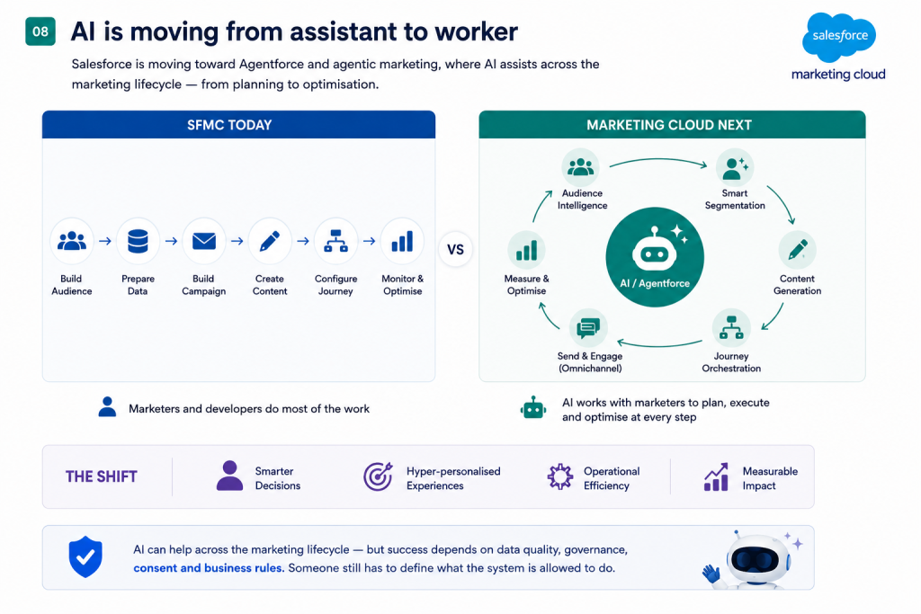
AI is moving from assistant to worker.
AI can increasingly help with several of these. But that doesn’t make developers unnecessary; if anything, the opposite. When AI starts making decisions from customer data, data quality, governance, consent, and business rules matter more, not less. Someone still has to define what the system is allowed to do.
What happens to AMPscript, SQL and SSJS?
My view is simple: don’t stop learning the skills you already use; expand them.
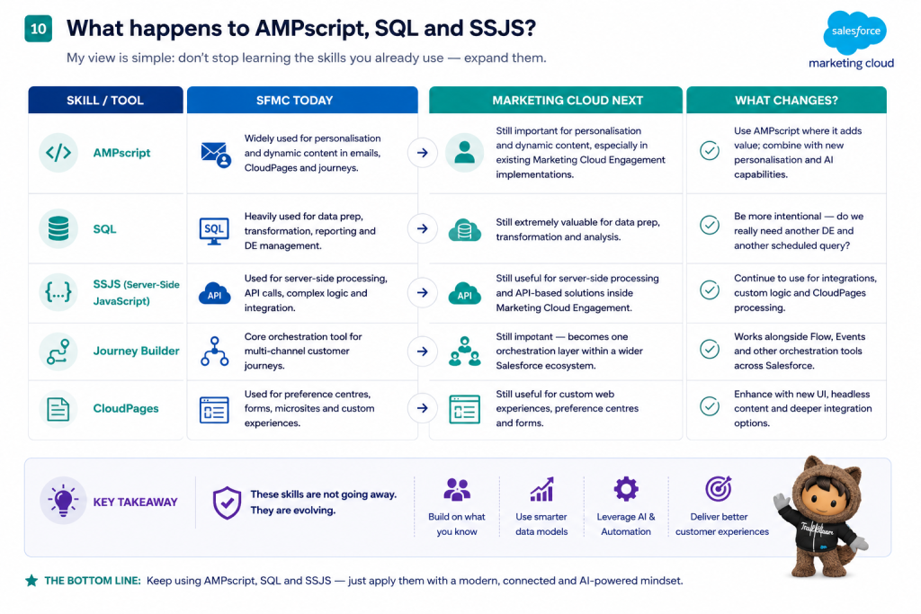
What happens to AMPscript, SQL and SSJS?
What this means for an existing SFMC implementation
Say your org runs 5 Business Units, 50+ journeys, hundreds of Data Extensions, SQL automations, custom preference centers, AMPscript-heavy emails, SMS, external integrations, and reporting dashboards. I would not rebuild any of that just because Marketing Cloud Next exists; that introduces unnecessary risk. Start with an inventory instead:
- Data: Where does it come from, what’s the source of truth, and how many copies exist?
- Journeys: Which are business-critical, which are outdated, and which carry excessive custom logic?
- Automations: Which SQL queries are genuinely required?
- Consent: Where is it stored, and how does unsubscribe work across brands and channels?
- Content: How much is duplicated?
- Reporting: Can engagement be connected to real business outcomes?
Then pick a real problem to solve. Not “let’s migrate Marketing Cloud” or “let’s modernise our win-back journey.” That gives you a manageable, measurable starting point.
So, what has actually changed?
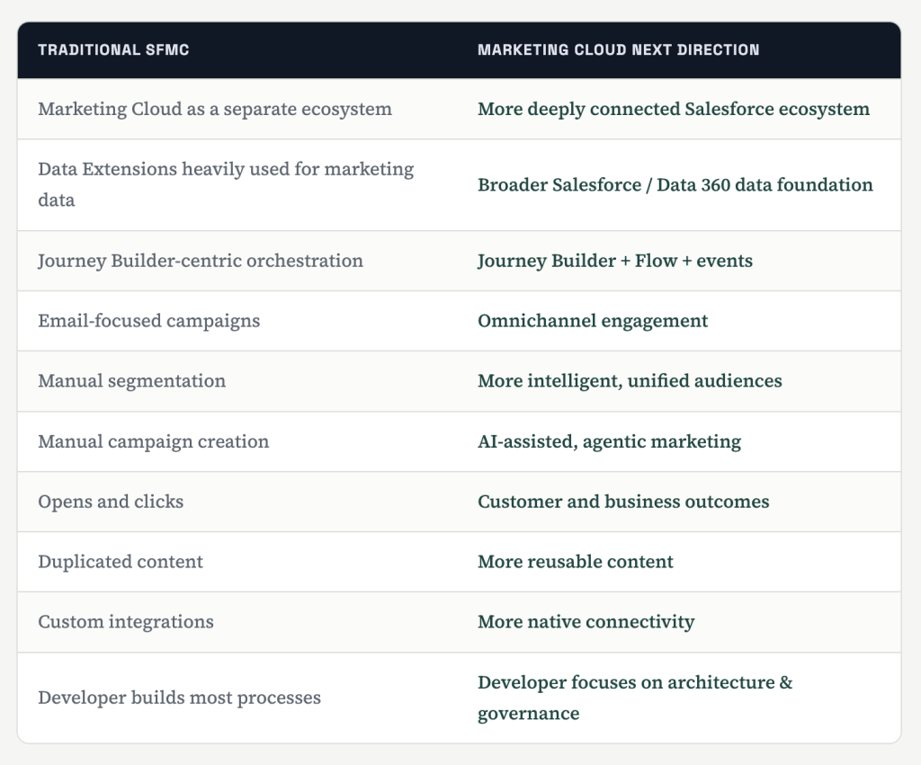
So, what has actually changed?
Final thoughts
I don’t think Marketing Cloud Next should be read as “the old SFMC is finished”. For organisations with mature Marketing Cloud environments, that framing creates more confusion than value. I see it instead as the next stage of the Salesforce marketing ecosystem; the fundamentals haven’t changed.
What’s changing is the technology around those fundamentals.
Marketing is becoming more connected to CRM data, more omnichannel, more automated, and increasingly AI-driven. For SFMC professionals, that means our skill set needs to grow with it, not abandon AMPscript, SQL, Journey Builder, or Data Extensions, but understand when to use them, when not to, and how they fit into the larger Salesforce architecture.
That, to me, is the real story behind Marketing Cloud Next. It isn’t simply a new version of Marketing Cloud; it’s a move toward a more connected model where data, marketing, AI, orchestration, and customer experience work together. For people who’ve already spent years with SFMC, that’s actually a good place to be. We already understand the marketing problems. Now we get to learn the next layer of technology that solves them.