


Introduction
If you are a Project Manager, your daily routine most likely is full of decisions, which are then followed by more decisions.
- What tasks should be prioritized today?
- Are we to accept this change request?
- Should this risk be escalated now or monitored?
- Do we push the release or wait?
Each decision considered separately, may appear as small ones. However, they collectively are a huge drain on mental energy. At the end of the day, even simple choices become hard to make. This is decision fatigue, which almost every PM encounters, without even realizing it in most cases.
Fortunately, decision fatigue has nothing to do with one's abilities or competence. It is about mental overload. And by using some practical changes, it can be controlled pretty well.
What decision fatigue looks like in a PM’s daily life
Decision fatigue doesn’t announce itself loudly. It shows up quietly in ways such as:
- Delaying decisions you would normally make quickly
- Overthinking even minor issues
- Feeling mentally drained even after productive days
- More frequent than usual use of the phrase “let’s discuss later”
- Choosing safe options only in order to avoid debate
For instance, a PM might be very efficient in running the sprint planning in the morning, however, by the evening, they may feel reluctant to respond to a straightforward request from a stakeholder, not because it is complicated, but because there is a lack of mental energy.
Now, let's take a look at some of the ways to reduce decision fatigue in our day to day decision making.
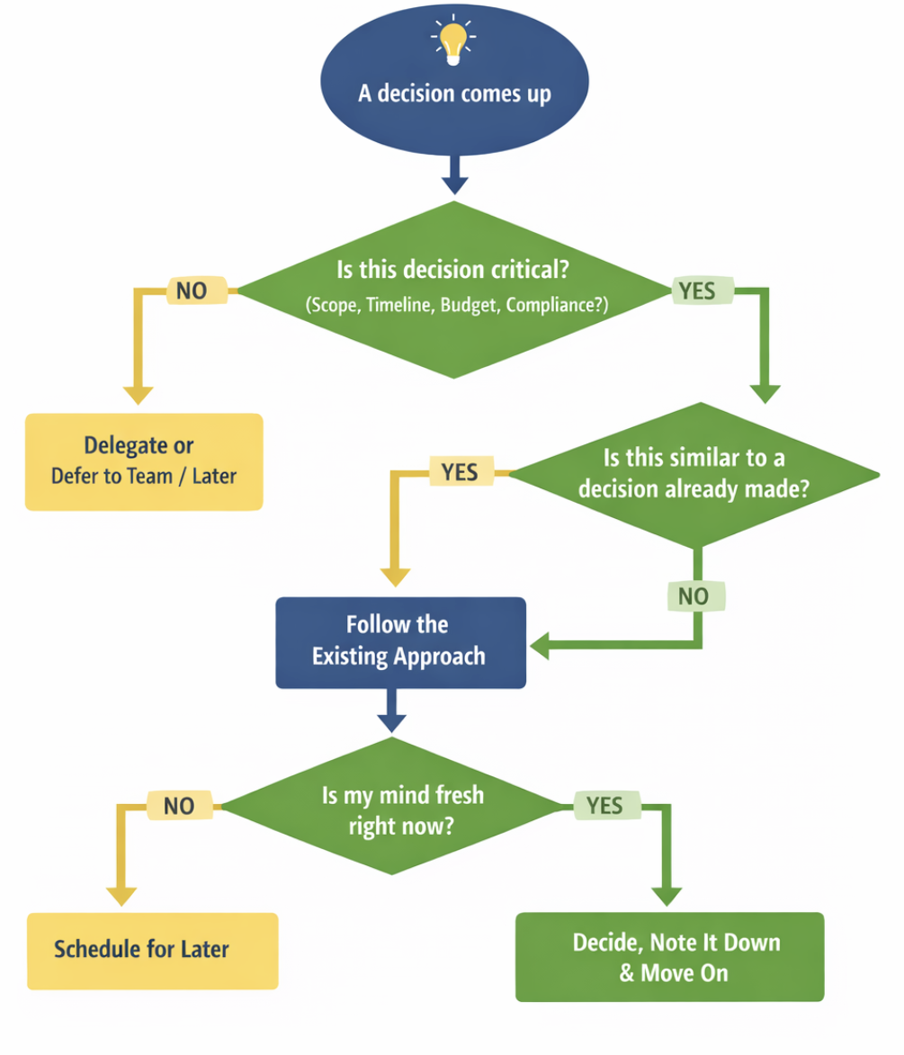
Reduce the number of decisions you personally handle
It is not necessary for a PM to be involved in every decision. A lot of PMs consider themselves responsible for making the right choice in every aspect of the project. This, gradually, becomes very tiring and needless.
So, instead:
- Helping the team leads to make the decisions regarding the execution of the routine work
- Relying on the experts for the technical or design-related decisions
- Getting involved only when decisions impact the scope, timelines, budget, or compliance
For instance, a PM instead of being engaged in each minor backlog alteration, is greatly involved in delivery risks and stakeholder alignment. The fewer decisions you have, the better your decisions will be.
Stop re-deciding the same things again and again
Some decisions return to you time after time in different projects or phases. Every time you reconsider them, you spend mental energy.
A very simple way is to decide once and stick to it unless circumstances change.
Examples:
- Minor changes in the scope will be deferred to the next sprint
- Input provided after signing will not be included in the current release
- Non-critical risks will be assessed weekly instead of daily
When expectations are set clearly, neither you nor your stakeholders have to spend time arguing the same topics over and over again.
Make important decisions when your mind is fresh
Not all hours in the day are equal. Most people are more productive in the morning and feel exhausted by the evening. Still, a lot of PMs make their hardest decisions late in the day after having back-to-back meetings.
A little change makes the difference:
- Dealing with complex or sensitive decisions early in the day
- Using the remaining hours for follow-ups, reviews, and communication
- Not finalizing major decisions when you are already worn out
This simple habit significantly improves clarity and reduces regret from rushed decisions.
Write things down to clear mental space
Trying to keep in your memory all assumptions, risks, and discussion outcomes only adds to your mental load.
Support your brain by externalizing information:
- Writing the reasons for a decision
- Noting the trade-offs discussed with the stakeholders
- Keeping simple notes of key choices
Subsequently, when the questions come up, you cannot rely on memory or reevaluate the situation as you have the answers at hand. This lowers the pressure and prevents unnecessary doubting.
Accept that “good enough” is often enough
A lot of PMs strive for the perfect decision. Most project decisions, in fact, don’t require perfection, they only need to move forward.
Frequently waiting for full clarity only causes delaying the movement more than it actually improves results.
For instance, picking a fairly good vendor today and having clear review points is more advantageous than putting the project on hold for weeks in the quest for the “best” option.
Progress is what really helps to reduce mental fatigue rather than continuous analysis.
Remember: Not Deciding Is Also a Decision
Decision postponement is still a choice, and quite often the most costly one.
When decisions are delayed:
- Teams slow down
- Uncertainty increases
- PM stress compounds
Sometimes, going ahead with a clear direction, even if it means making adjustments later, is better than being stuck.
Closing thought
Decision fatigue is not a personal failing. It is the natural consequence of being in a position that constantly requires judgment and taking responsibility.
Good Project Managers don’t try to carry the burden of every decision. They make things simpler, focus on what is important and most of all create clarity, both for their teams and themselves.
That is, when you cut down on the unnecessary decisions, your mind becomes clearer, your leadership gets calmer and your projects advance with more confidence.
Doing less work is not the real detox, it is thinking less about things that don’t really need your attention.