


Why Does Enterprise Website Rebranding Matter?
In today’s fast-evolving digital landscape, a website is more than just an online presence - it’s the face of the brand.
Our latest project was about rebranding a client’s website for our business, and it was aimed not only to refresh the visual identity but also to elevate performance, scalability and user engagement. As part of this transformation, we re-engineered the site’s architecture, implemented the new UI, and optimised its overall experience.
Rebranding is often misunderstood as a visual redesign. In reality, it is an opportunity to:
- Align digital presence with evolving brand identity
- Deliver an accessible, modern, and intuitive user experience
- Strengthen technical foundations for omnichannel delivery
- Improve Core Web Vitals, SEO, and content scalability
- Build a reusable design system to accelerate future rollouts
For enterprises, a well-executed rebranding program enables stronger digital performance and reduces long-term maintenance and marketing costs, making it both a strategic and operational investment.
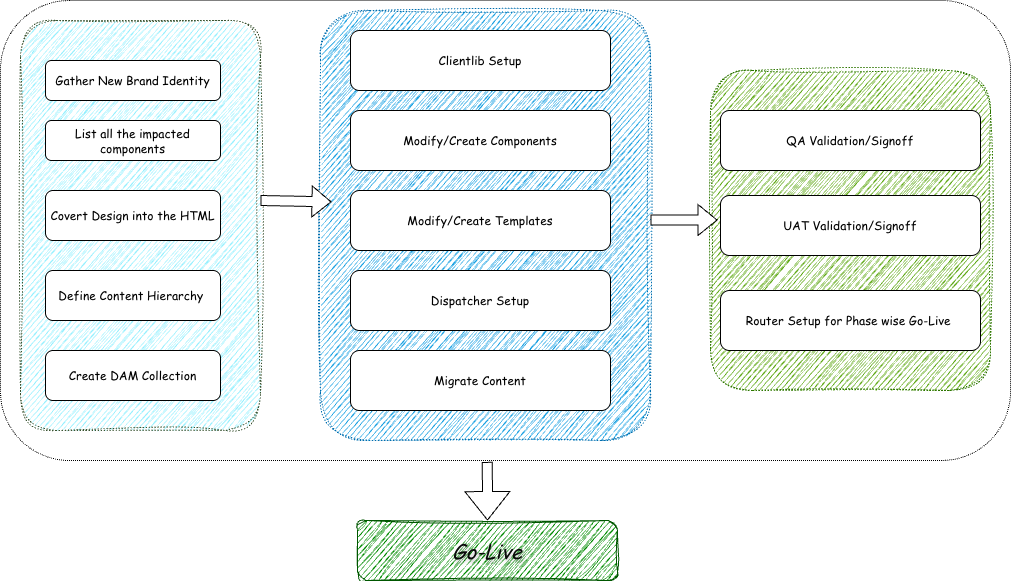
Primary Objectives of the Rebranding
This rebranding was a complete overhaul of our digital platform. The primary objectives were as follows:
- Align the UI with refreshed brand guidelines and identity
- Deliver a modern, responsive, and accessible experience
- Improve page performance and Core Web Vitals metrics
- Build a scalable, component-driven AEM library for future growth
Key Highlights of Rebranding
Revamped User Interface
We collaborated closely with the UX and design team to create an intuitive, visually appealing interface. The new design emphasizes simplicity, accessibility and brand consistency across all devices. We ensured faster rendering and seamless interactivity of all the pages. All pages were built to be fully responsive, ensuring smooth navigation across desktops, tablets and mobile devices.
AEM Component Development
A major part of the project involved building reusable, modular components in AEM. We used Sling exporters to ensure headless content delivery to allow authored data reusability in mobile apps. Adobe Experience Manager (AEM) provides Component first architecture as a base, which ensures that the business team can easily author customized pages without needing developer's intervention.
Key technical improvements included:
- Creation of core component-based custom components
- Enablement of Sling Exporter on each component model
- Use of editable templates
- Use of CDN for faster delivery of the web pages and images
- Configuration driven design updates to reduce code changes for updating the design
Performance Optimization
Website performance is a critical focus for a web property. We conducted multiple rounds of performance audits and implemented the following:
- Lazy-loading for image and videos
- Client-side caching and CDN optimization
- Minified CSS and JS with bundle splitting
These efforts resulted in a significant increase in page load speed, directly improving user engagement and SEO rankings.
SEO and Accessibility Optimisation
We applied best practices into the component design, such as semantic HTML Structure, Metadata configuration and schema markup. Additionally, WCAG 2.1 accessibility standards were adopted, ensuring inclusivity for all users.
Challenges in Enterprise AEM Website Rebranding (and How We Solved Them)
Rebranding a website hosted on AEM is more than just visual changes, it requires alignment of design systems, content structure, components, assets and integrations. Here are some key challenges faced during website rebranding, along with effective mitigation strategies.
| Key Challenge | Impact | Mitigation |
|---|---|---|
| Design-Component Misalignment |
| Adopted Core Components, design tokens, configurable style systems. |
| Content Migration and Structure |
| Automate migration using scripts such as Groovy and use Experience Fragments. |
| Integration and Environment Challenges |
| User Cloud Manager pipelines, regression testing and monitoring tools. |
| SEO and URL Management |
| Conduct pre-launch SEO audits and validate redirect mappings. |
| Performance and Rollout Risks |
| Perform staged rollout and load testing, re-warm dispatcher rules. |
| Testing and Quality Assurance |
| Use Automated test frameworks and tools. |
| Stakeholder and Change Management |
| Use agile sprints with clear UAT checkpoints. |
Key Learnings
Every transformation project comes with multiple challenges. This gives us the opportunity to learn something new. Key learnings from this project are as follows:
- Balancing creative freedom with Component reusability
- Managing Legacy content migration to the new component model
- Ensuring cross-browser and device compatibility for complex UI elements
Our agile delivery model and strong collaboration between Design, Development, QA and Devops teams ensured timely delivery with uncompromised quality.
Outcome and Business Impact
The rebranding delivered measurable improvement across user experience, technical scalability, and operational efficiency:
- Reduced bounce rate significantly
- Faster authoring due to reusable AEM components
- Improved Core Web Vitals (LCP and CLS metrics)
- Enhanced brand perception through responsive, modern design
- Future-ready foundation for personalization and omnichannel delivery
Conclusion
Enterprise rebranding is not a cosmetic overhaul, it is a digital transformation initiative. By adopting a component-driven AEM architecture, embedding accessibility and SEO at the core, and prioritizing performance and scalability, we built a future-proof platform that enables omnichannel growth, faster go-to-market, and a stronger brand experience.
This transformation sets the foundation for upcoming phases in digital innovation, including personalization, headless content delivery, and advanced customer experience optimization.