
The Real Cost of Website Development Services in the USA

The Real Cost of Website Development 
Services in the USA

Khan Mohammed Tabish
By Khan Mohammed Tabish
Oct 17, 2025 6 min read

The Real Cost of Website Development Services in the USA

Why Does Website Development Cost Vary in the USA?

Multiple factors contribute to web development costs, and these can be categorized based on the services an organization provides. The cost of website development in the USA is influenced by multiple factors, including project complexity, team structure, and ongoing maintenance. According to GoodFirms’ 2025 web development cost survey, business websites may cost between $3,000 and $60,000+ depending on features and scale.

To begin, let’s break down the high-level services required to build an end-to-end application.

What Are the Key Phases of Web Development Solutions?

Requirement Processing

A reliable web development company typically invests significant time in multiple rounds of discussions with the client to understand their requirements and the underlying business case fully. This helps them provide better guidance, suggest alternatives, and recommend the most suitable approaches. During the Requirement Processing phase, the primary costs come from the involvement of the business team.

Architectural Design- What Drives Costs Here?

Once the Business team completes the requirement understanding discussion, it moves to the Senior Development Team to create the architectural diagram and the flow of the application. This phase is very crucial because many decisions are taking place here, like:

  • Selection of a programming language for developing a web application largely depends on the client’s requirements. For example, if the application is expected to have a mobile-heavy user base, then adopting a responsive web design approach becomes essential. Impacts scalability and future digital transformation.
  • Selection of infrastructure and Provider services is another major factor contributing to development costs. Defining the application’s requirements carefully is crucial to avoid unnecessary infrastructure expenses. For instance, if security is a priority, implementing HTTPS becomes essential. At this stage, the decision is also typically based on the services needed and a cost comparison among available providers. AWS even provides a cost calculator for transparency.

Once the decisions are made, the team creates an architectural diagram that explains everything in High Level. It also explains the complete journey of the user's interaction with the application.

Estimation- How Do Companies Calculate Costs?

Once the architecture diagram is finalized, it is handed over to the development team to estimate the effort required for the proposed design and requirements. The team consolidates these details into an estimation document, outlining the features along with the time needed for each task. This document forms the basis for calculating the overall development cost.

Additionally, application testing contributes to the total cost. Depending on whether manual testing or automated testing is chosen, the associated expenses will vary.

Development

This is where the estimate turns into code. The cost here is primarily a factor of Time x Team Size x Hourly Rate.

Frontend Development: Building the user interface that the user interacts with. Costs change based on complexity of animations, single-page application (SPA) frameworks (React, Angular, Vue), and responsive design.

Backend Development: Building the server, database, and application logic. This is the engine of the website. Complexity (user accounts, data processing, integrations) is the main cost driver here.

Content Management System (CMS): Will the client need to update content themselves? Options range from budget-friendly WordPress to enterprise-level headless CMS like Strapi, Contentful etc, each with different development costs.

Quality Assurance (QA) & Testing: This is one of the very important phases of application development where the complete testing of the application is required.

Bugs found after launch are 10x more expensive to fix. Include: Functional Testing Usability Testing Performance Testing Security Audits/Penetration Testing.

The Ongoing Cost or the Hidden Cost of Custom Website Development

Many clients think cost ends at launch. It doesn't.

Hosting & Infrastructure: Recurring monthly/annual fees for servers, databases, and CDNs (e.g., AWS, Google Cloud, Azure). This fee is also dependent upon how much the usage or the traffic on your site, So this cost is not fixed.

Domain Name: Annual renewal fee of the domain provider.

SSL Certificate: Annual renewal for HTTPS (now a standard, not an option).

Maintenance & Support: Websites are not static. Costs for fixing bugs, updating software for security, and providing technical support. Often a monthly retainer.

Content Updates: Who adds new blog posts, products, or images? If the agency does it, this is an ongoing cost.

Marketing & SEO: A website is useless without visitors. Ongoing SEO, Google Ads, and social media marketing are separate, significant costs.

Key Cost Variables

Complexity: A simple 5-page brochure site vs. a custom e-commerce platform with 10,000 products. This is the main cost factor.

Team Location and Structure: This is one of the most important aspects of web development cost. A Freelance developer is Lower cost but higher risk, single point of failure. The Web development agency provides the Higher cost, but offers project management, diverse expertise, and reliability.

Integrations: Connecting to third-party systems (e.g., ERP, payment processors, booking systems) adds substantial development time and cost.

Interaction: If your application is B2B or B2C, if your application’s interaction is with the external users then we should be more cautious about the security, performance etc.

How Much Does Web Application Development Cost in the USA?

For small businesses, a basic corporate site may cost $5,000–$15,000, while custom website development with e-commerce features can exceed $60,000. A robust web application development project, including web application security audits, often crosses $100,000.

Forbes notes that professional websites can start at $1,500 and increase significantly with premium features, marketing tools, and integrations.

How to Reduce Website Development Costs Without Compromising Quality?

Have a Clear Vision: The more detailed your requirements, the more accurate the estimate.

Get Multiple Quotes: But remember: the cheapest option is often the most expensive in the long run due to rework. So get multiple quotes from a reliable web development company.

Prioritize Features (MVP): Build a Minimum Viable Product first, then add features later based on user feedback.

Ask What is Included: Does the quote include project management, hosting, and maintenance? Always ask for a detailed breakdown.

Conclusion:

The real cost of website development services in the US depends on complexity, integrations, and ongoing operations. Instead of chasing the lowest quote, businesses should look for a reliable web development company that balances cost, quality, and innovation. By focusing on quality and expertise, you secure a powerful asset that drives growth, enhances user trust, and delivers a strong return on investment far beyond the launch date. Ultimately, the right development partner ensures you pay for value and performance, not just code.


Website Development Trends in 2026: What US Businesses Should Invest In

Website Development Trends in 2026: What US Businesses Should Invest In

Kondipudi Pradeep
By Kondipudi Pradeep
Oct 13, 2025 10 min read

Website Development Trends 2026: What US Businesses Should Prioritize

Why Early Website Modernization Matters

There’s an old saying: “The early bird gets the worm.” But in website development, it’s not about being first - it’s about being ready. Ready to give every visitor a clear, meaningful experience, and ready to handle the unexpected.

At TO THE NEW, we learned this the hard way while overhauling an e-commerce client’s website last year. We had polished the UI, optimized page speeds, and streamlined checkouts - everything a modern website needs. Then came the big sale. Orders were pouring in, but payments weren’t going through. After a quick investigation, we found the payment gateway had stalled. Thankfully, our backup plan kicked in, and we switched gateways without losing a single sale.

Experiences like this taught us a simple truth: modern website development process isn’t just about sleek designs or the latest trends. It’s about anticipating problems, building systems that adapt, and keeping the business running smoothly.

Whether you’re launching a new site or upgrading an existing one through a web development company, investing in the right tools and architecture today ensures your customers have a seamless experience tomorrow - and that your website is ready for whatever comes next.

Do all website trends matter for your business?

Not every business needs the same digital wardrobe. An e-commerce store may thrive on the latest checkout tools, while a law firm might just need clear messaging and trust signals. Hospitals, real estate agencies, restaurants - each have their own priorities.

That’s the beauty of today’s web development solutions: choice. You don’t want to implement every shiny update in the website development process - just the ones that make your customers’ lives easier. For some, that’s custom web application development services with smart integrations. For others, it’s a clean, mobile-first site that nails the user experience.

This article will walk you through the web development trends shaping 2026, showing which ones are must-haves for every sector - and which are nice-to-haves that you can pick up only if they fit.

Must-Have Website Features Every Business Should Invest In Data Analytics & Insights: Know Your Customers

Imagine running a website without really knowing how your visitors behave - it’s like trying to care for patients without looking at their charts. In 2026, understanding user behavior isn’t just a nice-to-have; it’s essential for every business, including healthcare.

Basic analytics can tell you which pages people visit, how long they stay, and where they drop off. But that’s just the starting point. Modern AI-powered tools - like Google Analytics 4, Hotjar, or Heap - combined with predictive AI models, go a step further. They uncover patterns, anticipate user needs, and even suggest personalized experiences automatically.

Take a recent project we handled for a healthcare client. We helped them automate their insurance workflow using AI. Now, patients visiting the website could:

  • Receive tailored recommendations for the insurance plans they were eligible for
  • Submit forms automatically for prior authorizations and claims
  • Track claim status in real-time, getting updates without having to call or email

Seeing this system in action was eye-opening. Not only did it make the patient experience faster and smoother, but it also freed up staff to focus on more critical tasks. A website using analytics and AI in this way isn’t just a static portal anymore - it becomes a smart, interactive platform that anticipates needs and delivers value proactively.

From my experience, analytics is never just about the numbers. Every click, scroll, or interaction is a clue about what works, what doesn’t, and how to improve. Businesses that embrace AI-driven insights make smarter decisions, reduce guesswork, and invest in web development services that genuinely pay off. When used thoughtfully, AI tools don’t replace human intuition - they enhance it, helping your website evolve alongside your customers and giving you a real competitive edge.

Cybersecurity & Data Privacy

Trust is fragile - a single security breach can undo years of hard-earned brand reputation. In 2026, US consumers are more aware than ever of where their data goes. Regulations like CCPA and evolving FTC guidelines are pushing businesses to take privacy seriously.

From my experience, a recent security test we conducted for a client highlighted just how easy it is to overlook potential risks. On paper, their application seemed solid and modern. In practice, however, the results were alarming. We discovered vulnerabilities that hadn’t been on our radar. That moment was a wake-up call for the entire team: no website, no matter how carefully built, is immune to blind spots.

Key lessons we take from these tests include:

  • Detect vulnerabilities early – don’t wait for issues to reach users
  • Learn quickly– analyze findings thoroughly to understand root causes
  • Fix gaps promptly– implement patches and safeguards before any damage occurs

The broader takeaway? Quality engineering isn’t just a technical requirement - it’s a trust-building exercise. Making testing a core part of the development process ensures your website is secure and protects both your users and your brand reputation.

Core Web Vitals & Performance Optimization

A fast website isn’t just convenient - it silently signals professionalism. Visitors trust sites that load quickly, while slow pages can create doubt about the business behind them.

In 2026, performance isn’t just about “make it fast.” Core Web Vitals measure real responsiveness:

  • Largest Contentful Paint (LCP)– how fast the main content loads
  • First Input Delay (FID)– how quickly the site responds to user actions
  • Cumulative Layout Shift (CLS)– stability of visual elements

These metrics help businesses identify where a site lags and fix issues before users notice. Combining Core Web Vitals with mobile-first strategies and progressive web apps (PWAs) makes speed even more critical. Mobile users are impatient, and slow pages can cost more customers than desktop delays ever would.

Fast, stable sites are not just a nice-to-have. They improve user experience, build trust, and give your business a competitive edge. A website that performs well quietly tells visitors your business is competent, reliable, and ready for their needs.

Web Accessibility (ADA Compliance)

A website that works for everyone doesn’t just include more people - it creates more opportunities. Accessibility isn’t simply about meeting legal requirements like ADA compliance in the US; it’s about demonstrating inclusivity in action. Features such as screen-reader support, captions, and proper color contrast send a clear message: “This space was built for you, too.”

Accessibility isn’t a new concept - it has been important for years. But in 2026, it’s more critical than ever. Stricter enforcement of ADA guidelines, evolving WCAG standards, and growing customer expectations make it impossible for businesses to treat accessibility as optional.

Key points to focus on for modern accessibility:

  • Screen-reader support – ensure all users can access content audibly
  • Captions and transcripts – provide alternatives for audio and video content
  • Color contrast and readability – make content visually clear for users with visual impairments
  • Inclusive design from the start – build accessibility into the website rather than adding it later

By prioritizing these elements, businesses not only comply with regulations but also create a more welcoming experience for all users, improving engagement, trust, and reach.

Nice-to-Have Trends for Sector-Specific Needs

These are the upgrades - the finishing touches that turn a functional website into a brand statement. They’re the add-ons to the must-haves we covered above, not essential for day-to-day operation but often essential for standing out.

Headless CMS & Composable Architecture

For media companies, SaaS providers, and enterprises managing multiple channels, a Headless CMS with composable architecture can be a true lifesaver. Its benefits, however, extend beyond traditional use cases.

We recently worked on a government-related website where business owners could get approvals to set up new businesses. Rules, regulations, and government updates changed almost daily, so the team needed a way to update content instantly without going through lengthy development and deployment cycles.

By implementing a Headless CMS with composable architecture, administrators could:

  • Update forms and guidelines instantly without developer intervention
  • Push policy changes across multiple channels in minutes
  • Streamline content management so updates happen smoothly and reliably

The system worked flawlessly. Tasks that previously took days now took minutes, making life easier for both administrators and end users. This project highlighted how modern web development solutions can turn complex, dynamic content into an easily manageable process.

For smaller businesses, traditional CMS platforms may still suffice. But in fast-changing environments with frequent updates and multiple channels, Headless CMS and composable architecture can be truly game-changing, offering speed, flexibility, and control that traditional systems can’t match.

Smart E-Commerce Features

Remember the eCommerce example from the introduction, where a quick switch in the payment gateway saved the day? That experience shows why smart e-commerce features are so important.

Key features that make a difference include:

  • One-click checkouts – reduce friction and speed up purchases
  • Subscription models – encourage repeat business and customer loyalty
  • Personalized loyalty programs – keep customers engaged and coming back

These features aren’t just flashy add-ons. They streamline the buying process, minimize abandoned carts, and enhance the overall shopping experience. For retail and direct-to-consumer businesses, implementing these smart e-commerce tools can be the difference between closing a sale and losing a customer.

AR/VR Experiences

Imagine trying on shoes virtually before buying, or taking a 3D walkthrough of a house from your living room. AR/VR doesn’t just add flair - it reduces uncertainty and builds confidence for customers in purchase-heavy industries like retail, real estate, and education.

Key benefits of AR/VR include:

  • Virtual try-ons: let customers experience products before purchasing
  • 3D walkthroughs: give a realistic sense of spaces or products remotely
  • Enhanced engagement: make the shopping or learning experience more interactive

For some industries, AR/VR may be less relevant. Customers of consulting firms or legal practices often prioritize clarity and authority over immersive experiences. But across sectors where user experience matters, AR/VR is redefining what it means to engage customers and interact with digital content.

2026 Web Development Trends You Should Know

TrendRelevant SectorsPossible Technologies / Tools*
Data Analytics & InsightsAll sectors; especially healthcare, finance, retail/eCommerce, education, SaaSGoogle Analytics 4, Hotjar, Heap, Power BI, Tableau, AI-driven predictive analytics, Python/R for data modeling
Cybersecurity & Data PrivacyAll sectorsSSL/TLS, HTTPS, Zero-Trust Security, Multi-Factor Authentication, Cloudflare, AWS Shield, encryption tools, secure payment gateways
Core Web Vitals & Performance OptimizationAll sectorsGoogle Lighthouse, PageSpeed Insights, Next.js / React optimization, CDNs (Cloudflare, Akamai), lazy loading, image optimization (WebP/AVIF)
Web Accessibility (ADA Compliance)All sectorsWCAG 2.2 Guidelines, ARIA roles, screen reader testing tools, UserWay, axe DevTools, color contrast checkers
Headless CMS & Composable ArchitectureMedia, SaaS, enterprises, government websites, multi-channel platformsStrapi, Contentful, Sanity, GraphQL, Next.js, APIs for composable components
Smart E-Commerce FeaturesRetail, eCommerce, direct-to-consumer brands, subscription businessesShopify Plus, BigCommerce, Stripe, ReCharge, Bolt, custom web application development services
AR/VR ExperiencesRetail, real estate, education, tourism, training & simulationUnity, Unreal Engine, WebXR, Three.js, ARKit/ARCore, A-Frame

Note: *This column is for reference only - not endorsements or recommendations.

Wrapping Up

Website development in 2026 isn’t about chasing every shiny trend - it’s about making the right investments. Some are must-haves that keep your business trustworthy, like security, accessibility, and performance. Others are nice-to-haves - sector-specific trends that can help you stand out, like AR/VR, Headless CMS & Composable Architecture, or Smart E-Commerce Features powered by generative AI.

And this applies no matter where you operate - whether you’re in retail and eCommerce, healthcare, finance and banking, education, technology and SaaS, real estate, hospitality and travel, professional services, or even manufacturing and logistics. Every industry has its must-haves, and every industry has its nice-to-haves.

If you’ve read this far, chances are you’re already thinking about where your own website stands in the website development process. Maybe you’re solid on the basics but curious about which custom web application development services could give you that extra edge. If that’s the case, feel free to reach out - we’re always up for a conversation about what’s practical, what’s possible, and what makes the most sense for your business.

How DevOps Automation Accelerates Software Delivery and Drives Business Agility

How DevOps Automation Accelerates Software Delivery and Drives Business Agility

Sanyam Munjal
By Sanyam Munjal
Sep 19, 2025 5 min read

How DevOps Automation Accelerates Software Delivery and Drives Business Agility

Introduction

Recently we realizedIn today’s competitive digital economy, the organizations that embrace DevOps automation early are moving at a fundamentally different pace than those that do not. One of our clients, for instance, successfully rolled out their fourth feature update in a single week, while their closest competitor remains tied to a quarterly release cycle that continues to face delays. This contrast underscores a larger truth: automation in DevOps has become the defining factor in achieving accelerated software delivery and market leadership.

The data confirms this trend. The global DevOps market is projected to surpass $25.5 billion by 2028, reflecting the growing adoption of automation in software engineering. Already, more than 83% of developers use DevOps practices in some form. What was once considered an emerging trend has now become a business imperative for modern software delivery.

Why Traditional Development Teams Struggle with Speed and Agility

Traditional software development often resembles moving at a slow pace on a fast highway. Developers finish new features, but delays in QA environments, operational reviews, and multiple handoffs slow down delivery. These problems lead to long release cycles that make organizations vulnerable to quicker competitors.

By bridging the gaps between the development, operations, and security teams, DevOps addresses these problems. Businesses can move from releasing updates every few months to deploying them in a matter of hours by integrating automation throughout the process, all while preserving improved quality and resilience.

Redefining DevOps Automation in Software Delivery

Many assume automation means replacing jobs, but in reality, DevOps automation enhances human expertise. It acts as a reliable system that never misses tasks, doesn’t suffer from fatigue, and continuously improves processes.

The numbers tell the story. DevOps automation tools market size grew from $9.74 billion in 2023 to $12.11 billion in 2024 – a 24.4% growth rate. That’s companies scrambling to catch up. Organizations are rapidly adopting automation to accelerate delivery pipelines, improve quality, and reduce manual dependencies.

AI-assisted DevOps automation is becoming more common with predictive monitoring, real-time anomaly detection, and automated bug detection. These technologies do not remove human judgement; they support it - teams can identify problems sooner and make informed decisions.

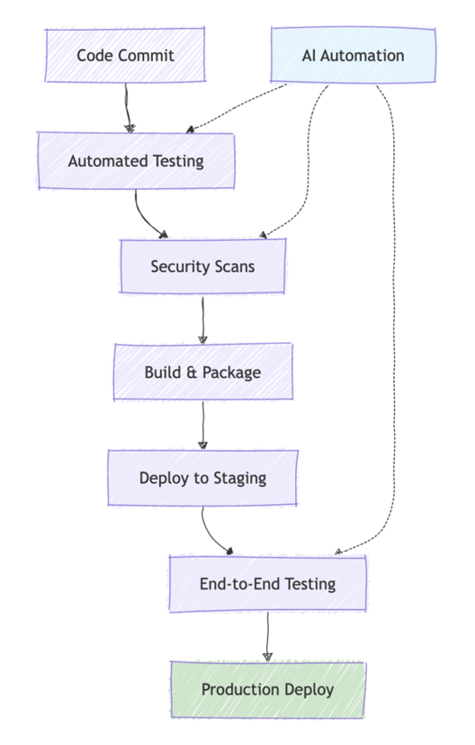
test

CICD – Continuous Integration & Continuous Delivery/Deployment

CI/CD: The Cornerstone of Modern Software Delivery

The way businesses release software has changed as a result of continuous integration and continuous delivery/deployment, or CI/CD. The days of demanding weekend deployments that involved high risk and prolonged downtime are long gone.

Organizations can confidently and regularly deploy updates with CI/CD pipelines. Automated testing cycles guarantee speed and dependability by finishing in a matter of minutes. Actually, businesses that use too many CI/CD tool frequently see a decline in performance, which emphasizes the necessity of a simplified DevOps toolchain approach.

Integrating Security Through DevSecOps

Historically, security teams resisted automation, fearing that automated scans might overlook risks. In practice, the opposite has proven true. Automated DevSecOps pipelines identify vulnerabilities far faster and with higher accuracy than manual reviews.

In one of our client implementations, automated scans flagged potential vulnerabilities within minutes of code being committed. Issues were immediately assigned back to developers, who could fix them while the context was still fresh - saving both time and cost.

Cloud and DevOps: Driving Scalable, Cost-Efficient Delivery

Cloud platforms have become a natural partner for DevOps automation. By leveraging cloud services and DevOps as a service, organizations accelerate adoption and scale without being constrained by legacy infrastructure.

[You may like reading: 5 Benefits of Using DevOps with Cloud]

Cloud strategy consulting plays a critical role in aligning technical implementation with organizational needs. One client reduced infrastructure costs by 38% through automated scaling policies, while Generative AI-driven cloud optimization. Generative AI services analyze usage patterns and suggest improvements that humans just don’t think of.

Leadership and Culture: The Foundation of DevOps Success

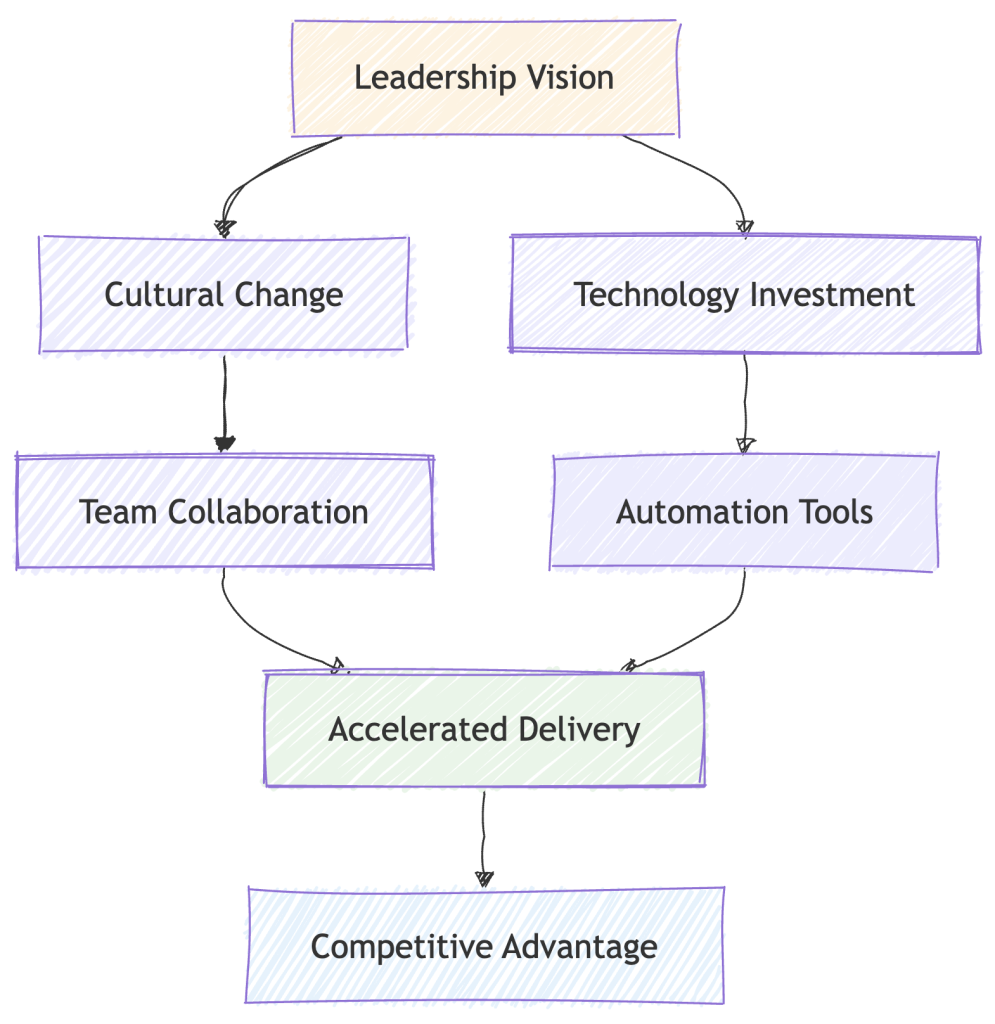
Though automation and tools are valuable, the ultimate strength of DevOps lies in altering the culture. It needs to be fostered by leadership through encouraging collaboration between development, operations, and security.

Small wins, like marking the first automated deployment or cutting deployment time in half, make teams embrace change. With time, such a shift in attitude transforms DevOps into a process and then into a competitive advantage. Companies with change leadership as a focus always enjoy superior adoption of DevOps automation, CI/CD pipelines, and cloud-native approaches. Absent this cultural consensus, even top-of-the-line tools cannot deliver their full benefit.

test

Leadership, Cultural Change to Competitive Advantage

Measuring Success in DevOps Automation

The success of DevOps automation can be tracked through four key performance indicators (KPIs):

  • Lead time for changes
  • Deployment frequency
  • Mean time to recovery (MTTR)
  • Change failure rate

Clients adopting this measurement-driven approach often see immediate improvements. One enterprise now deploys to production six times daily with increased system reliability, proving that smaller, automated releases enhance both stability and speed.


[ You may like reading: 5 Benefits of Using Strategic Approach to Automation in DevOps: Knowing When and What to Automate]

What’s Next: The Future of DevOps Automation

The DevOps ecosystem is changing, especially with the rise of serverless computing, edge architectures, and AI-driven development. Those organizations investing now in digital engineering services and cloud migration services are laying the groundwork for greater agility in the long-term.

The principles remain the same, automation, reliability, and speed, but the tools will continue to evolve. Organizations that think ahead, should put flexible architectures as a priority to remain competitive.

Conclusion

DevOps automation is no longer optional. It is a strategic necessity for companies that want to speed up software delivery. By breaking down silos, using automation, and adopting cloud-native practices, businesses change from slow-moving organizations into market leaders.

The message is clear: speed wins. Companies that embrace DevOps automation respond faster to market changes and also shape them. They become innovation leaders in their industries.

How AI and Headless Drupal Are Shaping the Future of Frontend Development

How AI and Headless Drupal Are Shaping
the Future of Frontend Development

Anjali
By Anjali
Sep 5, 2025 4 min read

How AI and Headless Drupal Are Shaping the Future of Frontend Development

Introduction

How we build digital experiences is changing faster than ever before. Drupal, once widely known as a sturdy monolithic CMS, has now evolved into a decoupled CMS that fully embraces headless architectures. This shift gives frontend developers the ability to build richer, faster, and more dynamic user interfaces using frameworks like React, Next.js, and Vue. The decoupled approach has unlocked a new level of flexibility - but the game-slash-changer is when we introduce artificial intelligence (AI) into the equation.

AI is no longer a buzzword for tomorrow; it is actively transforming frontend development today. From adaptive content presentation and intelligent searching to predictive interfaces, AI is revolutionizing user interaction with websites and apps. When combined with Drupal’s API-first philosophy and robust backend, the possibilities for creating AI-powered digital experiences are limitless.

In this article, we will talk about how headless Drupal frontends powered by AI will build the future of digital experience - what is achievable, what solutions you can use today, and what challenges developers should keep in mind.

Why Headless Drupal is the Future of Frontend

Drupal’s heritage as a powerful content management system remains unmatched, but today’s users demand faster, more interactive, and more personalized experiences. That’s where headless Drupal shines, separating the backend from the frontend to empower developer creativity and performance.

[You may like reading: Content Management in the age of Customer Experience Management]

Key advantages of adopting a Drupal decoupled CMS approach include:

  • Decoupled architecture using React, Next.js, Vue, Angular
  • API-first strategy providing freedom for frontend developers to innovate
  • Faster SPAs, PWAs, and omnichannel content delivery for consistent digital experiences

AI Meets Drupal: Opportunities in Frontend

Headless Drupal delivers flexibility, but AI-driven Drupal frontends elevate it further—making digital experiences smarter, more responsive, and adaptive to real-time user behavior.

Examples of AI personalization in Drupal frontends include:

  • AI-driven personalization: Adaptive UIs that respond to user engagement
  • Natural Language Processing (NLP): Smart search and voice-based interfaces
  • AI performance enhancement: Automated image compression, code optimization, and accessibility improvements
  • Predictive UX: Interfaces that suggest the next action or content before the user clicks

This integration of AI with headless Drupal not only improves functionality but also ensures future-proof, intelligent Drupal frontends.

Real-World Use Cases

The real value of AI in Drupal frontend development becomes clear when applied to practical implementations. Organizations are already enhancing customer engagement, accessibility, and conversion rates through AI-enabled features.

Examples include:

  • AI chatbots integrated with headless Drupal frontends for customer service
  • AI-powered recommendation engines driving eCommerce personalization in Drupal
  • Multilingual websites leveraging AI translation and localization for global audiences
  • Predictive content delivery, serving the right content to the right user at the right moment

Tech Stack & Tools to Explore

Building AI-powered Drupal frontends is already a reality with the right technology stack. By combining Drupal’s decoupled CMS model with modern frontend frameworks and AI integrations, developers can deliver next-generation experiences.

Essential tools include:

  • Drupal JSON:API or GraphQL for data retrieval
  • Next.js + AI APIs (OpenAI, Hugging Face, LangChain) for intelligent frontends
  • AI-driven testing tools (e.g., Cypress + AI test generators)
  • Accessibility tools powered by AI (axe-core + ML integrations)

Partnering with an experienced Drupal consulting team can help enterprises choose the right stack, implement AI integrations, and accelerate digital transformation.

Challenges & Considerations

While the integration of AI with Drupal frontends is powerful, it comes with challenges that developers and enterprises must address responsibly:

  • Data privacy and GDPR compliance: Ensuring user data protection across AI-driven workflows
  • Balancing AI automation with developer control: Maintaining flexibility without losing human oversight
  • Ethical AI: Guaranteeing that AI outputs remain unbiased, ethical, and transparent
  • Performance trade-offs: Managing infrastructure impact when integrating heavy AI features

Many of these challenges can be addressed by engaging expert Drupal consulting services, ensuring compliance, performance optimization, and seamless AI adoption.

Conclusion

Headless Drupal and artificial intelligence together are not just a step up in technology - it's a revolution of how we think about and deliver digital experiences. With the powerful backend of Drupal coupled with AI-driven frontends, the possibilities are limitless as developers get to create websites and apps that are not only faster and more responsive but also smart, personalized, and future-proof.

While AI keeps on evolving, Drupal frontends in the future will only see more possibilities - whether predictive interfaces, real-time personalization, or omnichannel delivery without seams. As a frontend developer, this is exactly the moment to start dipping your toes in AI integrations and getting at the forefront of that change.

The future of Drupal is not headless, it's intelligent.

How to Develop an iOS App: The Ultimate Guide for 2026

How to Develop an iOS App:
The Ultimate Guide for 2026

Shivam Tiwari
By Shivam Tiwari
Aug 14, 2025 11 min read

How to Develop an iOS App: The Ultimate Guide for 2026

Introduction

The world of mobile technology is evolving at a stunning pace and iOS devices remain at the forefront of innovation, style and user-friendliness. In 2026, iOS app development leverages powerful new tools, modern programming languages and advanced design standards. Known for their unmatched security and privacy features, Apple devices continue to set the benchmark for trusted digital experiences. Developing an iOS app in 2026 is not only a rewarding technical endeavor but also a strategic business move. Whether you’re exploring how to develop iOS apps or simply want to understand what an iOS application is, this guide will help you navigate every stage and bring your ideas to millions through the sleek interface of the iPhone and iPad.

For many organizations, iOS apps have become a cornerstone of broader digital transformation services, enabling businesses to connect with customers and optimize operations. Whether you’re building on your own or leveraging expert iOS mobile app development services, working with the right mobile app development services provider ensures your product is designed for performance, security, and scalability. This comprehensive guide will walk you through everything you need to know to successfully plan, design and launch an iOS app that stands out in 2026.

State of the iOS App Market in 2026

Apple’s ecosystem is more powerful than ever. With iPhones, iPads, Apple Watches and even the new Apple Vision Pro, iOS apps are not just smartphone companions - they’re now immersive, multi-platform experiences.

Here’s why iPhone app development is still a top choice in 2026:

  • Higher revenue per user compared to Android
  • Premium global audience with high spending behavior
  • Easier testing and deployment with fewer device types
  • Deep integration with AI, health, AR and spatial computing

Whether you’re planning to build a fitness tracker, productivity tool or game, the iOS market offers massive ROI potential. Many businesses begin by asking how to make an iOS application or what is the easiest way to make an iPhone app - a reflection of the platform’s reputation for simplicity, scalability and strong user adoption. This is why iPhone app development continues to be one of the most sought-after areas in mobile technology.

Native vs. Hybrid: What Should You Choose in 2026?

You’ve probably heard of Flutter, React Native or other cross-platform tools. While they’re useful, native iOS development is often the better long-term bet, especially in 2026.

Native vs. Hybrid Feature Comparison
FeatureNative (Swift)Hybrid (Flutter/React Native)
PerformanceHighMedium
Apple Feature AccessFullPartial
UI ConsistencySeamlessCustom work needed
MaintenanceEasierCan be harder with OS updates

So to capture the elegance and precision “Apple” is known for, build it natively. For those learning how to code an iPhone app, choosing native tools like Swift and SwiftUI ensures maximum performance and long-term flexibility.

Can You Develop iOS Apps on Windows in 2026?

This is one of the most common questions:
“Can you develop iOS apps on Windows?” or
“How can I develop iOS apps on Windows?”

The short answer? Not natively.

Apple’s development tools - especially Xcode and the iOS Simulator - are tightly integrated with macOS. That means you can’t install Xcode directly on Windows. But in 2026, there are more workarounds and tools than ever before to help Windows users get started.

Thanks to cloud platforms, cross-platform frameworks and remote access tools, it’s entirely possible to code, build and even test iOS apps on Windows - though you’ll still need access to macOS at some point in the process.

Why You Can’t Natively Develop iOS Apps on Windows

One of the biggest roadblocks for Windows users is that Apple’s official iOS development tools only run on macOS. This includes:

  • Xcode – the primary IDE for iOS development
  • Interface Builder – for designing iOS UI visually
  • iOS Simulator – to test your app without a physical device
  • Transporter or Xcode Organizer – for uploading to the App Store

These tools are essential to:

  • Build and sign final .ipa files
  • Access and run the iOS Simulator
  • Submit your app to the App Store

So, while you can write code using other tools or frameworks, you’ll still need macOS to finalize and publish your app.

Your Options to Develop iOS Apps on Windows in 2026

Here’s a breakdown of tools and methods you can use to develop iOS apps on Windows, along with their pros and cons:

Options to develop iOS Apps on Windows
MethodDescriptionProsCons
Cloud Mac ServicesRent a virtual macOS machine via providers like MacStadium, MacInCloud, CodeMagic or CodeanywhereNo hardware needed. Full access to XcodeMonthly cost. Dependent on stable internet
Remote Access to a Physical MacUse AnyDesk, Chrome Remote Desktop or Microsoft Remote Desktop to access a Mac remotelyUse your own or a friend’s Mac from anywhereRequires owning or borrowing a Mac
Virtual Machine / HackintoshRun macOS in a VM on Windows using tools like VMware or VirtualBoxLow cost (if successful)Violates Apple’s Terms of Service. Risky and unstable
Cross-Platform FrameworksUse Flutter, React Native or Xamarin to code on WindowsStart coding right away. Write once, deploy both platformsStill need macOS to test or submit to App Store

So, while you can start developing iOS apps on Windows, you’ll still need macOS at some point - especially for running the iOS Simulator, compiling the final build or submitting to the App Store.

If you're serious about iOS application development, investing in a Mac (or using a cloud-based solution) will save you significant time and effort.

iOS App Development Best Practices in 2026

Building a successful iOS app is about more than writing code - it’s about programming an app for iOS thoughtfully, crafting experiences that delight users and drive business growth. Businesses seeking how to develop iOS apps in 2026 should focus on strategic planning, user experience and scalability rather than only the technical steps. Here’s what leading companies prioritize:

  • User-Centric Design: A well-designed iPhone app improves engagement, retention and conversion. Companies today prioritize designing iPhone apps with accessibility, intuitive navigation and aesthetic appeal in mind. A thoughtfully crafted UI ensures that application development for iPhone feels seamless to users, while adhering to Apple’s Human Interface Guidelines guarantees a smooth and consistent experience.
  • Performance Optimization: Minimize load times, optimize animations and manage memory efficiently to reduce crashes, enhance responsiveness and improve battery usage.
  • Scalable Architecture & Modular Code: Design modular backend systems and APIs that can grow with your app’s features, future expansion and increasing user base. Adopt code organization patterns to simplify maintenance and updates.
  • Code Quality & Maintainability: Write clean, modular and well-documented code. Use version control, automated testing and CI/CD pipelines to maintain consistent quality across teams and releases.
  • Testing & Debugging Practices: Regularly perform unit, integration and UI tests. Leverage Xcode tools and simulators to identify issues early, preventing critical bugs in production.
  • App Monitoring & Analytics: Implement tools for crash reporting, performance tracking, and user behavior analytics to continuously improve app quality and measure real-world performance effectively.

Professional teams provide custom iOS application development services, helping brands tailor features, scale apps and reduce long-term costs.

What It Takes: Cost, Time and Skills to Build an iOS App

Before you start, understand the basic costs and time investments involved in iOS app development:

What it takes to build an iOS App
FactorSimple AppMid-Range AppComplex App
Cost (USD)$5,000–$15,000$20,000–$50,000$60,000–$150,000+
Time3–6 weeks2–4 months4–8 months
Skills NeededSwift, SwiftUI+ Backend/API+ Architecture, DevOps, QA

Whether you want to build an Apple app as a simple utility or a complex enterprise tool, planning costs and timelines upfront prevents delays.

Also factor in ongoing updates, backend management and possible design/QA outsourcing. Modern development teams often rely on cloud and DevOps services to streamline builds, deployments, and monitoring. By incorporating DevOps automation services, businesses can reduce release cycles, maintain continuous integration, and deliver updates faster - keeping pace with evolving user expectations.

  • Apple Dev Fee: $99/year
  • Ongoing updates and feature improvements
  • Possible design/QA outsourcing

[You may like reading: Understanding iOS app Development cost: Factors governing the estimations]

Top Strategies for iOS App Success in 2026

Launching a successful iOS app is a strategic business decision. Leading companies in 2026 prioritize aligning app features with market needs, leveraging Apple’s ecosystem, and innovating continuously to maximize user engagement and long-term growth.. Leading organizations in 2026 prioritize sustainable growth and meaningful user experiences over quick launches. Key insights include:

  • Prioritize ROI and Market Fit: iOS apps provide access to premium audiences who are more likely to engage and spend. Aligning app features with target user behavior maximizes adoption and revenue. Analyzing user patterns and market trends ensures your app delivers measurable business outcomes.
  • Leverage the Apple Ecosystem: Successful apps extend beyond the iPhone, integrating seamlessly with iPads, Apple Watches and Apple Vision Pro. By designing experiences across devices, businesses can deliver immersive AR, spatial computing and multi-device interactions that enhance engagement and brand perception. Harnessing Apple’s tightly integrated hardware and software ecosystem enables unique, high-quality user experiences that competitors may find difficult to replicate.
  • Focus on Innovation, Not Just Implementation: Incorporating emerging technologies such as AI or advanced AR features differentiates your app in a competitive market, leading to higher retention and user satisfaction. Continuous innovation positions your app as forward-thinking, helping your brand stay relevant as new iOS capabilities emerge. Some teams even add gamification while developing iOS applications, while others rely on custom iOS application development services to tailor unique features that boost retention and long-term loyalty.
  • Ensure Security & Privacy: Prioritize secure authentication, data encryption and privacy-first design. Protecting user data builds trust, enhances app credibility, and aligns with Apple’s stringent security standards.
  • Accessibility & Inclusivity: Design your app to be accessible to all users, including those with disabilities. Following Apple’s accessibility guidelines not only broadens your audience but also enhances user satisfaction and compliance.
  • Engage Professional Expertise: Using professional custom iOS application development services ensures your app is optimized for performance, security and scalability, reducing long-term maintenance costs. Partnering with experts also accelerates development timelines and allows your team to focus on strategic growth initiatives.
  • Iterative Growth Strategy: Rather than building a fully-featured app upfront, adopt an iterative approach - launch MVPs, gather user feedback and add features gradually - to control costs, validate product-market fit and reduce risk. This approach encourages continuous learning and adaptation, making your app more resilient to market changes.
  • Cross-Platform Decisions as Strategic Choices: When considering Windows or hybrid tools, make decisions strategically - balancing cost, timeline and user experience - rather than focusing solely on technical limitations. Viewing platform choices through a business lens ensures your resources are invested where they deliver the highest impact.

Post-Launch Considerations: Marketing, User Acquisition and ASO

Launching your iOS app is just the beginning. To ensure long-term success, focus on post-launch strategies that drive visibility, engagement and growth:

  • App Marketing: Promote your app through social media, email campaigns, content marketing and paid ads to reach your target audience effectively. Spread awareness to your ideal users.
  • User Acquisition Strategies: Optimize onboarding, referral programs, retention campaigns and gamification elements to attract and retain high-quality users. Convert visitors into loyal, active users.
  • App Store Optimization (ASO): Improve your app’s discoverability on the App Store using keyword optimization, compelling descriptions, screenshots and positive reviews. Maximize visibility for higher downloads.

By combining iOS app development best practices with these post-launch strategies, you can maximize user engagement, retention and ROI in the competitive iPhone app development ecosystem.

Conclusion: Start Small, Launch Smart

Developing an iOS app in 2026 is both an exciting technical challenge and a strategic opportunity to reach millions of premium users. Whether you choose in-house development or rely on professional mobile app development services, the right strategy ensures long-term success. By following the process, you can successfully make an app on iPhone that delights users and meets business goals. Once the core app works smoothly, you can expand functionality with backend services, APIs or additional features to create a more complex, professional-grade product. With proper testing, iteration and adherence to Apple’s guidelines, your app can deliver a seamless experience, achieve App Store approval and stand out in the competitive iOS ecosystem. In short, when you build an Apple app with the right foundation, it not only drives your digital transformation but also scales for future growth, positioning your brand strongly in the digital marketplace.

Why Mobile App Security needs a Paradigm shift: From Patchwork fixes to Secure-by-design

Why Mobile App Security needs a Paradigm shift: From Patchwork fixes to Secure-by-design

Pushan Singh
By Pushan Singh
Aug 21, 2025 5 min read

Why Mobile App Security needs a Paradigm shift: From Patchwork fixes to Secure-by-design

Introduction

Mobile apps are no longer just utilities, they're our wallets, health records, IDs, and entertainment hubs. With such a wide scope of use, mobile app security is now a make-or-break element for user trust and business resilience. Yet, in many organizations, security still enters the picture only after the core functionality is built. The result? Vulnerabilities, leaks, and costly patches that inflate the iOS app development cost and jeopardize the entire product lifecycle.


This article explores the evolving mobile threat landscape, reveals why conventional security practices fall short, and lays out a forward-looking, secure-by-design approach for mobile app development-especially for iOS app development services and Android platforms. Security is not just a technical necessity but a pillar of your organization’s digital transformation strategy.

Why mobile app security fails in modern app development

Despite an explosion in security tools and SDKs, mobile data breaches are increasing. A 2024 report by Mobile Security Watch revealed that 65% of financial and health apps store sensitive data in unencrypted form. Often, the issue isn’t technical capability-it’s organizational mindset.

Common reasons security fails today:

  • Security checks are delayed until the QA stage.
  • Developers hardcode secrets due to tight deadlines.
  • Teams use outdated dependencies without regular audits.
  • Business pressure prioritizes features over protection.

Evolving threat landscape: Smarter attackers, bigger stakes

Attackers are becoming faster, more resourceful, and increasingly automated:

  • AI-based reverse engineering tools can now decompile apps and locate weak points within minutes.
  • Frida-based runtime manipulation enables live code interception, bypassing app logic.
  • Credential stuffing via leaked app secrets and tokens is on the rise.
  • Even state-sponsored spyware is leveraging mobile zero-days.

This is no longer a game of hiding keys or writing clever if-checks. The security landscape demands architectural reform. Ignoring it can lead to breaches that cost more than the entire iOS app development cost itself.

Secure-by-design: The future of mobile app security

Moving from reactive fixes to a proactive security-first approach means embedding security into every development phase. Digital engineering teams must adopt security-first principles early in the lifecycle to mitigate risks at scale.

1. SSL/TLS pinning done right

Problem: MITM attacks and forged certificates.

Solution: Certificate pinning binds your app to trusted certificates or public keys.

  • Android: Use NetworkSecurityConfig for pin lists, and host keys remotely for rotation.
  • iOS: Implement URLSessionDelegate with key comparison logic and fetch pins from secure sources.
  • Always fail securely-never allow fallback to an unverified cert.

2. Jailbreak/root detection as a layered defense

Problem: Compromised devices run arbitrary code.

Solution: Detect root/jailbreak via known binaries, unsafe syscalls, and Frida traces.

  • Android: Look for Magisk, su binaries, and modified build.prop files.
  • iOS: Scan for /Applications/Cydia.app, substrate files.
  • Obfuscate checks using ProGuard (Android) or LLVM (iOS).
  • Integrate Play Integrity API (Android) or DeviceCheck (iOS).

3. Store nothing in plaintext - Secure data storage

Problem: XML/Plist data is often readable by attackers.

Solution:

  • Android: Use EncryptedSharedPreferences with keys in Android Keystore.
  • iOS: Use Keychain for sensitive info and enable file protection options.
  • Automate audits to spot usage of putString or NSUserDefaults.set with secrets.

4. Avoid hardcoded secrets

Problem: Reversed apps expose API keys, access tokens, etc.

Solution:

  • Fetch secrets post-authentication from a secure backend.
  • Use Android Keystore or iOS Secure Enclave to store session credentials.
  • Avoid using Info.plist or constant files for sensitive data.

5. Manage permissions and component exposure

Problem: Overexposed components increase attack vectors

Solution:

  • Apply the principle of least privilege.
  • Android: Use android: exported=false wherever possible.
  • iOS: Enable granular access and validate runtime authorization requests.

6. Internal over external storage

Problem: External storage is world-readable.

Solution:

  • Android: Use getFilesDir() and implement Scoped Storage
  • iOS: Stick to the app sandbox and enable Data Protection.

7. Validate input, sanitize queries

Problem: SQL injection and command injection.

Solution:

  • Use parameterized queries and ORM frameworks.
  • Avoid shell execution APIs.
  • Validate all user input with regex and strict type checks.

8. Prevent visual leakage

Problem: Screenshots capture sensitive data.

Solution:

  • Android: Use FLAG_SECURE for sensitive activities.
  • iOS: Monitor UIApplication.userDidTakeScreenshotNotification and blur sensitive views.

Security as a product differentiator

In an age where every app claims user-first innovation, security can be your competitive edge. Fintech, healthtech, and government apps are increasingly judged on how securely they handle data.

Examples:

  • Signal gained millions of users because of its security-first reputation.
  • Apps like LastPass suffered due to perceived negligence in encrypting user vaults.

Building secure apps boosts user trust, app store ratings, and regulatory compliance.

Who owns mobile security? Developers or leadership?

This is not just a developer’s job-it’s a cross-functional imperative:

  • Product Managers must prioritize security stories in sprints.
  • Engineering Managers must invest in code scanning tools and secure CI/CD pipelines.
  • Business leaders must understand that security delays now prevent financial loss later.

Adopt a threat modeling approach in every release and involve security from design through deployment.Security integration into cloud and DevOps workflows—like CI/CD pipelines—is key to reducing attack surfaces.

Looking ahead: Mobile app security, now and beyond

  • OS-level security APIs will offer better isolation but require developers to keep pace.
  • Privacy regulations (India DPDP, EU GDPR) will demand more secure data handling.
  • Zero-trust mobile architecture will evolve, with ephemeral tokens and decentralized identity.
  • Expect AI-enhanced malware that learns how to bypass static checks-making runtime detection critical.

Conclusion

Mobile app security is not a checklist-it’s a mindset. To truly protect user data and build trust, organizations must shift from reactive patching to proactive protection. From encrypting storage and validating runtime environments to educating teams and integrating security into CI/CD, every step counts. This is especially critical for custom mobile app development teams working in regulated sectors like healthcare, finance, and government.


Security is no longer optional-it’s your moat, your brand promise, and your best investment.


Need help building secure-by-design mobile apps? Let’s talk . TO THE NEW’s mobile engineering teams specialize in crafting apps with robust, scalable security built into every layer.

Reflections on Agile Network India Noida Conference: Integrating HCD and UX with Agile

Reflections on Agile Network India Noida Conference: Integrating HCD and UX with Agile

Divik Thareja
By Divik Thareja
Jul 22, 2025 2 min read

Reflections on Agile Network India Noida Conference: Integrating HCD and UX with Agile

Event overview

I had the opportunity to participate in Agile Network India’s conference in Noida, themed “Integrating Human-Centered Design (HCD) and UX with Agile.” The gathering brought together passionate professionals exploring ways to seamlessly blend user experience and agile practices for more innovative, human-centered solutions. Hosted by Comdez Communication Pvt. Ltd., the event provided valuable sessions, panel discussions, and hands-on workshops.

Conference experience & key themes

Human-Centered Design (HCD) Meets Agile

The sessions explored how HCD can enrich agile product development. The key takeaways included:

  • The role of continuous user feedback in building meaningful products.
  • Techniques for integrating design strategy into agile teams.
  • Challenges and success factors when cross-functional teams simultaneously pursue speed and empathy in development.

Panelists and speakers highlighted the benefits of collaborative, iterative cycles, and the need to prioritize end-user outcomes over outputs. Metrics linking design success and business value were discussed as essential anchors for agile UX efforts.

My Kanban Workshop: The Kanban Pizza Activity

  • Setup Teams simulated a pizza shop, visualizing their workflow for making and delivering (paper) pizzas. In the first round, production was chaotic without structure or limits.
  • Core Principles Experienced
    • Visualizing workflow and bottlenecks.
    • Implementing work-in-progress (WIP) limits.
    • Managing flow and improving collaboration.
  • Debrief After reflecting on the first round, teams reorganized their stations, set WIP limits, and distributed tasks more efficiently. The second round showed dramatic improvement: smoother flow, less rework, and better teamwork.

Why Kanban Clicked

Participants discovered that:

  • Simple visual boards can drastically boost clarity and reduce multitasking.
  • WIP limits expose bottlenecks, encouraging timely collaboration.
  • Process transparency fosters a culture of feedback, learning, and continuous improvement - key to agile and HCD values.

Many shared that the tangible, playful simulation made Kanban principles far more memorable than any lecture. Several attendees planned to try similar activities back at work to help teams self-organize and adapt processes more effectively.

Personal Learnings & Next Steps

  • Synergy of Agile and HCD Integrating human-centered design with agile is not just about adding UX steps; it's about adopting a mindset of experimentation, close user involvement, and cross-functional team learning.
  • Practical Workshops Matter Active learning through simulations like the Kanban Pizza Game builds lasting understanding and practical skills.
  • Community Strength Connecting with peers and experts motivated me to keep experimenting, sharing, and fostering agile transformation in my own circles.

How SSAI is shaping the future of video monetization

How SSAI is shaping the future of video monetization

Shishupal Singh Shakya
By Shishupal Singh Shakya
Jul 22, 2025 7 min read

How SSAI is shaping the future of video monetization

Introduction

The OTT streaming industry continues to grow and the monetization strategies have become a crucial focus for content providers. And as competition intensifies, the focus has shifted to effective monetization strategies. Among the most impactful innovations reshaping ad delivery is Server-Side Ad Insertion (SSAI). This technology is revolutionizing how ads are integrated into video content, helping platforms deliver seamless viewing experiences, overcome ad-blockers, and unlock new revenue potential.

In this article, we explore how SSAI works, its strategic advantages, implementation challenges, and emerging trends that make it an indispensable tool for OTT providers.

What is Server Side Ad Insertion (SSAI)?

Server-Side Ad Insertion is a technology that dynamically stitches ads into VOD contents on the server before delivery to the viewer.

Unlike client-side ad insertion (CSAI), SSAI ensures a seamless ad experience by eliminating buffering, reducing ad-blocker interference, and maintaining video quality across devices.

The SSAI workflow typically involves:

  1. The video content is prepared and segmented into chunks.
  2. An ad decision server selects suitable ads based on the viewer profile.
  3. The server stitches ads into the content stream before delivery.
  4. A manifest is created for each unique viewer, determining the playback sequence.

This allows OTT providers to offer fully personalized, uninterrupted streams at scale.

How SSAI enhances OTT monetization

1. Seamless ad experience for higher engagement

One of the biggest challenges in advertising is viewer retention.

SSAI provides a smooth transition between video content and ads, reducing buffering and minimizing the chances of users dropping off during ad breaks.

This leads to higher engagement rates and better ad completion metrics, directly impacting revenue.

2. Bypassing Ad Blockers for Maximized Revenue

Users were able to block CSAI with the help of Ad Blocker Softwares.

Since SSAI stitches ads within the video stream itself, it makes ad detection and blocking difficult, ensuring that ads are delivered to a larger audience and it increases monetization opportunities for publishers.

3. Personalized Ad Targeting with Dynamic Ad Insertion

Server Side Ad Insertion supports Dynamic Ad Insertion (DAI), allowing content providers to deliver relevant ads based on user preferences, demographics, and behavior.

This level of personalization improves ad relevance, leading to higher conversion rates and better Cost Per Thousand Impressions.

4. Consistent Multi-Device Ad Delivery

OTT viewers consume content on devices including Mobile, Web, and Smart TV Apps.

SSAI ensures that ads are delivered consistently across all platforms, maintaining a high-quality experience regardless of the device or bandwidth conditions.

5. Scalability for Live and On-Demand Content

SSAI is well-suited for high-traffic live events like sports, elections, or reality shows. With cloud-based infrastructure, it scales dynamically to serve millions of personalized manifests without performance lags.

It enables broadcasters to scale ad delivery for large audiences, ensuring a smooth experience even during high-traffic events like sports streaming.

Challenges and Considerations

While SSAI offers rich benefits, implementing it requires considerations such as:

  1. Latency Management: SSAI ensures ad decisions happen in real time without disrupting the stream.
  2. Ad Tracking & Measurement: In SSAI, ads are stitched server-side, tracking impressions and interactions requires integration with third-party measurement tools.
  3. Integration Complexity: SSAI implementation needs compatibility with various ad servers, video players, and analytics platforms.
  4. Scalability Requirements: SSAI demands a highly scalable origination infrastructure to handle real-time processing.
  5. Non-Cacheable Manifests: In SSAI, personalized manifests cannot be cached, which leads an increasing load on the server.
  6. Ad Visibility for Clients: Video players must be aware when an ad is played to enable accurate reporting and custom behaviors.
  7. Diverse Ad Standards and Environments: In SSAI, variations in ad formats (VAST, MAP), ad servers, origin configurations, and playback environments complicate workflows.
  8. Buffering: Content buffering is one of the limitations of SSAI ads.
  9. Ad Blocker: AdBlockers do not impact SSAI ads. Even if an ad blocker is enabled, SSAI still works because the ads are delivered within the stream.

Managing viewer fluctuations with cloud-based SSAI

Live events often experience a spike in concurrent users, especially during crucial moments of a game or a TV series finale. Effective scaling depends on cloud-hosted encoding and packaging that can be virtualized for rapid deployment and auto-scaling.

Unlike rigid, hardware-based encoders and packagers, cloud-based video processing allows dynamic resource allocation, making it ideal for generating millions of individualized manifests in real-time. This flexibility ensures seamless ad integration and a high-quality streaming experience, even during peak demand.

Future Trends in SSAI

  1. AI-Powered Ad Selection
  2. Augmented Reality (AR) Ad Overlays
  3. Programmatic SSAI Integration
  4. SSAI for FAST Channels

Key metrics to track SSAI success

To ensure the effectiveness of SSAI implementation, OTT providers should monitor:

  • Ad completion rate
  • Viewability score
  • Revenue per user (ARPU)
  • Average session duration
  • Bounce rate during ad breaks
  • Personalized ad match rate

These metrics help fine-tune targeting strategies and improve both user experience and ad revenue.

Conclusion

Server-Side Ad Insertion is not just a technical upgrade, it’s a strategic advantage in the OTT monetization playbook. SSAI is enhancing ad delivery, increasing user engagement, and maximizing revenue. As advertisers seek more seamless and personalized ad experiences, SSAI stands out as a powerful tool for content providers to unlock the full potential of their ad inventory.

As content consumption diversifies and user expectations rise, SSAI is poised to become the backbone of intelligent video advertising. Ready to elevate your OTT ad monetization strategy? Explore how SSAI can power your next-level streaming experience.

Challenges and Considerations

While SSAI offers rich benefits, implementing it requires considerations such as:

  1. Latency Management: SSAI ensures ad decisions happen in real time without disrupting the stream.
  2. Ad Tracking & Measurement: In SSAI, ads are stitched server-side, tracking impressions and interactions requires integration with third-party measurement tools.
  3. Integration Complexity: SSAI implementation needs compatibility with various ad servers, video players, and analytics platforms.
  4. Scalability Requirements: SSAI demands a highly scalable origination infrastructure to handle real-time processing.
  5. Non-Cacheable Manifests: In SSAI, personalized manifests cannot be cached, which leads an increasing load on the server.
  6. Ad Visibility for Clients: Video players must be aware when an ad is played to enable accurate reporting and custom behaviors.
  7. Diverse Ad Standards and Environments: In SSAI, variations in ad formats (VAST, MAP), ad servers, origin configurations, and playback environments complicate workflows.
  8. Buffering: Content buffering is one of the limitations of SSAI ads.
  9. Ad Blocker: AdBlockers do not impact SSAI ads. Even if an ad blocker is enabled, SSAI still works because the ads are delivered within the stream.

Managing viewer fluctuations with cloud-based SSAI

Live events often experience a spike in concurrent users, especially during crucial moments of a game or a TV series finale. Effective scaling depends on cloud-hosted encoding and packaging that can be virtualized for rapid deployment and auto-scaling.

Unlike rigid, hardware-based encoders and packagers, cloud-based video processing allows dynamic resource allocation, making it ideal for generating millions of individualized manifests in real-time. This flexibility ensures seamless ad integration and a high-quality streaming experience, even during peak demand.

Future Trends in SSAI

  1. AI-Powered Ad Selection
  2. Augmented Reality (AR) Ad Overlays
  3. Programmatic SSAI Integration
  4. SSAI for FAST Channels

Key metrics to track SSAI success

To ensure the effectiveness of SSAI implementation, OTT providers should monitor:

  • Ad completion rate
  • Viewability score
  • Revenue per user (ARPU)
  • Average session duration
  • Bounce rate during ad breaks
  • Personalized ad match rate

These metrics help fine-tune targeting strategies and improve both user experience and ad revenue.

Conclusion

Server-Side Ad Insertion is not just a technical upgrade, it’s a strategic advantage in the OTT monetization playbook. SSAI is enhancing ad delivery, increasing user engagement, and maximizing revenue. As advertisers seek more seamless and personalized ad experiences, SSAI stands out as a powerful tool for content providers to unlock the full potential of their ad inventory.

As content consumption diversifies and user expectations rise, SSAI is poised to become the backbone of intelligent video advertising. Ready to elevate your OTT ad monetization strategy? Explore how SSAI can power your next-level streaming experience.

Understanding OLGR QLD: Navigating gaming licenses & compliance in Queensland

Understanding OLGR QLD: Navigating gaming licenses & compliance in Queensland

Shreya Agrwal
By Shreya Agrwal
Jul 22, 2025 5 min read

Understanding OLGR QLD: Navigating gaming licenses & compliance in Queensland

Introduction

In Queensland’s rapidly evolving gaming landscape - with digital betting, loyalty programs, and compliance technology on the rise, it is important to maintain transparency and accountability in public interest. As online gaming regulation in Australia tightens, operators must stay informed and agile to remain compliant.

The Office of Liquor and Gaming Regulation (OLGR) also known as OLGR QLD is a pivotal authority operated under the Department of Justice and Attorney-General that ensures the gambling and liquor activities are conducted lawfully and responsibly. It is in-charge of fostering an environment that minimizes harm associated with alcohol and gambling.

Whether you’re an operator seeking a Queensland gaming license, a customer engaging with gaming venues, or a stakeholder in the broader ecosystem, understanding the role of the Office of Liquor and Gaming QLD is crucial to navigate this tightly regulated space. This blog delves into Queensland OLGR's responsibilities and its impact on Queensland's gaming landscape.

What is the role of OLGR?

OLGR regulates a wide range of gambling-related activities in Queensland, which include:

  1. Casinos
  2. Electronic gaming machines (EGMs)
  3. Wagering and betting operators
  4. Keno and lottery providers
  5. Club and hotel gaming operation
  6. Community gaming (e.g., raffles, bingo)

The jurisdiction of Liquor and Gaming QLD extends across the entire state.. The following diagram taken from OLGR's official publications represents how regulatory and policy functions operate to achieve the balanced objective of community benefit.

Key responsibilities of OLGR

A few key responsibilities of OLGR include licensing, compliance and harm reduction initiatives spread across liquor and gaming sectors. Let’s take a closer look:

1. Licensing

The Office of Liquor and Gaming Regulation is responsible for issuing and managing a range of licenses related to gaming operations. This includes:

Individual licences are designed to assess the probability and suitability of the particular person who is to be permitted access to sensitive aspects of gaming operations.

Key employee and key person licences under the Casino Control Act are investigated similarly to individual licences but an additional determination must be made as to whether the person is suitable to perform the duties of a key employee or key person. This category applies to any person who has the power to exercise significant influence or authority over casino operations.

Body corporate licences are applicable to the licensing of casinos, gaming machine monitoring operators and wagering, lotteries and Keno operations.

Gaming equipment licences such as gaming machine manufacturers, service contractors and repairers, ensure that the gaming equipment is manufactured, tested, maintained and performed against appropriate technical and performance standards.

To obtain these licenses any entity needs to go through a rigorous process. This involves various background checks, financial assessments, and fit-and-proper-person evaluations. Businesses looking to enter the iGaming platform development in Australia space must be especially diligent in aligning with OLGR requirements.

2. Compliance

Queensland OLGR monitors gaming venues and operators to ensure they are complying with relevant legislation such as following:

  • Casino Control Act 1982
  • Charitable and Non-Profit Gaming Act 1999
  • Gaming Machine Act 1991
  • Interactive Gambling (Player Protection) Act 1998
  • Lotteries Act 1997
  • Keno Act 1996
  • Wagering Act 1998

In order to achieve this, the following activities are scheduled on regular intervals:

  • Scheduled visits from gaming inspectors
  • Reviewing financial and operational reports for apparent breaches of legislation
  • Enforcing technical standards for gaming machines and software

Any entity (an individual or a gaming operator) which is found faulty to adhere to above is presented with a warning, a letter of censure, a prosecution or a show cause proceeding against the licence.

3. Audits and Investigations

OLGR conducts regular audits to identify potential breaches or complaints received from the public or industry. These audits usually focuses on:

  • Accurate revenue reporting
  • Financial record keeping
  • Responsible allocation of gaming profits, particularly for community purposes

These investigations are typically confidential and may also involve collaboration with other law enforcement or regulatory bodies.

4. Harm minimization

An important keystone of OLGR's mission is reducing the social impact of gambling. Key initiatives include:

  • Enforcing self-exclusion programs when people are too involved in gambling activities
  • Requiring responsible gambling signage and help services in venues
  • Monitoring loyalty programs and marketing techniques to avoid encouraging excessive gambling
  • Introduction of mandatory training on Responsible Service of Gambling for venue employees involved in the delivery of gaming services

These efforts support the broader push for responsible gambling initiatives across Australia's digital and physical gaming environments.

OLGR also engages in policy development and public awareness campaigns to create a safe gambling environment.

Conclusion

OLGR is not just a regulatory body but it acts as a watchdog for the public in Queensland. It plays a vital role in governing gaming licenses. It is important that businesses considering buying or selling that have a gaming license are compliant to the regulations specified by OLGR.

Adhering to these rules, demonstrates a commitment of business towards responsible service and fosters trust with customers and the community which in turn helps maintain business integrity.

Non-compliance to the gaming licenses can have significant financial and operational impacts on businesses including fines, suspension, or revocation of licenses.

By understanding and respecting OLGR’s role, all stakeholders can contribute to a safer, fairer, and more transparent gaming environment in Queensland.

Looking to build an iGaming platform that aligns with OLGR’s regulations? TO THE NEW brings deep expertise in secure, compliant mobile development tailored to Australia’s gaming landscape.

If you’re planning to build your next iGaming platform or need a technology partner familiar with the regulatory landscape in Queensland, reach out to TO THE NEW - a trusted partner in delivering secure and scalable mobile app development solutions tailored for the gaming industry.