
The Generative AI Potential: How Global Enterprises Are Scaling GenAI for Real Business Value

The Generative AI Potential: How Global Enterprises 
Are Scaling GenAI for Real Business Value

Shreya Tiwari
By Shreya Tiwari
Nov 26, 2025 10 min read

The Generative AI Potential: How Global Enterprises Are Scaling GenAI for Real Business Value

Introduction

Enterprises are no longer asking ‘What can Generative AI do?’ - they’re asking ‘How do we operationalize it to transform the bottom line? Excitement over this technology is palpable; early pilots involving generative AI services are compelling, and the potential is limitless. From hyperpersonalization to medical imaging- Gen AI is widely adopted across the globe. But leaders still have second thoughts about buzzing questions like managing the risks inherent in generative AI, determining what new skills and capabilities the workforce will need, and rethinking core business processes such as retraining and developing new skills.

Mckinsey suggests that Generative AI could contribute $2.6 trillion to $4.4 trillion in annual economic value across use cases, mainly in functions such as customer operations, marketing and sales, software engineering, and R&D. With such promising potential, let’s uncover how enterprises can scale up with generative AI while optimizing cost and improving efficiency through responsible AI practices.

Why is Gen AI so popular among Modern Enterprises?

Gen AI’s projected value surge represents a 15–40% increase above previous AI impact forecasts, signaling that generative AI is evolving into a critical driver of productivity and growth across sectors such as banking, retail, high tech, and life sciences. For CFOs, this means that investing strategically in generative AI technologies is not just about cost-cutting but unlocking new sources of revenue and efficiency that could fundamentally reshape competitive dynamics.​

Enterprises are moving beyond pilot projects to production-scale implementations. As generative models like GPT, Claude, and Gemini demonstrate enterprise-grade reliability, organizations are embedding them across workflows - from product design and marketing to software engineering and customer service. With digital transformation reaching maturity, Generative AI acts as the next strategic inflection point, transforming data and digital ecosystems into intelligent, self-optimizing systems. But how is Gen AI different from the AI that we have known for this long? Let’s find out.

Traditional AI Vs Generative AI

Artificial Intelligence has been there since ages and it has been advancing with each passing day. The true business advantage lies in understanding the impact of AI and utilizing it for precision and control, for innovation, personalization, and intelligent automation. Let’s understand the key differences between traditional AI vs Gen AI.

AspectsTraditional AIGenerative AI
DefinitionTraditional AI, also known as discriminative AI, focuses on analyzing data, identifying patterns, and making predictions or classifications based on predefined rules or labeled datasets.Generative AI is a subset of AI that uses large-scale models (like LLMs and diffusion models) to generate new content - text, images, code, video, and even data - that matches human creativity and cognition.
Core ObjectivePredict outcomes, categorize data, and support decision-making through analytics.Create new content, designs, and ideas autonomously from existing data.
Data DependencyRelies heavily on structured, labeled, and domain-specific datasets for model training.Utilizes massive, unstructured datasets (text, audio, visuals) to learn contextual relationships.
Learning ApproachBased on supervised learning and rules-based models that predict or classify.Uses unsupervised or self-supervised learning to understand context, semantics, and relationships across data.
Industry ApplicationsBanking, insurance, manufacturing, logistics - focused on optimization and efficiency.Media, healthcare, retail, education, IT - focused on creativity, personalization, and engagement.
LimitationsLimited creativity, dependent on clean data, and lacks contextual awareness.Can hallucinate or generate biased or inaccurate outputs without governance.
Security & GovernanceEasier to monitor and audit due to deterministic outputs.Requires advanced controls for data privacy, IP protection, and output validation.

Transforming Businesses with Gen AI: Industry Wise Gen AI Use Cases

Generative AI is impacting all the key sectors of digital ecosystems. We will take a look at how various industries are implementing Generative AI to generate real business value and then cover the practical uses of adopting Generative AI into practice.

1. Media & Entertainment: Redefining Creativity and Production

For the media and entertainment industry, Generative AI transforms content creation, production workflows, and audience engagement. From script generation and video editing to dubbing, localization, and personalized recommendations, AI is enhancing creativity while reducing costs and turnaround time.

Use Cases

Automated Content GenerationGenerating persuasive, keyword-optimized content at scale.
Localization and TranslationReal-time multilingual dubbing and subtitling powered by speech-to-text and text-to-speech models.
Personalized Content DiscoveryAI models predicting viewer preferences to curate hyper-personalized streaming experiences.
Virtual Influencers and Digital AvatarsAI-generated characters and avatars unlock new storytelling formats and marketing activations.

Netflix uses Generative AI to create dynamic artwork and video previews depending on what an individual user likes. The AI works with the viewing patterns and creates the thumbnails that maximize the engagement levels in the form of the higher click-through rates and better user retention.

2. eCommerce: Hyper-Personalization and Intelligent Merchandising

In eCommerce, Generative AI is transforming how brands engage with consumers - enabling dynamic product descriptions, image generation, and personalized shopping experiences. It allows businesses to scale catalog management, improve SEO, and boost conversions through intelligent automation.

Use Cases

Automated Product Descriptions and SEO CopyGenerating persuasive, keyword-optimized content at scale.
Visual Content GenerationCreating lifestyle imagery or 3D product renders using AI.
Conversational CommerceSmart virtual assistants offering real-time recommendations.
Dynamic Pricing ModelsAI predicting consumer demand and competitor pricing trends.

Shopify utilized GenAI into its “Shopify Magic” package, which uses the generated merchandise product description, email messages, and blog articles. Not only does this shorten the time spent on content creation but it also allows small businesses to have professional level marketing on a large scale with generative ai services.

3. Financial Services: Automating Insight and Risk Intelligence

Financial businesses are using Generative AI to improve compliance, fraud detection, and customer advisory services. By leveraging synthetic data generation and intelligent summarization, banks can enhance decision-making and reduce operational risks.

According to a Mckinsey report Gen AI could deliver value equal to an additional $200 billion to $340 billion annually for the banking sector if the use cases were fully implemented.

Use Cases

Synthetic Data for Model TrainingGenerating persuasive, keyword-optimized content at scale.
Automated Document ProcessingExtracting insights from complex reports, KYC documents, or contracts.
Personalized Wealth AdvisoryAI-driven financial recommendations and portfolio analysis.
Regulatory Compliance and Audit AutomationSummarizing compliance reports and identifying anomalies.

JPMorgan Chase uses Generative AI to auto generate reports and investment research summaries, a feature that greatly increases productivity and ensures the accuracy of compliance documentation across the board.

4. Healthcare: Precision, Personalization, and Patient Empowerment

Generative AI has become a key pillar in curating healthcare technology solutions and is also bridging gaps in diagnostics, treatment personalization, and patient engagement. From drug discovery to clinical documentation, AI is streamlining medical workflows and enabling faster, data-driven healthcare delivery.

Use Cases

Drug DiscoveryGenerating molecular structures and predicting compound efficacy.
Medical ImagingEnhancing scan quality and identifying anomalies through AI synthesis.
Clinical DocumentationAutomating patient summaries and medical notes.
Virtual Health AssistantsAI-powered conversational interfaces for patient guidance.

Pfizer uses Generative AI models to hasten the design of drug molecules making the discovery process take weeks, months, or years.This technology has accelerated the process of research and development in vital fields such as oncology and rare diseases.

5. iGaming: Immersive Player Experiences and Game Design

Generative AI is empowering the iGaming industry by providing the ability to create dynamic content, personalize in real time and format intelligent NPC (non-player character) behaviour. It assists studios to speed up the designing of games and provide a more immersive experience.

Use Cases

Procedural Game GenerationCreating storylines, levels, or assets on the fly.
Dynamic NPCsAI-powered characters that learn from player behavior.
Fraud PreventionIdentifying irregular betting patterns through synthetic data.
Marketing and Community EngagementGenerating in-game promotions or social content.

Ubisoft designed Ghostwriter: It is a Generative AI-based tool that generates original dialogue options to non-playable characters to enable writers to work at a higher narrative design level and leave AI to do the repetitive scripting.

6. Travel & Hospitality: Tailored Journeys and Smart Operations

The travel industry uses GenAI to deliver personalized itineraries, streamline customer service, and enhance operational efficiency. AI enables brands to predict traveler preferences and optimize pricing in real time.

Use Cases

Personalized Itinerary GenerationCreating dynamic travel plans based on user interests and constraints.
AI-Powered ChatbotsEnhancing customer support with natural conversation.
Predictive Demand ForecastingOptimizing room rates and inventory management.
Virtual ToursGenerating immersive destination previews using GenAI imagery.

Expedia incorporated ChatGPT-based GenAI to offer personalized trip, flight, and itinerary suggestions, using the Gen AI directly in its app which significantly improved its user engagement and conversion rates.

7. Transportation & Logistics: Smarter Routes and Predictive Efficiency

In logistics and mobility, Generative AI enables predictive route optimization, digital twin simulations, and intelligent demand forecasting. It reduces fuel costs, minimizes delays, and supports sustainable operations.

Use Cases

Predictive MaintenanceAI generating models that predict equipment failures.
Route OptimizationSynthesizing traffic, weather, and supply chain data for efficient routing.
Digital Twin SimulationsGenerating synthetic data to test logistics scenarios.
Demand ForecastingPredicting shipment volumes and optimizing capacity planning.

DHL uses Generative AI to simulate the logistics networks to model the demand in the future and optimize the delivery schedule. This proactive intelligence has enhanced on-time delivery figures as well as reducing operation costs all over the world.

Also Read: How AI is Transforming Security Testing in a Changing Threat Landscape.

The New Gen AI Engine: Optimizing Cost and Improving Productivity

The era of Generative AI is redefining how businesses operate. Beyond the hype, it has become a catalyst for measurable productivity and smarter cost control.

Supercharging Productivity with Automation

  1. Content teams can significantly cut creation time while maintaining consistent quality by leveraging generative AI services.
  2. Software developers using GitHub Copilot and similar tools code faster with fewer errors.
  3. Customer service divisions leverage AI chatbots to resolve tier‑one issues without human intervention.

The result: faster workflows, empowered employees, and amplified creativity - all leading to exponential productivity growth, driven by artificial intelligence.

Optimizing Cost with Gen AI’s Scalable Efficiency Advantage

  1. Predictive maintenance powered by AI analytics reduces downtime expenses.
  2. Automated documentation and AI‑enabled process optimization save enterprises millions annually.
  3. Supply chain leaders using Generative AI for demand forecasting see up to 50 percent lower inventory overheads.

A Gartner study predicts that by 2026, 40% of enterprise apps will feature task specific AI agents. The numbers speak for themselves, AI is no longer just an innovation expense; it’s an efficiency investment.

From Smart Processes to Smarter Decisions

Generative AI does more than automate, it elevates intelligence at every organizational level. Its ability to interpret vast datasets, generate insights, and enable predictive decisions creates a continuous loop of optimization. Marketing, HR, manufacturing, and finance divisions alike are leveraging AI to ensure accuracy, reduce redundancy, and drive business agility.

Enterprises combining GenAI with robust governance and MLOps maturity are shaping what’s now called the “AI‑native operating model” - a lean, resilient structure designed for continuous performance improvement.

Scaling the Future: Reimagining Productivity and Value

As the world moves toward 2026 and beyond, Generative AI is emerging as the central growth multiplier for forward‑thinking enterprises. GlobalData projects that GenAI will contribute over $1.3 trillion in productivity gains to the global economy by 2030.

By streamlining workflows, empowering teams, and optimizing costs, Generative AI is creating a powerful advantage for organizations ready to lead with intelligence and scale with purpose.

The future belongs to those who don’t just adopt AI but operationalize it to achieve measurable, lasting transformation.

Also Read: Testing GenAI Applications: Challenges, Best Practices, and QA Strategies.

To Sum Up

Generative AI is no longer a frontier technology, it’s a competitive mandate. As enterprises move from experimentation to large-scale adoption, those that embed GenAI into their core business processes are seeing measurable outcomes: faster innovation, hyper-personalized experiences, streamlined operations, and data-driven decision-making at scale. The key differentiator is how your business effectively operationalizes GenAI solutions - aligning strategy, governance, and technology to drive sustainable business value.

The time to act is today! Whether you're looking to transform customer engagement, automating knowledge workflows, or transforming digital experiences, GenAI can redefine what’s possible for your enterprise. Partner with Gen AI experts who understand both the technology and the business impact - and start scaling your Generative AI initiatives for real, measurable outcomes.

Unlock the full potential of Generative AI. Let’s build your enterprise of the future, today.

Unveiling Lottery Integrity: The Technology and Safeguards Behind Every Fair Draw

Unveiling Lottery Integrity: The Technology 
and Safeguards Behind Every Fair Draw

Rohit Aneja
By Rohit Aneja
Nov 4, 2025 8 min read

Unveiling Lottery Integrity: The Technology and Safeguards Behind Every Fair Draw

Introduction

And when you are hunting lotto balls on television or when you see numbers appearing on the screen, it seems like mere luck. Yet in the background of each draw, there exists a phenomenally vast web of individuals, technology and protection operating twenty four hours a day to ensure that all is above board. Randomness of lotteries is what we are going to touch upon involving a whole lot of effort.

Your faith in the lottery? It is made by the million hours of trial, error and scrutiny - to the last second.

The Art and Science Behind the Lotteries

These colorful balls of the lottery aren’t just plastic spheres, they are fine-tuning tools. They are all weighed to a few thousandth of a gram, since it is possible that a single grain will make some balls have a greater chance of being picked than others.

Technicians handle these balls as a treasure before each draw. They are kept in rooms with controlled climates and new sets are taken out with every drawing. Once the show is over, all the balls are photographed, recorded, and put into lock up. There are places that will not even reuse the same set in a week.

The air also which causes the balls to dance is strictly monitored. The pressure, speed and direction are all documented since an air system that is tilted to the wrong direction may be biased towards some numbers. They even test the surface of the drawing machine in case of the build up of the electricity, which can attract some balls.

It is this detailing that makes it really random.

When Computers Replace the Drawing

There is an increasing number of lotteries that are moving over to computer-generated numbers as opposed to using physical balls. This may not sound so convincing initially - after all, there is no way you will be able to see a computer number being drawn. However, such digital systems have better evidence trails than mechanical ones do.

These are not ordinary computers that use lottery programs. They are purpose-designed, closed systems, which inhabit locked rooms with limited access. They apply complicated mathematical equations to generate numbers based on random values such as minute variations in the timing of computer clocks, changes in temperatures, or even the precise time of keystroke.

These systems are highly tested with independent laboratories to ensure that they are indeed random before any official drawing can be done. The results are stored, time stamped and checked by external experts who are specialists in randomness testing.

The Crown Jewel: The Random Seed

The core of any given computer drawing system is what is referred to as a seed - the starting point of the entire randomly generated sequence. It is a kind of state secret in this seed.

In live drawings, the seed could be made on camera within seconds by mixing randomness: the milliseconds time stamp, background noise, key strokes of two officials. Once it is made, it is cryptographically locked away such that even the lottery operators will not predict the following numbers.

There are places where two officials of the various organizations are required to contribute half of the seed so that no one individual has total control of the process.

Your Local Lottery Terminal: There is More Than Meets the Eye

That touchscreen in your corner store is not really so basic. Within that innocent looking box is a hardened computer whose seals are clear indications of tampering, encrypted software and a booting process that makes everything clear every time.

All tickets receive a special code connecting them with the central system, and it is nearly impossible to counterfeit a ticket. In the instant-win games, the results are even created on the spot at some terminals which have their own random number systems - however, they are isolated, safe, and under constant surveillance.

When a terminal goes dead in the middle of the purchase, the system marks the ticket as uncompleted and resorts all the stuff upon the reestablishment of the connection. Nobody is stuck with a ghost ticket or accidentally billed twice.

Why We Even Still Love Those Spinning Balls

With such secure and reliable computer systems, why is it that so many countries still tend to use ball machines in order to draw big jackpots?

Trust is not just a technical thing - it is an emotional thing. Human beings desire the occurrence of randomness. Spinning balls on live television make sense more justly than computer code ever will. And that is why a lot of lotteries have both, instant games and a scratch-off done by computer, and the big jackpots are drawn by the mechanical device.

These mechanical attractions are being handled as religious rituals. Different organizations have multiple witnesses to every step. The drawing room is dual locked, has many cameras and power supplies. Should anything go wrong during the drawing, power outage, mechanical malfunction or anything, they do a complete restart.

Watchful Eyes of Independent Auditors

Hanging back on all this is an army of independent auditors who are not employed in the lottery companies. They thoroughly test every aspect: the randomness of the numbers, the security of the software, the integrity of the hardware, and the access logs with the list of those who touched anything and when.

Any small modification - even a small software update - results in a full re-certification. These independent experts do not give it the green light till nothing goes live.

Other lotteries even have reserve systems that can recreate any lotto draw as it was done, since computer systems can repeat the results they gave in the same starting conditions.

When Things Don't Go According to Plan

All these precautions notwithstanding, technology occasionally breaks down. Surge of power, disconnection, malfunctioning machines. Lottery business has outlined the process of all possible failure cases.

In case of a terminal crash when the ticket is being printed, the terminal knows in detail what transpired and the transaction is completed or canceled depending on whether the drawing was already done. All the stories of the tickets can be tracked back to the computer records.

The Global Puzzle

Lotteries nowadays tend to go international. One game may have many jurisdictions, one requiring physical draws, and another one allowing RNG. Making those differences reconcile is an engineering quiet problem that not many people talk about.
In these constructions, regulators concur on interoperability standards: timestamp coordination, common entropy sources, mirrored draw logs and joint audit ceremonies. At times a live physical draw in one location is replicated by a complex of RNG simulations in another to validate the tickets the whole time maintaining fairness and transparency.

Who Defines What is Random enough?

Finally, it is not only math but also governance that makes randomness trustworthy. That’s where third-party certifiers like GLI, BMM Testlabs, and iTech Labs come in. These accredited testing bodies perform rigorous statistical evaluations—battery tests, Chi-square, serial correlation, entropy deviation—to ensure that output cannot be distinguished from true randomness at accepted levels of significance.

But randomness isn’t a “set it and forget it” achievement. Certification is not a one-time event—it expires. Labs retest annually or after any code change, ensuring that what was random enough last year still holds today.

Beyond the math, certified RNG systems are often governed under robust data governance frameworks and internationally recognized standards such as ISO/IEC 27001 (Information Security Management) and SOC 2 (System and Organization Controls). These frameworks ensure that the software, infrastructure, and handling of sensitive data meet strict requirements for integrity, security, and compliance. In regulated markets, these certifications are not just add-ons—they’re essential pillars of trust.

The Future: To a Common Draw Standard

Think about the situation in a future where all draws, whether mechanical or digital, are in a Universal Draw Standard: a worldwide specification of what it means to be random, auditable, and transparent, independent of technology. Public blockchain proofs were used to ensure that a draw was authentic. Cross-border games with common entropy references could be audited by the regulators.
The sector is gradually moving in that direction. Then until that moment the people behind the scenes will continue things, shield the servers, and keep an eye on the chance, lest any win is in any way not by chance.

Wrapping it up

Lottery draws promise luck, but guarantee trust through layered security, oversight, and modern technology. Every draw, whether physical or digital, is safeguarded by precision, discipline, and independent review. As the industry evolves towards standardized, intelligent systems, one thing remains constant: fairness is built—not left to chance.

Step-by-Step Web App Redesign Guide: From Migration to SEO, UI/UX, and Performance Optimization

Step-by-Step Web App Redesign Guide: From Migration to SEO, UI/UX, and Performance Optimization

Deepak Kumar
By Deepak Kumar
Nov 4, 2025 7 min read

Step-by-Step Web App Redesign Guide: From Migration to SEO, UI/UX, and Performance Optimization

Introduction

Redesigning a live online application is similar to operating on an open heart while the patient continues to run a marathon. From design and SEO to data, infrastructure, and testing, it's thrilling, dangerous, and full of moving components.

It's a business growth exercise that, when done well, enhances architecture, increases discoverability, increases user trust, and speeds up your team. It's more than just a visual improvement.

This is a detailed handbook based on practical experience, intended for business executives who own the results as well as tech leaders who own the delivery.

Start with Why, and Treat It as a Business Transformation

There is more to a redesign than "new screens and colours." It affects: Rankings and traffic (you could suddenly lose years of SEO equity).

  • Conversions and performance (slow pages result in lost leads)
  • Perception of the brand (ancient versus contemporary experience)
  • The speed at which your teams may post and adjust content

Treating this as a cross-functional program rather than a design sprint is the first step. Bring together teams from product, marketing, design, engineering, SEO, and quality assurance. Clearly state the "why": is it a performance? modernisation of the brand? CMS change? new areas? Every decision made downstream is motivated by the "why." This approach aligns with modern digital engineering solutions, where business outcomes guide every technical decision.

Discovery & Audit, Know What You’re Fixing Before You Fix It

Map out your complete ecosystem before working using Figma or code. This stage determines the success of your custom web application development strategy.

Make a thorough inventory:

  • Assets, redirects, templates, and URLs
  • Types of content and data models
  • Schemas, SEO tags, and tracking scripts
  • Conversion funnels and analytics setup
  • Points of accessibility, legality and compliance

This becomes your starting point. Without it, you cannot transfer cleanly or safeguard SEO equity.

Calculate your present reality:

  • SEO: high-traffic URLs, top keywords, and indexed pages
  • Performance: Google's new responsiveness statistic, INP, has replaced LCP and CLS as the primary web vitals for performance
  • Accessibility: preparedness for WCAG 2.2
  • Conversion: which pages produce tangible results

Do a content quality audit, of course. Dead weight migration is not what you want. This discipline preserves equity and streamlines your web application modernization effort.

Architecture: Build for the Next Five Years, Not the Last Five

This is where you choose the framework, which determines how well your website functions, grows, and launches. The modern web development trends emphasize flexibility, performance, and maintainability.

What's effective right now:

  • SSR + SSG + ISR hybrid rendering for dynamic content
  • CDN-based edge delivery for reliability and speed
  • Headless CMS for reusable, organised content
  • Integrated monitoring, logging, and real-time performance tracking

Business and technology must also agree on deployment strategy at this point, including uptime SLAs, staging parity, rollback procedures, and blue-green rollouts.

Migration: Don’t Lose What You’ve Already Earned

The silent killers of redesign efforts are migrations of data and URLs. Thousands of lost visits could result from a single broken link or missing reroute.

Here's what you should lock down first:

  • Create a 1:1 redirect map from each old URL to the new one
  • For permanent movements, use 301s; unless it's a temporary test, never use a 302
  • Keep canonical URLs and internal link logic intact
  • Before launching, use automated crawls to test each reroute
  • Resubmit XML sitemaps to Google Search Console after updating them
  • Use repeated ETL scripts (export → transform → load → verify) for content/data migration
  • Before and after, compare the counts of entries, assets, and categories

Continue using the previous system in parallel until parity is confirmed. Imagine this as a data ledger, where each entry needs to match the new platform.

A well-executed migration preserves historical performance and sets the foundation for scalable custom web application development.

SEO: Preserve, Then Improve

Redesigns are times when SEO matters. Broken URLs, altered purpose, deleted material, and missing tags are all visible to Google.

Things that cannot be negotiated:

  • Maintain the current page intent (the same search query should still be answered by the titles, H1s, and meta)
  • Add more structured data to strengthen (FAQ, HowTo, BreadcrumbList, etc)
  • Aim for Core Web Vitals optimisation, particularly for INP (Interaction to Next Paint)
  • After launch, use Search Console to track coverage and indexing every day

Don't reduce everything to "cards"; instead, preserve the depth of internal connectivity. Maintain a 30- to 60-day "SEO watch period" after going live to identify irregularities before they cause long-term harm.

Redesigns are opportunities to integrate SEO-friendly web design and web application practices that drive long-term visibility.

UI/UX: Modernize with Purpose, Not Just Aesthetics

Usability enhancements, not merely colour gradients, are what provide a redesign with its true return on investment.

Use user experiences as a starting point rather than design files.

The actions of effective teams:

  • Establish a consistent design system using typographic, colour, and space tokens
  • From the beginning, design with accessibility and motion sensitivity in mind
  • Quick usability tests, not subjective judgements, should be used to validate flows

Include localisation and legal evaluations as soon as possible (WCAG, bilingual design, privacy text). For dev handoff, use Storybook or comparable tools; sharing components makes it easier to achieve pixel-perfect results.

Every design choice should be supported by a business metric, such as conversion uplift, load time, or click rate. When integrated with digital engineering solutions, this creates design systems that are both elegant and efficient.

Testing: Automate Trust

You cannot "test manually later."

Nothing should merge without passing through a controlled CI/CD flow in your redesigned pipeline:

  • Integration and unit tests
  • End-to-end testing for important user paths in Playwright
  • Audits of accessibility (Lighthouse, Axe)
  • SEO verification (canonical, meta, and schema)
  • Lighthouse CI allocates funds for best practices and performance

Testing is now a shared responsibility across development, design, and DevOps teams, aligning with the agile spirit of website development services.

Performance: Design for Real Responsiveness

The speed at which consumers may interact is the single most important factor for both modern SEO and UX.

Pay attention to these three metrics:

  • How quickly stuff emerges is determined by LCP (Largest Contentful Paint)
  • The page's perceived stability is measured by CLS (Cumulative Layout Shift)
  • The speed at which the application responds to user input is known as INP (Interaction to Next Paint)

To optimize performance:

  • Preload important fonts and materials
  • Use ‘srcset’ to create responsive images for responsive web design
  • Divide bulky JS bundles
  • Put off unnecessary scripts
  • Using real-user monitoring (RUM), profile user flows frequently

Performance optimization is an ongoing KPI, the backbone of modern web application modernization practices.

Launch Strategy: Roll Out Smart, Not Hard

Steer clear of "big-bang" launches. Use controlled rollout techniques instead:

  • Canary or blue-green releases → direct some traffic to the updated version
  • Risky features can be controlled with feature flags without requiring redeployments
  • If KPIs decline, rollback readiness → one command to revert

A successful rollout also depends on a robust deployment ecosystem.

Integrating cloud and DevOps services at this stage enables seamless CI/CD automation, scalable environments, and faster feedback loops, ensuring every release is stable, monitored, and secure.

After launch, monitor the redirect and 404 logs closely.

  • The trend of Core Web Vitals
  • Accuracy of analytics
  • Variance in traffic (organic, direct, and referral)

You will genuinely "launch" if everything remains green for two to three weeks.

Post-Go-Live: Stabilize, Observe, Optimize

The work is finished when the site is stable, not when it is live.

  • Monitor error rates, redirect hits, and performance deltas every day
  • Every week, check the website for duplicate pages, broken links, and sitemap inconsistencies
  • Review field performance statistics for CrUX (Chrome UX Report) once a month
  • Adjust image payloads and responsiveness (INP hotspots)
  • Verify traffic baselines and SEO rankings

After the go-live, keep a small "stabilisation squad" on standby for 30 to 60 days.

Great initiatives differentiate themselves at this point by aggressively fine-tuning rather than continuing.

What Leaders Should Measure

Before starting the redesign, establish success criteria from a leadership perspective:

  • After 60 days, SEO traffic within ±5–10%
  • Green Core Web Vitals for users in the 75th percentile
  • Score for accessibility ≥ 90
  • Increased conversion or decreased bounce rate
  • Measurable release stability and no downtime

Measure team velocity as well. Your architecture should deploy features and content more quickly after launch, not more slowly. These are tangible outcomes of investing in digital engineering solutions and structured web development services.

The Actual Lesson

A web app makeover is a planned overhaul of your complete online presence, not merely a cosmetic change.

By combining custom web application development, web application modernization, and continuous optimization, organizations can create digital experiences that are faster, more scalable, and future-ready.

Put discipline before design, and transformation before overhaul, and your next redesign will be a true business accelerator.

Cypher 2025 Bengaluru: How Enterprises Can Turn AI Insights into Scalable Action

Cypher 2025 Bengaluru: How Enterprises Can Turn AI Insights into Scalable Action

Vikas Kumar Gupta
By Vikas Kumar Gupta
Oct 29, 2025 6 min read

Cypher 2025 Bengaluru: How Enterprises Can Turn AI Insights into Scalable Action

Introduction

At Cypher 2025 in Bengaluru, the spotlight shifted from what AI can do to how it should be done. The three-day summit (September 17–19) marked a turning point in India’s AI ecosystem - with discussions centered around trust by design, agentic systems, ROI-driven transformation, and responsible scaling.

The takeaway was clear: AI’s competitive edge no longer lies in generation, but in integration. The conversations focused on how enterprises and service providers can operationalize AI - making it intuitive, accountable, and outcome-oriented.

From Infrastructure to Intuition: Trust by Design

Key Learnings

  • Infrastructure is no longer the differentiator
    Compute and storage are commodities today. The differentiator is how well enterprises turn raw data into decisions through retrieval, workflows, and governance.
  • Multimodal is mainstream
    AI that combines text, images, voice, and telemetry data produces far richer insights. For example, a hospital combining patient notes (text), MRI scans (images), and doctor dictations (voice) can detect issues earlier and more accurately than relying on text alone.
  • Small Language Models (SLMs) can be more practical than LLMs
    A critical insight was why we default to large models for every use case when smaller, fine-tuned models can deliver the same business value at a fraction of the cost.

Examples:

  • Customer Support FAQs: Instead of deploying a 70B-parameter LLM to answer “How do I reset my password?”, a lightweight 1–3B parameter model trained only on FAQs can respond faster, with lower latency and at 1/20th the cost.
  • On-device AI: A logistics company using handheld scanners in warehouses can run an SLM directly on the device to classify damaged goods from images - no need for cloud-based heavy LLMs.
  • Banking Compliance Checks: A tuned SLM can validate loan applications against rulebooks. Using an LLM would be overkill, expensive, and potentially slower.
  • Takeaway
    SLMs enable cost-effective, domain-specific deployments where speed, cost, and edge deployment matter more than scale of language capability.
  • Trust is table stakes
    Privacy-first AI design is mandatory. Enterprises increasingly want data minimization, tokenization, and audit trails before signing off.
  • will evolve, not vanish
    AI isn’t about job elimination, but about role transformation. Repetitive tasks are automated, while humans focus on strategy, empathy, and oversight.

Implications for Service Providers

  • Not every client problem needs a giant LLM - smaller, domain-tuned SLMs can often do the job better and cheaper
  • Multimodal + privacy-first design must be the baseline in enterprise-grade delivery
  • Service firms must include role redesign and upskilling strategies when rolling out AI-driven transformations

Agentic Systems and Real ROI

Key Learnings

  • Agentic AI is production-ready The shift from simple chatbots to agents that plan, call APIs/tools, and verify outputs is already happening. These agents don’t just answer queries-they execute workflows.

Example: An insurance claim processing agent could:

  • Read uploaded documents (OCR + NLP)
  • Validate policy rules against a knowledge base
  • Call APIs for claim history
  • Summarize eligibility for a human adjuster to approve
  • ROI must be defined up front

    Successful AI programs start by identifying clear KPIs:

    • Time-to-resolution (reduce by 30%)
    • Cost per transaction (cut by 15–20%)
    • Accuracy (improved by 10% vs. baseline models)
    • Customer satisfaction (CSAT/NPS uplift of 5 points)
  • Without these, pilots become science experiments instead of business outcomes
  • Systemic AI > isolated pilots
    Enterprises that succeed with AI treat it as a system data pipelines, governance, observability, retrieval quality, and human oversight.

Example: A retail chain that implements AI-powered recommendations also establishes evaluation datasets, A/B testing pipelines, and drift monitoring. The result isn’t just a better model-it’s a sustainable recommendation engine.

  • India as an AI testbed
    With massive language diversity, a mobile-first population, and domain-rich industries (finance, healthcare, logistics), India offers the perfect ground to build global-grade, cost-efficient AI systems.
  • Position AI solutions around workflow automation, not just chat interfaces
  • Provide ROI dashboards alongside deployments
  • Create repeatable accelerators (RAG, agent frameworks, FinOps, observability)
  • Leverage India’s domain diversity to export solutions globall

Governance, GTM, and the Human Factor

Key Learnings

  • Governance is go-to-marketEnterprise buyers increasingly demand AI policies, explainability, and compliance artifacts before signing off. Far from being red tape, these are accelerators for adoption.

Example: A BFSI client may approve a loan-processing agent faster if it comes with model cards, bias audits, and explainability workflows.

  • Legacy organizations can reinvent
    Traditional enterprises can still compete-if they embrace product thinking build iteratively, define service-level objectives (SLOs), and integrate AI into customer-facing workflows.

Example: A legacy telecom could reimagine billing support with agentic AI rather than outsourcing to call centers.

  • Delight drives adoption
    Multilingual, voice-first interfaces and transparent explanations ensure AI is not just deployed but actually used. Trust is earned through design.

Example: A logistics AI system that explains “Why delivery will be delayed” (using weather + route data) will win more user trust than one that gives a generic update.

Implications for Service Providers

  • Develop explainability-first offerings
  • Bring product mindset into delivery-small, fast, iterative wins
  • Focus on voice-first, multilingual UX for wider adoption

A Legendary Session with Leander Paes

One of the highlights of Cypher 2025 was an inspiring session with the legendary Leander Paes. He shared his remarkable journey-born into a family of champions, growing up with the genetics of sport, and choosing tennis after giving up a promising football career at the Barcelona Academy. From his first steps at the Britannia Amritraj Academy to becoming India’s first Asian male inducted into the Tennis Hall of Fame, Leander’s story is one of relentless perseverance, reinvention, and adaptability.

What stood out was his philosophy that success is built on self-awareness and constant learning. He spoke of studying legends like Vishy Anand and Sachin Tendulkar, and how science-genetics, breathwork, brain mapping-played a role in his evolution as an athlete. His iconic “flying man” shot at Wimbledon, he said, was pure instinct and adaptability-qualities that remain critical not only in sport but also in technology and leadership.

Leander then drew a parallel to the world of technology and AI. In his words:

  • Artificial Intelligence is still artificial-it is data-driven. Human intelligence, emotions, and adaptability are what make the difference.
  • Athletes (and professionals in every field) must constantly reinvent themselves, learning faster than technology predicts their next move.
  • The real opportunity for India lies in combining foreign investment with Indian intelligence-building in India, creating jobs, and leveraging our unique emotional quotient that machines cannot replicate.

Twelve Principles to Apply Going Forward

  1. Start with outcomes, not models
  2. Treat AI as a system, not a component
  3. Keep humans in the loop for oversight
  4. Make privacy and safety features, not afterthoughts
  5. Measure ROI relentlessly
  6. Launch narrow, high-value workflows first
  7. Design for multilingual and multimodal reality
  8. Balance open-source and proprietary tools pragmatically
  9. Bake evaluation frameworks into delivery
  10. Build model-agnostic architectures
  11. Treat security and governance as differentiators
  12. Include a people and skills roadmap in every AI project

Closing Thoughts

Cypher 2025 made one truth undeniable: AI’s competitive advantage lies not in building bigger models, but in delivering trustworthy, outcome-driven systems. Its true value no longer lies in what it can generate, but in how seamlessly it integrates into workflows, makes context-aware decisions with guardrails, and scales safely across enterprise systems with governance and compliance. The playbook is clear: design for trust, measure relentlessly, automate workflows, and embrace multilingual voice-first adoption. Enterprises and service providers that follow these principles will not just ride the AI wave-they will shape its direction and create sustainable value.

Custom Mobile App Development vs. Off-the-Shelf Solutions: What’s Right for Your Business?

Custom Mobile App Development vs.  
Off-the-Shelf Solutions: What’s Right for Your Business?

Shivam Tiwari
By Shivam Tiwari
Oct 28, 2025 8 min read

Custom Mobile App Development vs. Off-the-Shelf Solutions: What’s Right for Your Business?

Introduction

Today's digital-first economy has made mobile apps more than merely a customer engagement channel. Often, they're the operational backbone, sales and brand experience. Still, there is one question that puzzles business leaders: whether you should spend on custom mobile app development or use an off-the-shelf option.

The answer is not in terms of speed or cost. It totally depends on the long-term goals, industry needs and how central the app is to the digital transformation journey. Here in this article, we will explore both options in depth to help make an informed decision.

What is Custom Mobile App Development and What it Offers

Custom mobile app development means building a mobile application tailored specifically for a business or need. Unlike generic apps, these are designed around specific workflows, customer expectations and brand identity. The process typically includes requirement analysis, UI/UX design, coding, mobile application automation testing, integration with existing systems, maintenance and ongoing support. Custom apps allow businesses to have complete control over the product - from functionality to security - making them ideal for businesses that view mobile as a strategic growth driver.

Pros

  • Complete Control: Businesses can decide exactly which features, user flows and integrations are included. This may be critical for industries like health tech , finance and logistics where compliance and security are non-negotiable.
  • Strong Branding and User Experience: Brand identity can be reflected on every screen by personalised UI and content. Custom apps enhance user engagement by delivering a seamless and personalized experience.
  • Scalability and Flexibility: Custom mobile apps are flexible enough to grow with the business. New modules, features or workflows can be added without being limited by a vendor’s roadmap.
  • Competitive Differentiation: A custom app allows unique functionality that sets businesses apart from competitors relying on standard, off-the-shelf solutions.
  • Optimised Performance and Security: Custom mobile apps provide higher efficient performance, faster load time and more robust security measures.
  • Long-Term ROI: Initially development cost may be on higher side but owning a custom mobile app reduces long-term costs related to licensing, subscriptions and vendor dependency.

Cons

  • Higher Initial Cost: A custom mobile app solution requires a higher initial investment due to different project development phases especially if the app is complex.
  • Longer Time to Launch: Compared to off-the-shelf solutions, developing a custom mobile app from scratch takes more time to market which can affect short-term launch plans.
  • Dependency on a Reliable Development Company: To achieve success, choosing a skilled mobile app development company plays a crucial role. We at To The New have a dynamic team of skilled professionals. We can provide a tailored solution that meets specific business needs, combining our expertise in custom mobile app development services and software engineering services to deliver a secure, scalable and high-performing app.

Custom mobile app development is ideal for businesses that prioritise control, scalability, branding and long-term growth over short-term cost and speed.

What are Off-the-Shelf Solutions and what it Offer

Off-the-shelf apps are pre-built by vendors to provide general business solutions. They are ready to use with minimal or no changes and provide standard functionality such as scheduling, inventory management and basic CRM tasks. Businesses with limited budgets or tight timelines can use these as these are quick to deploy.

Pros

  • Lower Initial Cost: Initial investment cost is low because the app is already developed and there is no need for specific design and development.
  • Faster Deployment: These apps can go live quickly within days or weeks as they are pre-built.
  • Tested and Supported: These apps are properly tested at vendor’s as well as end-user’s end as they are already being used widely. Businesses are relieved from ongoing maintenance as it is handled by the vendor.
  • Simplicity: Off-the-shelf apps may cover most requirements without additional customization for businesses with standard needs.

Cons

  • Limited Customisation: There are restrictions for businesses to use the features and workflows provided by vendors which may not align perfectly with business needs.
  • Generic User Experience: Brand identity may not be reflected in the terms of design and content. This may weaken the customer engagement.
  • Integration Challenges: There may be restrictions when integrating an off-the-shelf app with existing systems, databases or third-party tools.
  • Vendor Dependency: Off-the-shelf apps are dependent on the vendor due to this app’s flexibility is limited.
  • Potential Scalability Issues: Off-the-shelf solutions have less potential for unique or large-scale requirements.

These solutions are ideal for businesses that need a quick, cost effective and reliable solution without extensive customisation or complex integrations.

Choosing iOS, Android or Hybrid

After it has been decided to go ahead with the custom development, another very important question comes: what platform should be used: iOS, Android or cross-platform/hybrid solution?

  • iOS app development provides excellent performance, smooth UI/UX, direct access to the latest Apple features and strong security measures, which are especially useful in apps dealing with sensitive information like healthcare, finance or payment apps. It gives direct control of design and functionality, which is best for companies targeting premium users or segments where iOS adoption is strong.
  • Android app development gives access to a wider, global base and accommodates a greater range of devices. But it has to be optimally approached so that device fragmentation can be handled and performance across platforms can be made consistent.
  • Hybrid or cross-platform frameworks like React Native or Flutter enable companies to create a single app that can run on several platforms. While this reduces development time and cost considerably, some native experience aspects like UI polish or performance might slightly be impacted in edge cases.

Selecting the most appropriate method will rely on the target market, budget, technical needs and plans for future development. A skilled mobile app development company such as To The New, can assist in making these decisions to choose the best solution that suits business objectives.

How to Choose the Right Mobile App Development Company

Choosing the right mobile app development partner is crucial, especially for custom mobile app development. Here are 5 key factors:

  1. Proven Experience
    Look for expertise in custom mobile app development services, particularly in iOS app development with a track record across industries.
  2. Strong Portfolio & UX 
    Check for apps with great UI/UX, smooth performance and satisfied clients. Past projects reveal design and technical capabilities.
  3. Modern Engineering Competence
    Ensure the company is skilled in software engineering, digital engineering, digital transformation services and emerging technologies like Generative AI(GenAI) to build scalable, intelligent and robust apps.
  4. Automation & Testing
    A reliable partner uses mobile application automation testing to ensure performance, stability and reliability across devices.
  5. Communication & Support
    A reliable partner ensures clear communication, provides transparent cost estimates and a structured process for maintenance, updates and scalability.

A strong software development company like To The New can guide through design, development, testing and post-launch support, ensuring the app aligns with business goals and user expectations.

Understanding Costs and ROI

It is crucial to understand the costs and potential returns when choosing between custom and off-the-shelf solutions.

  1. Initial Investment vs Long-Term Value
    There is a higher initial cost in custom development but it often delivers great returns over the time because the app aligns with the business goals and workflows.
  2. Hidden Costs to Consider
    There may be additional costs, including licensing fees, vendor lock-in, integration challenges, maintenance, security updates and scaling for both types of apps. Having an awareness about these may prevent budget surprises.
  3. Measuring ROI
    There are multiple forms of return on investment: improved operational efficiency, higher customer satisfaction, stronger competitive differentiation, increased conversions, reduced manual effort and fewer support issues. A well built app can pay off well beyond just financial metrics.

It is important to evaluate both upfront costs and long-term ROI to make a strategic choice that supports growth, efficiency and customer engagement.

Final Thoughts

We have discussed every fact of both custom mobile development and off-the-shelf solutions. The choice between them is a strategic one that best suits the needs of the company, the expectations of the client and the goals for expansion.

While off-the-shelf solutions offer quicker deployment and lower upfront costs, making them suitable for standard business needs, custom apps offer control, scalability, strong branding and optimised performance - all of which are ideal for businesses with unique workflows or long-term growth goals. Platform selection - iOS, Android or hybrid - adds another level of complexity. To The New, a reputable mobile app development company, can help you make the best choice. Assessing cost, return on investment and hidden costs guarantees that your investment has a significant business impact. The right approach turns your mobile app into a strategic growth engine.

Your Expert Guide to Smart TV App Development: Cracking the Big Screen

Your Expert Guide to Smart TV App Development: Cracking the Big Screen

Shishupal Singh Shakya
By Shishupal Singh Shakya
Oct 23, 2025 5 min read

Your Expert Guide to Smart TV App Development: Cracking the Big Screen

Introduction

Smart TVs have redefined how people consume media, combining the comforts of traditional television with the personalization and interactivity of modern apps. Smart TV app development is becoming a crucial part of many brands’ mobile app development solutions, offering entrepreneurs and businesses an exciting opportunity to expand into living rooms across the globe.

If you’ve ever thought, “how do you make a smart TV app?”. This blog breaks down the essential platforms, development tools, and best practices for building high-quality, high-performance smart TV apps tailored for today’s connected audiences.

The global smart TV market is projected to hit $284.19 billion by 2025, and the rise of video streaming services and OTT platforms is fueling this growth. In the U.S., smart TV household penetration has risen from 32% in 2019 to 72% in 2024, with 88% of smart TV owners using their devices primarily for streaming.

Smart TV Ecosystem

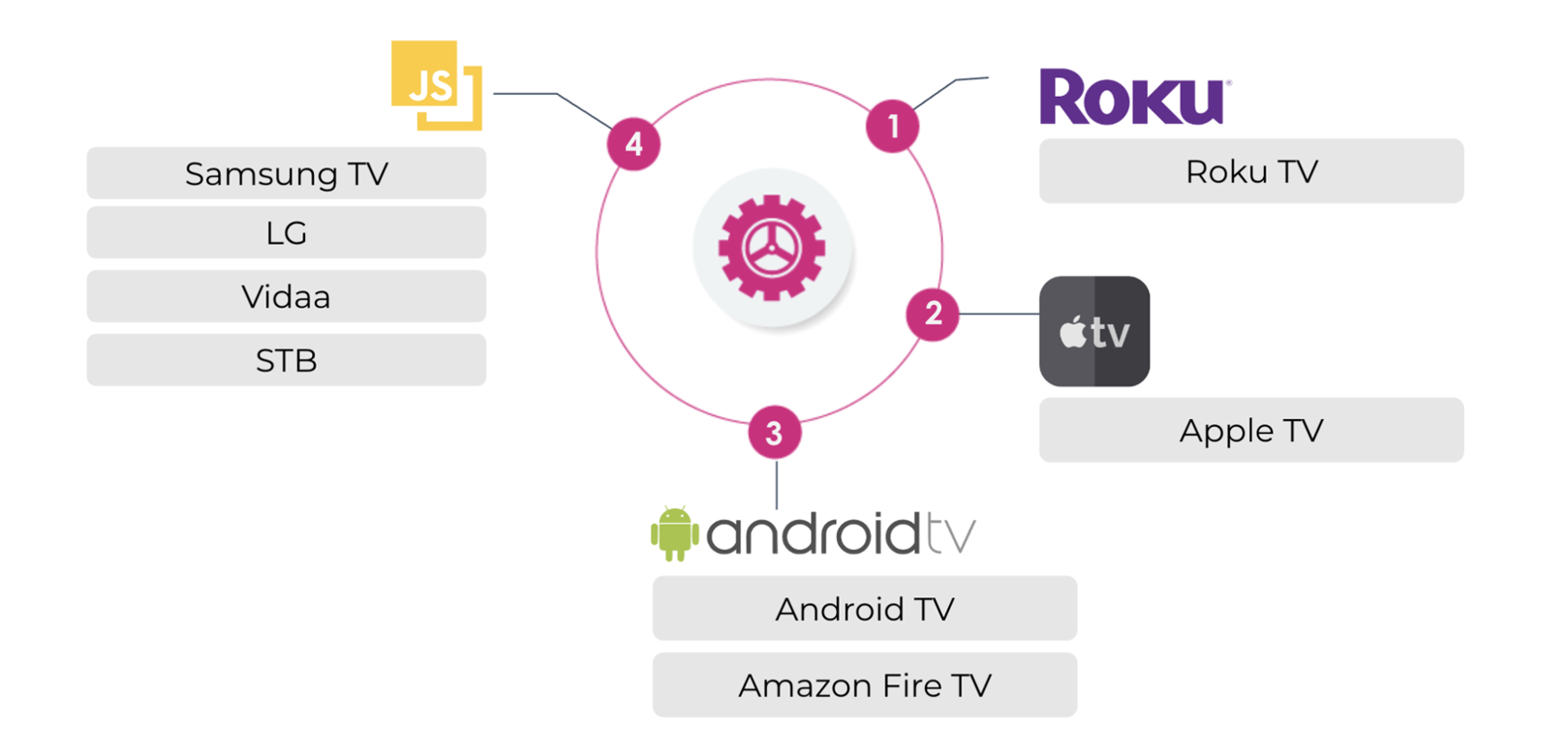
When considering smart TV application development, it’s crucial to understand the different operating systems and their development environments. All platforms have their own development kit or IDE, design patterns, and app distribution mechanisms.

Major Smart TV Platforms

PlatformKey Features
Android TVBacked by Google and widely adopted by brands like Sony and TCL. Hold the largest market share across the globe.
Samsung TizenPowered by a Browser based OS, it supports apps built with JavaScript/HTML5.
LG webOSSimilar to Samsung Tizen, a browser based OS
Apple tvOSApple’s OS for TVs embedded with the Apple TV hardware
Roku OSPopular in the U.S., known for its neutrality in content prioritization. Uses BrightScript for app development.
Amazon Fire TVCompatible with Fire OS SDKs, Android Studio, and HTML5 apps, offering a rich set of tools for OTT platforms and video streaming.

Tech Stack: How Do You Make a Smart TV App?

There are two primary development paths: native (for platform-specific performance) and cross-platform (for broader reach and code reusability).

1. Native Development

Native development of smart TV apps uses platform-specific technologies for optimal performance.
Android TV apps are built with Kotlin or Java, Leanback library, and Jetpack Compose for TV.
Tizen relies on JavaScript, HTML5, CSS, and React, while webOS uses JavaScript, React, and Enact.

PlatformTechnologies
Android TVKotlin/Java, Leanback library, Jetpack Compose for TV
TizenJavaScript, HTML5, CSS, React
webOSJavaScript, React, EnactI
tvOSSwift/Objective-C, SwiftUI, TVMLKit
RokuBrightScript, SceneGraph
Fire TVJava/Kotlin, Kepler

2. Cross-Platform & Hybrid Development

Cross-platform and hybrid development allows smart TV apps to run on multiple platforms using frameworks like React Native, Flutter, and HTML5/JavaScript. With these solutions, developers can target Android TV, Apple TV, tvOS, Tizen, webOS, and Fire TV, often improving code reusability and reach.

FrameworkPlatforms
React Native (react-native-tvos)Android TV, Apple TV
FlutterAndroid TV, tvOS (experimental)
HTML5/JS & JS FrameworksTizen, webOS, Fire TV

Smart TV App Testing

Smart TV app testing is crucial to ensure consistent performance, seamless navigation, and cross-platform compatibility. Unlike mobile or web applications, smart TV apps must be optimized for the 10-foot user experience, accounting for remote-based navigation, slower device processors, and diverse screen resolutions across TV models and brands.

After development, distributing your smart TV app across various application stores, such as the LG Seller Lounge, Samsung Seller Office, Google Play Store (for Android TV), Apple App Store (for tvOS), and the Roku Channel Store also needs careful attention to their platform compliance and guidelines.

Conducting professional and platform-targeted testing ensures your app meets the strict quality, performance, and design standards set by each ecosystem. This reduces the risk of rejection and minimizes the approval cycle back-and-forth, saving valuable time and accelerating your app’s go-to-market.

Key areas of testing include:

  • Focus management and navigation
  • Overscan testing
  • Video playback (buffering, quality, ABR, Subtitles, SSAI & CSAI)
  • Network performance for OTT platforms
  • Compatibility for different screen sizes
  • Compatibility across different models and firmware
  • Performance testing (VST, Memory and CPU usage, Crash & freeze scenarios)

Smart TV App Monetization

Smart TV apps can earn money in several ways. One common method is showing ads during shows or videos using a smart system called Server-Side Ad Insertion, which makes the ads play smoothly. Some apps offer subscriptions where users pay monthly for extra features or to watch without ads. Others may offer in-app purchases, like paying to unlock special content. Brands pay to feature their products inside the App and monitor how people use their App to earn more. A good balance of user experience and smart planning helps apps grow and make money.

Factors Affecting Smart TV App Development Cost?

Understanding the factors affecting smart TV app development cost is essential for budgeting:

  • Platform diversity: The number of devices that you would like the app to support
  • Custom UI/UX & Features: The customisation of UI/UX and the List of features to be built up
  • Video integration: Streaming protocols, DRM, ad insertion
  • Backend & 3rd Party services: CMS, user accounts, analytics, subscription management
  • Maintenance: Regular updates for OS versions and security patches

Conclusion

Smart TV app development opens direct access to millions of viewers through the home's primary entertainment hub. Whether you're creating a streaming service, expanding digital offerings, or building one of the best apps for a smart TV, success lies in selecting the right technologies, crafting living-room-friendly interfaces, and ensuring robust performance.

If your team already has experience in Android app development or iOS application development, you're well-positioned to transition into this space. Leveraging your existing skills in mobile applications testing can also fast-track your QA processes across TV platforms.

For enterprises, integrating Smart TV into your product strategy is more than just an app—it’s a key pillar of broader digital transformation services.

So if you're considering building a SmartTV app you now have the roadmap. Dive in, build, test thoroughly, and get ready to see your brand come to life on the big screen.

JS-Roku