
LangGraph vs LangChain: Choosing the Right Framework for AI Workflows
Introduction
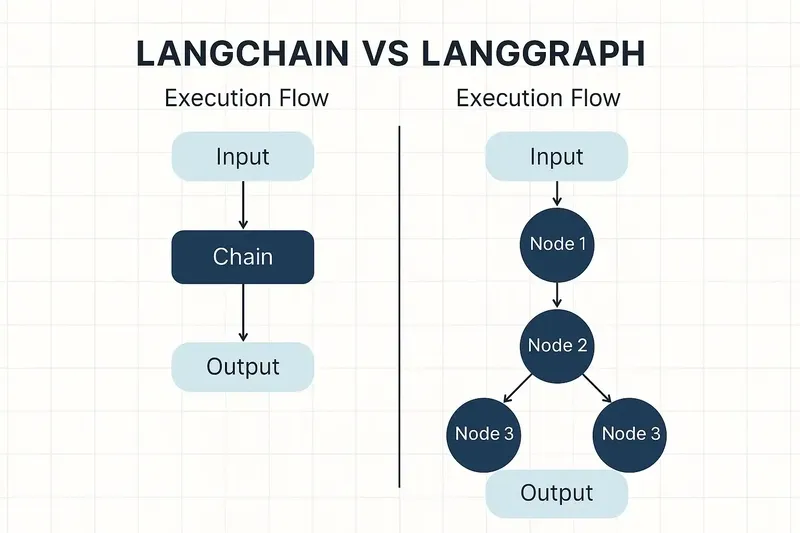
As AI developers, we’re constantly deciding which tools best serve our projects—whether we’re building chatbots, automated reports, or document analysis platforms. Two frameworks have emerged as frontrunners: LangChain and LangGraph. While they complement each other, they solve fundamentally different problems.This guide explores what makes each framework unique, their ideal use cases, and how teams leverage both to create powerful AI solutions.
Understanding LangChain: The Foundation
LangChain is the most popular framework for developing LLM applications. It makes it easy to work with prompts, chain development, and integrations with vector databases and APIs. Developing RAG models and chat interfaces is simple using its API.
We should use LangChain when:
- Rapidly prototyping new ideas or MVPs
- Building simple chatbots and Q&A systems
- Creating linear workflows without complex logic
- Working with tight deadlines
LangChain’s strength lies in its simplicity and speed. We can go from concept to working prototype in hours, not days.
Exploring LangGraph: Built for Complexity
LangGraph, built on top of LangChain, handles sophisticated, stateful workflows. It provides advanced features essential for production systems: loops, conditional branching, retry mechanisms, multi-agent coordination, and complete audit trails.
We should use LangGraph when:
- Building production-critical workflows with robust error handling
- Creating multi-step validation pipelines (financial reports, legal analysis)
- Orchestrating multiple specialized agents
- Requiring compliance and complete audibility
- Managing long-running processes that need persistent state
LangGraph excels where reliability, complexity, and state management are paramount.
The Hybrid Approach
Most successful teams don’t pick one over the other—they use both strategically:
Begin with LangChain for rapid prototyping and simple components. Quickly test ideas and check assumptions with low overhead.
Move to LangGraph when the workflows are complex or for production. Simpler components can stay in LangChain while developing strong infrastructure where necessary.
Langgraph_vs_Langchain
Industry Examples
Financial Services: LangChain is used for customer chatbots, while LangGraph is responsible for fraud detection and loan processing pipelines.
Healthcare: Patient intake is handled by LangChain, while LangGraph performs clinical decision support systems that involve multi-step validation.
Legal Tech: LangChain supports document search, while LangGraph is used for contract review systems with full audit trails.
Performance Issues
LangGraph wins for:
- Complex production processes with 40–60% lower failure rates
- Async processing and state efficiency
- In-built retry capabilities and error robustness
LangChain is the best choice for:
- Development speed—days or weeks faster for simple apps
- Hundreds of pre-built integrations
- Less overhead for simple workflows.
Making the Right Choice
Factors to consider include:
- Project Complexity: Simple workflows → LangChain. Complex, stateful processes → LangGraph.
- Timeline: Tight deadlines → LangChain. Production robustness → LangGraph.
- Team Experience: LLMs – newbie? Begin with LangChain to develop a foundation.
- Scale Requirements: Thousands of concurrent users or complex orchestration → LangGraph.
Conclusion
LangChain and LangGraph are not competitors but complementary tools for different problems. LangChain assists us in moving fast and implementing simple applications. LangGraph enables us to implement complex, production-level applications that can deal with complexity elegantly.
For us, the best way to use both tools is to prototype in LangChain, test it out quickly, and then move more complex tasks to LangGraph for the final product. This way, we get the speed and ease of use of one tool and the power of the other.
In this way, we put ourselves in a position to develop AI applications that scale, perform, and add value. It’s not about choosing a winner; it’s about choosing the right tool for the jo

