


Introduction
As we continue progressing and evolving through different ways of managing projects, Agile is the name that always shines through. The very name itself carries the essence of managing projects efficiently. When we look at what it takes to effectively manage a project, an important and widely used ceremony comes into picture that not only uncovers the potential issues / blockers but also brings everyone onto the same page of updates. When done correctly, the outcome makes the team energetic, focused and committed towards the sprint goal. However, when done incorrectly, it turns into a long discussion with repeatitive status updates, keeping the team frustrated with no real progress towards the sprint goal. The name of this ceremony is Daily Stand-up.
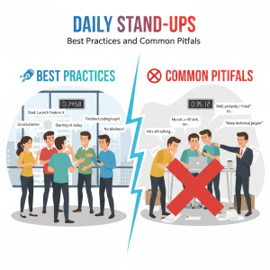
Daily Stand-ups: Best Practices and Common Pitfalls
Daily Stand-up
It comes with it’s own format, a defined way of running it, and a time-boxed activity. Also, it is important to understand that it is not a status update meeting, neither it it is the forum to deep dive into technical blockers or challenges. The main objective of the meeting is to inspect the team’s progress towards the Sprint goal, where the team also adapts a plan for the next 24 hours. They certainly can highlight any blocker in their way impacting their progress. When this meeting is done in a correct manner, it enables the team to:
- Identify any roadblocks, potential issue at an early stage
- Synchronize the work across different roles
- Maintain transparency along with team alignment
- Promote Team collaboration and ownership
In this blog I have tried to explain and highlight some of the best practices for running the Daily Stand-ups, uncovering common pitfalls that teams can learn and avoid so that the overall outcome of the meeting becomes meaningful and create impacts in a day to day performance.
This experience is drawn from working with various enterprise-level clients, cross-functional teams, and within To The New.
Conducting Daily Stand-ups the Right Way
The key to an effective Daily Standup is to remember that it’s a time boxed activity with concise and relevant information to share.
- Duration: Should range between 10 to 15 mins.
- Context Setting: Keep it to 30 seconds covering priorities, sprint goals or any key announcements.
- Individual Updates: Aim for 1 minute per person, covering:
- Yesterday’s Key Progress
- Today’s Planned tasks
- Any risk, blocker or dependencies to highlight
- Blocker Ownership: Once a blocker is raised, ensure an owner is assigned within 2 minutes and then move to the next item.
- Parking lot: Maintain a parking lot to capture topics that require deep discussion or, additional time for their resolution.
If a Daily Stand-Up is consistently fails to achieve the outcome, it requires a course correction. Either the format needs refinement, or team’s mindset needs to be adjusted.
Best Practices for an Effective Daily Stand-up
1. Keep clear, concise and, consistent Agenda
Meeting should have a simple structure where a format should be followed by traditional questions as:
-
- What have I completed since yesterday?
- What am I going to do today?
- Any blockers and dependencies to highlight?
2. Time-boxed meeting
Daily standups should be short and focused, and should not exceed the 15 minute time frame. A timebox actively enforces concise communication, and refrains unnecessary details. Starting and finishing on time demonstrates respect for everyone’s schedule and enforces discipline within the team.
3. Focusing on Plan instead of a Detailed Discussion
Stand-ups should always be focused on the future tasks. Team members should avoid detailed explanations of their past work; instead they should clearly present the tasks they plan to accomplish in the next 24 hours.. This keeps the conversation aligned with the results and ensures it remains action oriented.
4. Highlighting Blockers and making them Actionable
Blockers should not just be documented in a tracking tool or on a shared document. Once a blocker is raised, it should have an assigned owner along with a plan or clear steps to resolve it. Blockers are not meant to be mentioned casually and forgotten. Following this practice ensures timely resolution and reinforces accountability.
5. Rotating the Facilitator
Encouraging each member to take ownership and active participation in running the Daily Syncup, ensures that the meetings are not driven by a single member. This encourages broader participation which in turn enhances the engagement across the team.
6. Adaptation for Hybrid and Distributed team
In today’s time, it is common for teams to work across different time zones as distributed or hybrid teams. In such setups, asynchronous daily stand-ups can complement live meetings by ensuring daily updates are shared and accessible, keeping everyone aligned and informed about progress. Collaboration tools like Jira and Trello, used alongside video conferencing, help maintain transparency and continuity of communication.
7. Use a Parking lot for Deeper Discussions
Some topics require deeper discussion, whether they are technical or related to a specific problem. The best way to address these is after the Daily Stand-up. Once the stand-up ends, keep the relevant stakeholders involved while allowing the rest of the team to leave, respecting their time. The detailed discussion can then continue separately. This practice ensures that the main meeting stays focused on its purpose.
8. Psychological Safe Environment
The facilitator should always promote and work towards providing a safe and supportive environment where team members feel free in raising their concerns, risks, or anticipated delays. This helps create an environment that encourages and values transparency.
For every best practice, there are certainly some common pitfalls which need to be identified and avoided for smooth functioning.
Common Pitfalls
1. Long running meetings
Off topic discussions that lead to long stand up meetings. Dividing the meeting into main format, having it timeboxed, and use of parking lots for detailed discussion will avoid the situation.
2. Status in Stand up meetings
When updates are directed toward the Manager, the meeting turns into a status meeting. Since status is meant to keep everyone updated, the updates should be shared with the whole team, using a task board as a reference point.
3. Low engagement
When a team is disconnected or disengaged, the updates become repetitive or robotic. Rotating facilitator and encouraging outcome focused updates significantly improves the energy, engagement and participation.
4. The loudest voice taking over the discussion
When a meeting is carried out in a structured manner, where each individual presents their status in turn with proactive facilitation, it ensures balanced participation and prevents the conversation from being dominated by a single person.
5. Repeated blockers without resolution
When blockers are not assigned with proper actionable items, they become repeated and unsolved which indicates weak ownership. To overcome this, assign clear responsibilities, and escalate unresolved issues.
Monitoring and measuring the effectiveness of Daily Stand ups
To ensure that the value is being delivered, the following indicators should be tracked:
- Average duration of the stand-up
- Percentage of meetings starting on time
- Turnaround time (TAT) for resolving blockers
- Qualitative team feedback
The Role of Leadership in Successful Daily Stand-ups
The responsibility of the Leader is not to control the meeting, but to support, observe, and remove blockers or impediments. Leaders play a crucial role in setting the tone for daily stand-ups. They must trust team members to be self-organized while focusing on enabling progress. By doing so, leaders ensure that stand-ups remain empowering and productive.
Conclusion
Daily Stand-ups are a simple concept, yet they can have a powerful impact. When aligned with best practices and carried out effectively, they become a key driver of collaboration, clarity, and predictability in deliverables. By continuously refining the format and avoiding common pitfalls, teams can maximize their effectiveness and turn stand-ups into a meaningful ceremony that drives success.