
Agile in Action: Designing with Heart
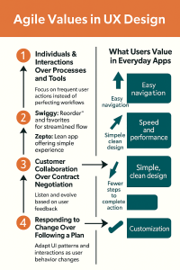
Agile Values for Design
Agile Is Not Just for Developers
Agile isn’t just for developers or project managers—when applied to design and UX, it becomes a service mindset. The most-loved apps in India and globally don’t succeed because of flashy animations or fancy tech. They succeed because they’re built with empathy, iterated with real feedback, and designed to feel easy, intuitive, and personal.
That’s the power of Agile UX—when used as design principles, they produce human-centered digital journeys that build trust and long-term loyalty.
Quick Primer: What is Agile?
Agile is a way of working and a methodology that emphasizes people, responsiveness, flexibility and continuous iteration over rigid plans. While it originated in software development, its 4 core values now inspire modern design teams to build with empathy and user intent.
When applied to UI/UX, Agile values produce human-centered digital experiences that feel natural, build trust, and retain users long-term.
Agile thinking extends far beyond coding. In UX, it inspires a set of Agile design principles focused on solving real user problems quickly, collaboratively, and flexibly.
Agile Values, Reimagined for UI/UX
Let’s explore how the 4 Agile values drive better UX, using real-life examples from apps you probably use daily:
1️⃣ Individuals and interactions over processes and tools
Focus on how real people use the app—not just wireframes and documentation.
Example: Swiggy’s “Reorder” button reflects repeated human behavior. Instead of expecting users to navigate through past orders, it surfaces intent early—just like a thoughtful service person would.
In Web, Google Workspace tools (like Docs and Sheets) prioritize seamless collaboration over structured templates. Features like “comment mentions” mimic natural conversations.
Design impact: Create flows based on user behavior patterns, not just clean process logic.
Business impact: Increases engagement by reducing friction in routine tasks.
2️⃣ Working software over comprehensive documentation
A beautiful Figma file is useless if users get stuck or confused in the live product.
Example: Zepto’s home screen is clean, fast, and functional. There’s no need for a tutorial. Users intuitively know where to go because the UI is focused on action, not explanation.
As an enterprise, Slack’s web interface introduces features like huddles and thread replies gradually, letting users explore without a manual.
Design impact: Prioritize shipping usable experiences, test with real users, and iterate—don’t overdesign upfront.
Business impact: Faster time-to-value for users = quicker activation and retention.
3️⃣ Customer collaboration over contract negotiation
Your users’ real-time feedback is more valuable than assumptions made during planning.
Example: WhatsApp voice messages started simple but evolved with feedback: playback speed, lock recording, draft previews. Every update felt like a conversation with the user base.
Design impact: Use live behavior and support tickets as data. Collaborate with users, not just designers.
Business impact: Builds trust and encourages organic feature adoption.
4️⃣ Responding to change over following a plan
Be ready to adapt the flow, tone, or interaction model when user needs shift.
Example: Instagram Reels was a response to changing user behavior and competition. The swipeable UI wasn’t planned from day one—it was adapted to evolving consumption patterns.
Design impact: Design teams should remain agile, ready to pivot based on new user insights or cultural shifts.
Business impact: Keeps products culturally and competitively relevant.
What Indian Users Value Most in an App
Here’s what a recent survey (Source: LocalCircles, 2024; N=10,000) shows Indian users prioritize in everyday apps:
| Feature | % of Users Who Prioritize It |
| Easy navigation | 78% |
| Speed and performance | 69% |
| Simple, clean design | 61% |
| Fewer steps to complete action | 58% |
| Customization/personalization | 41% |
Source: LocalCircles App Usability Survey 2024
The overlap with Agile design values is no coincidence—ease, adaptability, and user-first flow are key.
4 Questions to Ask Yourself Before You Launch
- Have we tested this flow with a real user?
- What emotion will the user feel at this screen?
- Can we make this one tap shorter?
- Are we serving the user—or just showcasing the tech?
What to Avoid in Agile UX
Even with the right intentions, teams often fall into traps that dilute user experience when certain antipatterns emerge.:
- Designing in isolation from users
Building the “perfect” interface on Figma, only to realize real users get confused. Agile UX demands co-creation—not assumptions. - Sticking to long-term UI plans
If your roadmap doesn’t flex when behavior shifts, your design will feel outdated fast. Don’t treat wireframes as contracts.
Takeaway: Agile UX is a competitive advantage.
When teams apply Agile design principles with empathy, the result isn’t just usable—it’s lovable.
In a crowded app market, human-centered design isn’t a bonus—it’s your edge. . That’s Agile design done with heart.

